


























Views
Downloads

Printable Division Mastery Worksheet | Grade 3 Math
Paste this activity's link or code into your existing LMS (Google Classroom, Canvas, Teams, Schoology, Moodle, etc.).
Students can open and work on the activity right away, with no student login required.
You'll still be able to track student progress and results from your teacher account.
This comprehensive division worksheet is designed to help third-grade students achieve total mastery of fundamental math facts. By moving from visual multiple-choice questions to rapid-fire calculation and practical word problems, learners develop the fluency required for higher-level mathematics. This resource ensures students can confidently solve division equations and apply them to real-world scenarios.
At a Glance
- Grade: 3 · Subject: Mathematics
- Standard:
CCSS.MATH.CONTENT.3.OA.C.7— Fluently divide within 100 using strategies like the relationship between multiplication and division- Skill Focus: Division facts mastery and word problems
- Format: 3 pages · 19 problems · Answer key included · PDF
- Best For: Independent practice and fluency checks
- Time: 20–30 minutes
What's Inside
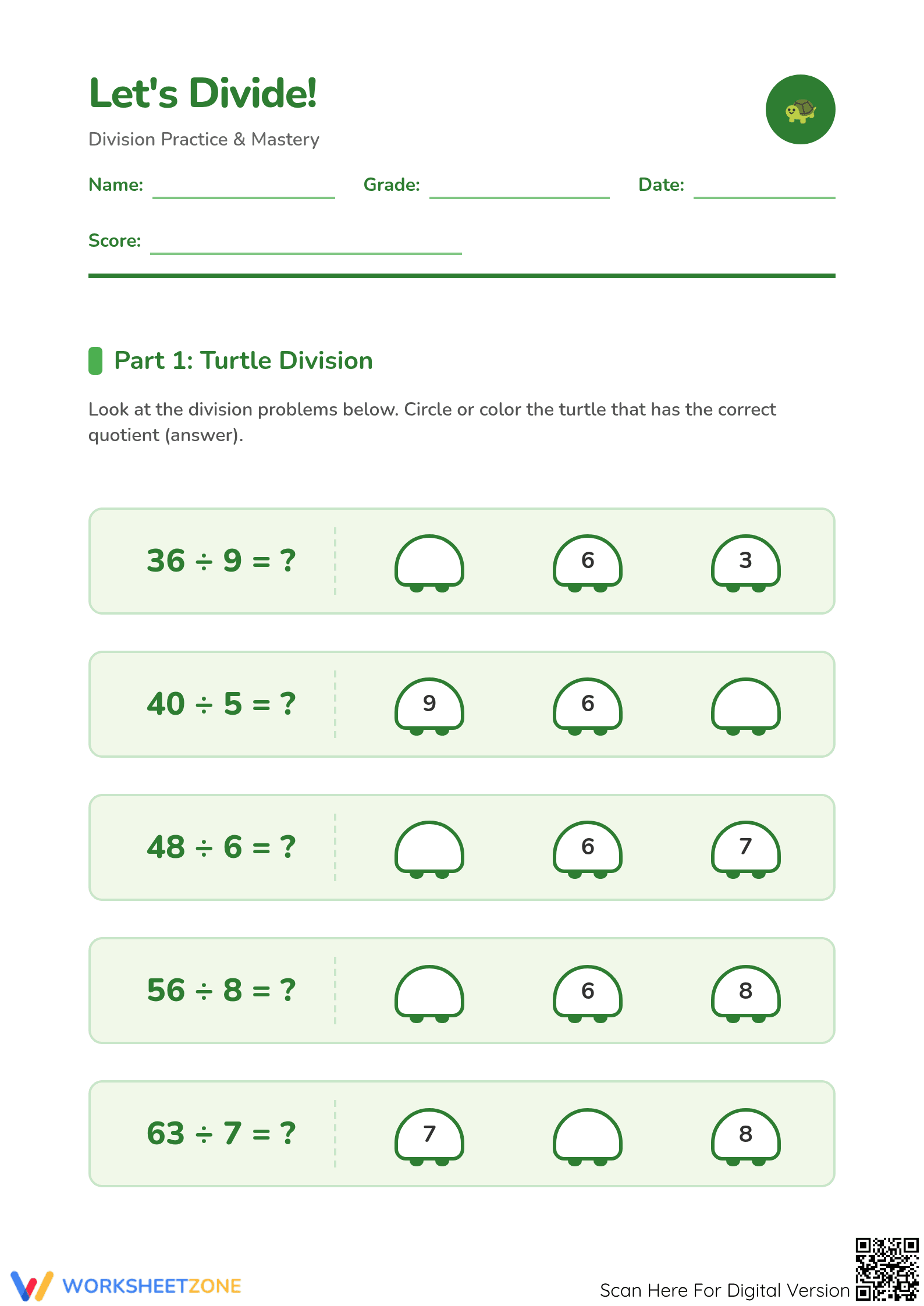
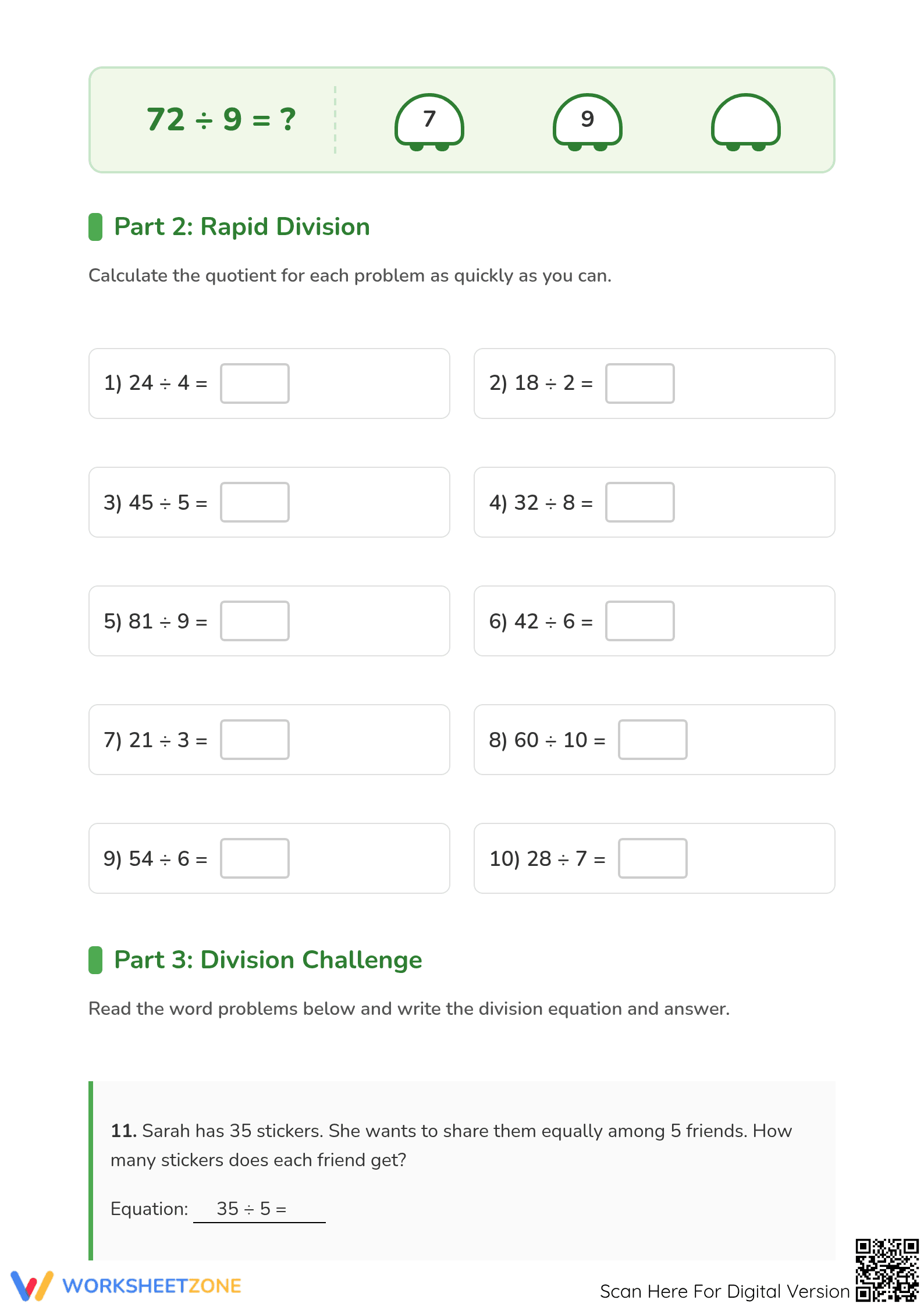
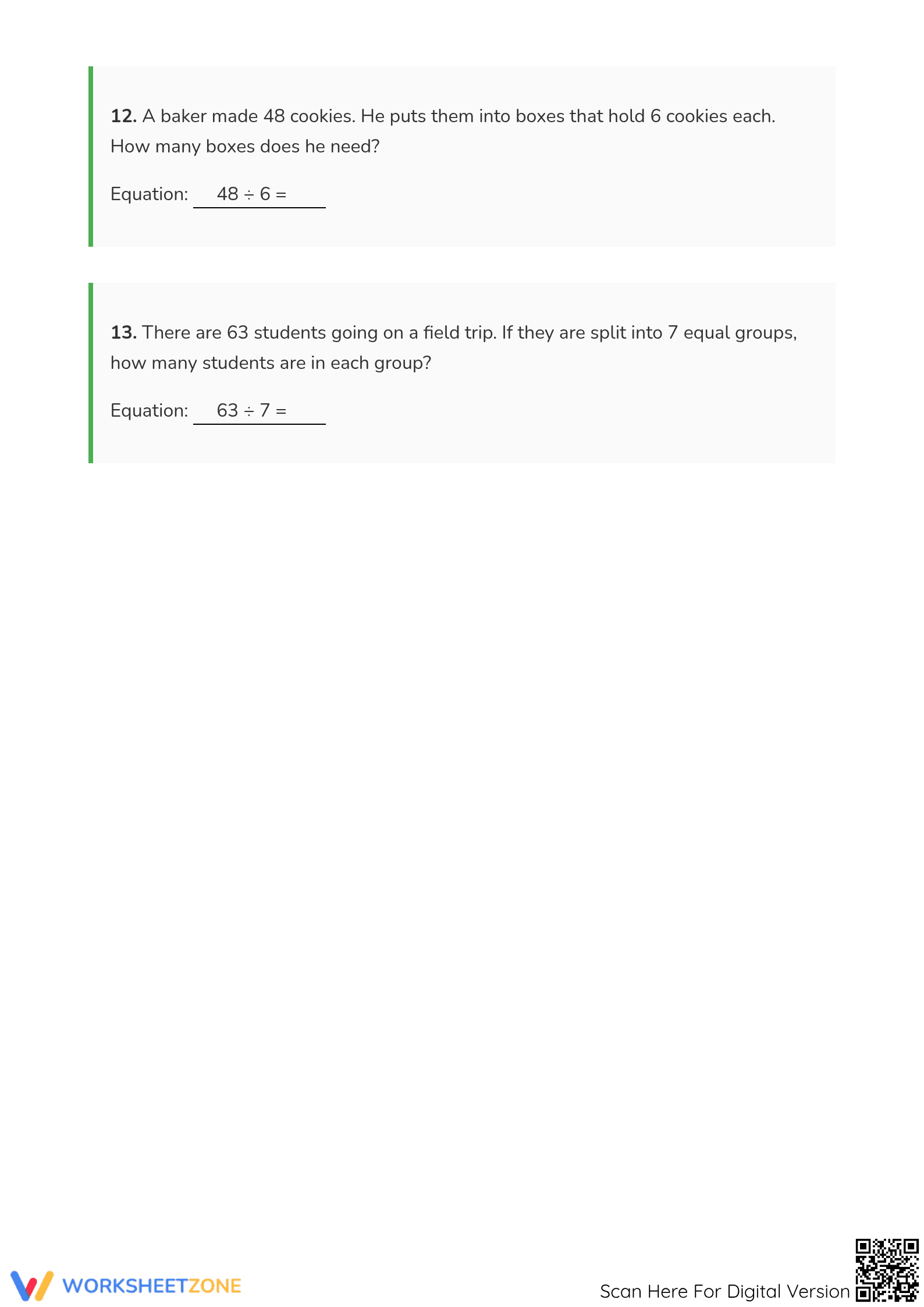
This three-page instructional packet contains 19 targeted division tasks organized into three logical sections. The layout includes "Turtle Division" multiple-choice options, a "Rapid Division" speed drill, and a "Division Challenge" featuring context-rich word problems. Each page is clean and student-friendly, featuring a clear workspace for equations and a full answer key for immediate feedback or grading.
Skill Progression
- Guided Practice: Part 1 uses 6 visual multiple-choice problems to scaffold the selection of correct quotients, reducing cognitive load while reinforcing fact recognition.
- Supported Practice: Part 2 provides 10 rapid-recall calculation boxes, stripping away scaffolds to build mental fluency and speed with basic division facts.
- Independent Practice: Part 3 offers 3 detailed word problems requiring students to translate verbal scenarios into division equations and solve for the unknown.
This sequence follows a gradual-release model, ensuring students have the confidence to tackle abstract problems after mastering the mechanics.
Standards Alignment
The primary focus of this worksheet is `CCSS.MATH.CONTENT.3.OA.C.7`, which requires students to fluently multiply and divide within 100. By the end of Grade 3, students must know from memory all products of two one-digit numbers and their related division facts. This standard code can be copied directly into lesson plans, IEP goals, or district curriculum mapping tools.
How to Use It
This resource is ideal for morning work or as a formative assessment after a unit on the relationship between multiplication and division. Teachers should observe students during Part 2 to identify which specific fact families require further intervention. The expected completion time for most third graders is between 20 and 30 minutes depending on their prior exposure to word problems.
Who It's For
This worksheet is primarily for 3rd-grade students working toward grade-level mastery. It also serves as an excellent remedial tool for 4th graders needing a refresher or as an enrichment activity for advanced 2nd graders. It pairs naturally with an anchor chart showing the inverse relationship between multiplication and division.
This resource aligns with the 'Gradual Release of Responsibility' model pioneered by Fisher & Frey (2014), which emphasizes the transition from highly scaffolded tasks to independent application. By structuring the worksheet into three distinct phases—visual selection, rapid calculation, and contextual problem-solving—students are supported as they internalize the inverse relationship between multiplication and division. Research suggests that interleaving different problem types, as seen in this 19-task set, significantly improves long-term retention compared to repetitive rote practice alone. Specifically for standard CCSS.MATH.CONTENT.3.OA.C.7, the progression ensures that learners move beyond simple memorization toward a conceptual understanding of sharing and grouping. This instructional design provides the necessary 'productive struggle' required for mathematical fluency, making it an essential tool for achieving grade-level benchmarks in elementary mathematics. Educators can confidently integrate this worksheet into their curriculum knowing it meets the rigorous demands of modern evidence-based pedagogy.


