


























Views
Downloads
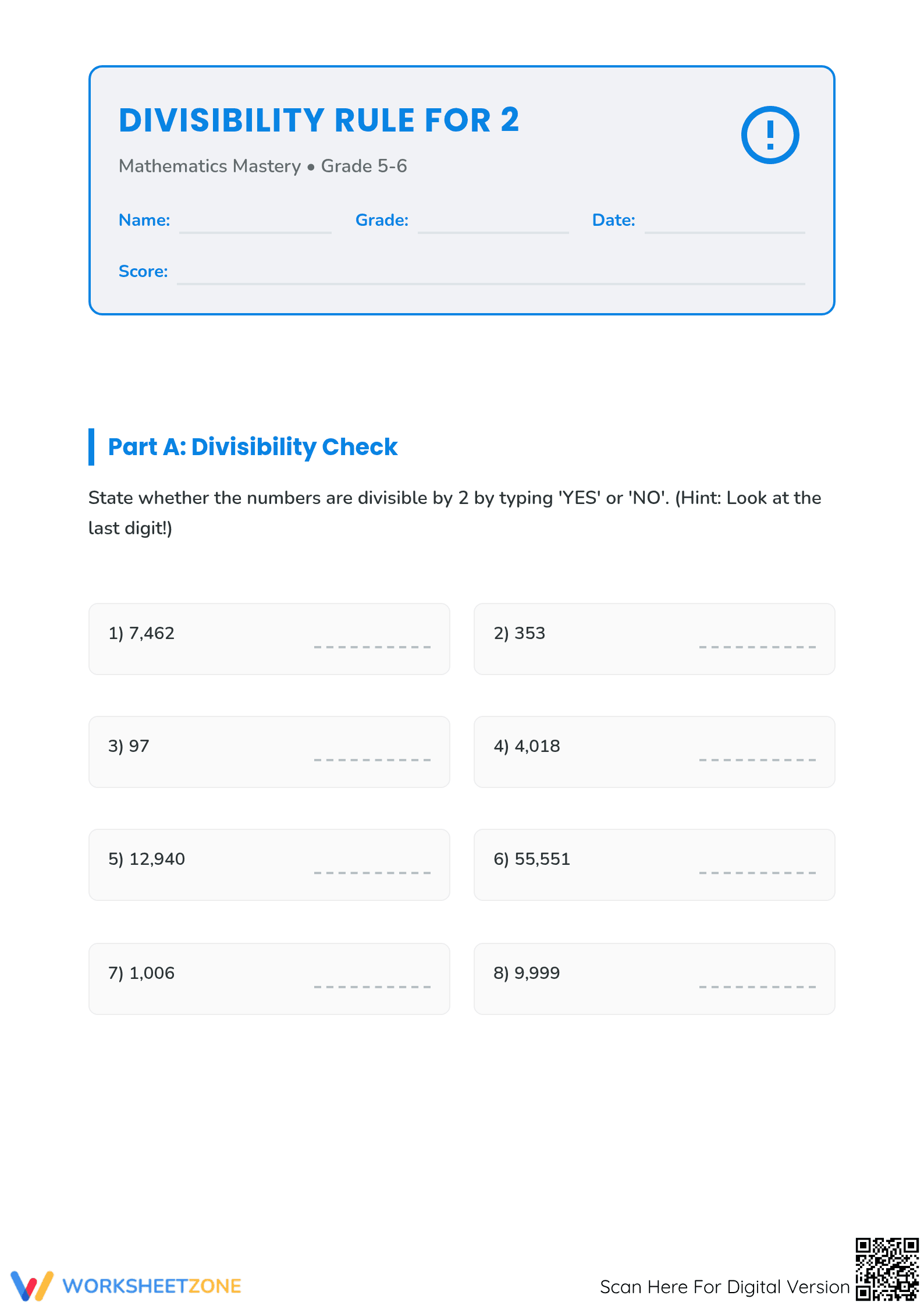




Essential Divisibility Rules Worksheet | Grade 5-6 Math
Paste this activity's link or code into your existing LMS (Google Classroom, Canvas, Teams, Schoology, Moodle, etc.).
Students can open and work on the activity right away, with no student login required.
You'll still be able to track student progress and results from your teacher account.
This essential Math worksheet helps Grade 5 and 6 students master divisibility rules with confidence and speed. By practicing with numbers ranging from simple two-digit integers to complex multi-digit values, learners develop the mental math fluency required for advanced fraction simplification and prime factorization. This comprehensive resource ensures students can identify factors without long division.
At a Glance
- Grade: 5-6 · Subject: Math
- Standard:
CCSS.MATH.CONTENT.6.NS.B.4— Find factors and multiples to solve problems efficiently- Skill Focus: Divisibility Rules for 2, 3, 4, 5, 6, 9, and 10
- Format: 5 pages · 45 problems · Answer key included · PDF
- Best For: Independent practice and sub-plan activities
- Time: 25–40 minutes
Inside this 5-page packet, you will find a structured progression of tasks designed to solidify number sense. The first page features a handy reference chart of divisibility rules followed by introductory identification tasks. Subsequent pages challenge students with larger numbers and mixed-review sets to ensure retention. The inclusion of a full answer key allows for immediate feedback or easy teacher grading.
Zero-Prep Workflow
The workflow for this resource is designed for maximum teacher efficiency. First, print the 5-page PDF packet, which takes less than 30 seconds for a standard classroom set. Second, distribute the worksheets to students; no additional manipulatives or setup are required. Finally, use the included answer key for rapid review or peer-grading, keeping total teacher preparation time under 2 minutes. This makes it an ideal solution for unexpected sub days or bell-ringer activities.
Standards Alignment
Primary alignment: `CCSS.MATH.CONTENT.6.NS.B.4` — "Find the greatest common factor of two whole numbers less than or equal to 100 and the least common multiple of two whole numbers less than or equal to 12." While focusing on divisibility rules, this worksheet provides the foundational fluency needed to identify factors and multiples quickly. Both standard codes can be copied directly into lesson plans, IEP goals, or district curriculum mapping tools.
How to Use It
Use this worksheet during the independent practice portion of a lesson after introducing divisibility shortcuts. It serves as an excellent formative assessment tool; teachers can observe which specific rules cause the most hesitation. Alternatively, assign individual pages as targeted homework to reinforce mental math strategies throughout the week. Completion typically ranges from 25 to 40 minutes depending on student fluency.
Who It's For
This resource is tailored for upper elementary and middle school students working on the Number System domain. It is particularly beneficial for students who struggle with long division and need scaffolds to find common denominators or simplify fractions. Pair this with a divisibility anchor chart or a short video tutorial for a complete, multi-modal learning experience that supports diverse learners.
Effective math instruction relies on the development of procedural fluency and conceptual understanding. As noted in RAND AIRS 2024, students who internalize number properties like divisibility rules show significantly higher performance in algebraic thinking and complex problem-solving. This worksheet addresses the specific need for repetitive, focused practice to move these rules from short-term memory to long-term application. By providing 45 structured tasks, the resource aligns with the principle of distributed practice, which NAEP research suggests is critical for maintaining mathematical proficiency over time. The standard `CCSS.MATH.CONTENT.6.NS.B.4` emphasizes the identification of factors, a skill that is directly scaffolded here. Educators can utilize this standalone summary to justify the inclusion of divisibility drills in their curriculum, ensuring that students are prepared for the rigors of middle school mathematics and beyond.


