




























Views
Downloads
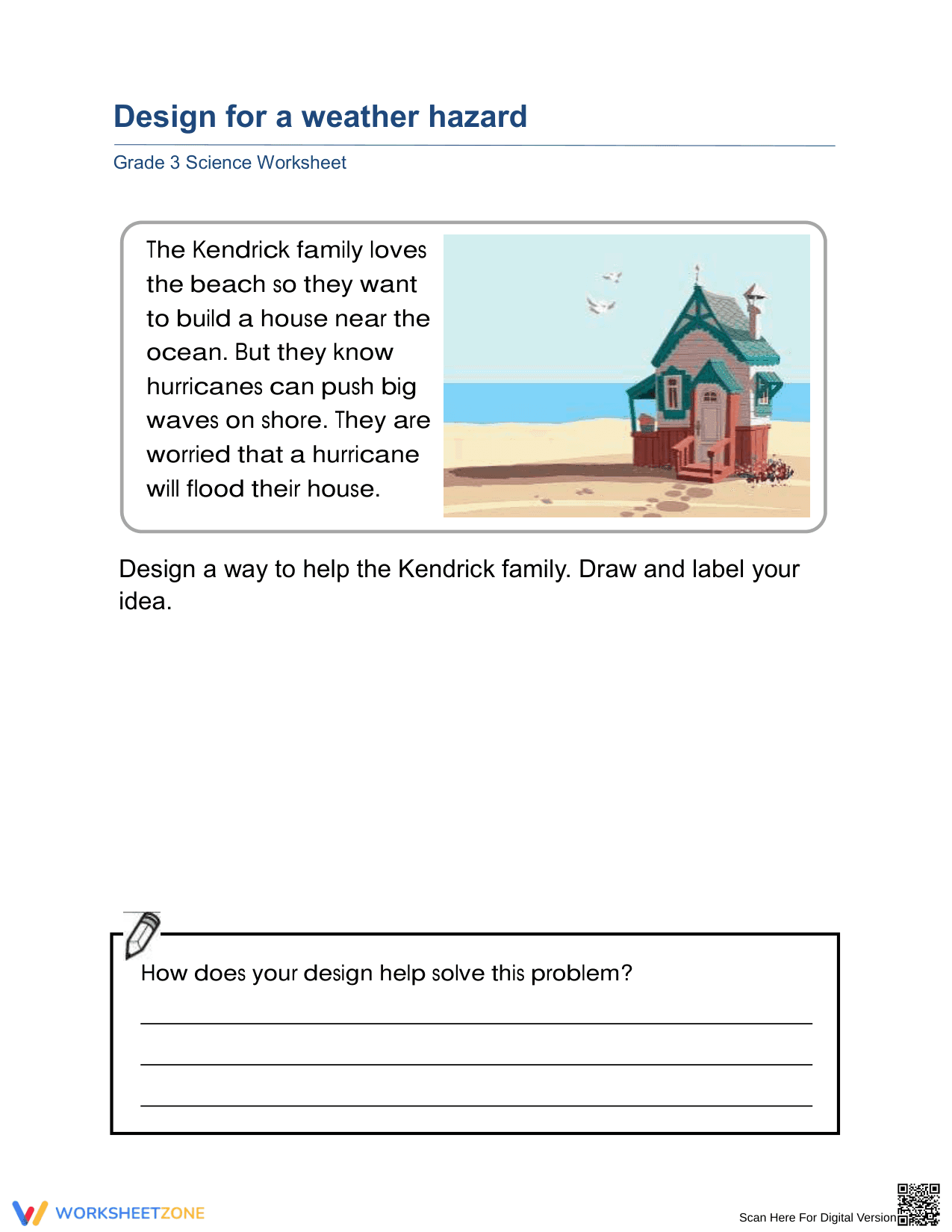

Essential Grade 3 Weather Hazard Design Worksheet

Paste this activity's link or code into your existing LMS (Google Classroom, Canvas, Teams, Schoology, Moodle, etc.).
Students can open and work on the activity right away, with no student login required.
You'll still be able to track student progress and results from your teacher account.
Engineering Solutions for Weather Hazards
This Grade 3 science worksheet provides students with a hands-on engineering challenge to mitigate the impact of weather hazards. By designing and explaining a flood-resistant home for a coastal family, learners demonstrate their ability to claim how specific structural interventions reduce the danger of storm surges. It bridges the gap between scientific theory and practical design.
At a Glance
- Grade: Grade 3 · Subject: Science
- Standard:
3-ESS3-1— Claim how design solutions reduce weather hazard impacts- Skill Focus: Engineering Design for Weather Hazards
- Format: 1 page · 2 tasks · Answer key included · PDF
- Best For: Unit on severe weather events, hurricane preparedness, and engineering projects
- Time: 20–30 minutes
What's Inside
This single-page PDF features a relatable scenario involving the Kendrick family's oceanfront home. It includes a clear prompt for students to draw and label a design that prevents hurricane flooding. A separate reflection box asks learners to explain the mechanics of their solution, ensuring they connect their visual design to scientific reasoning. A sample answer key is provided for grading.
Zero-Prep Workflow
- Print (1 min): Select the single-page PDF and print enough copies for your whole class or science centers.
- Distribute (1 min): Hand out the sheets alongside colored pencils or markers for the design and labeling phase.
- Review (5-10 mins): Use the reflection responses as a quick formative assessment or exit ticket to gauge understanding of 3-ESS3-1.
The entire activity requires less than two minutes of teacher preparation, making it an ideal choice for substitute lesson plans, rainy day science rotations, or a focused homework assignment following a lesson on extreme weather events.
Standards Alignment
The primary standard addressed is `3-ESS3-1`, which requires students to "make a claim about the merit of a design solution that reduces the impacts of a weather-related hazard." This worksheet prompts students to create that solution and justify its effectiveness. This standard code can be copied directly into lesson plans, IEP goals, or district curriculum mapping tools.
How to Use It
Use this worksheet as a culminating activity after teaching about hurricanes and their effects on coastal topography. It serves as a great formative assessment during direct instruction; as you circulate, look for students who incorporate specific structural features like stilts or sea walls. Expect completion in about 25 minutes, followed by a brief gallery walk.
Who It's For
This resource is designed for Grade 3 students but is easily adaptable for Grade 4 review. It works well for English Language Learners due to the visual nature of the drawing task. Pair this with a non-fiction passage about real-world flood mitigation or a video showing how stilts protect coastal houses from storm surges.
Standard 3-ESS3-1 represents a critical shift in elementary science from passive observation to active engineering and problem-solving. According to EdReports 2024, high-quality science materials must integrate the three dimensions of NGSS, specifically the application of disciplinary core ideas to engineering design challenges. This worksheet facilitates that transition by asking Grade 3 students to analyze the physics of flooding and propose structural solutions. By requiring both a visual model and a written explanation, the task aligns with the research of Fisher & Frey (2014) regarding the power of multimodal literacy in science education. Students don't just learn about hurricanes; they evaluate the merits of specific interventions. This evidence-based approach ensures that learners develop the higher-order thinking skills necessary for modern climate literacy and technical proficiency. The activity provides a clear benchmark for assessing whether students can move from identifying hazards to mitigating their risks through design.


