


























Views
Downloads



Describing Distributions on Histograms | Grade 6 Math Ready
Paste this activity's link or code into your existing LMS (Google Classroom, Canvas, Teams, Schoology, Moodle, etc.).
Students can open and work on the activity right away, with no student login required.
You'll still be able to track student progress and results from your teacher account.
Mastering data interpretation is a critical milestone for middle school mathematicians. This Grade 6 worksheet focuses on describing distributions on histograms, teaching students to identify symmetrical, skewed, and bimodal patterns. By analyzing visual data representations, learners develop the vocabulary and analytical skills needed to summarize numerical data sets effectively and accurately.
At a Glance
- Grade: 6 · Subject: Math
- Standard:
6.SP.B.2— Describe data distributions by their center, spread, and overall shape- Skill Focus: Histogram Distribution Analysis
- Format: 3 pages · 7 tasks · Answer key included · PDF
- Best For: Independent practice or formative assessment
- Time: 25–35 minutes
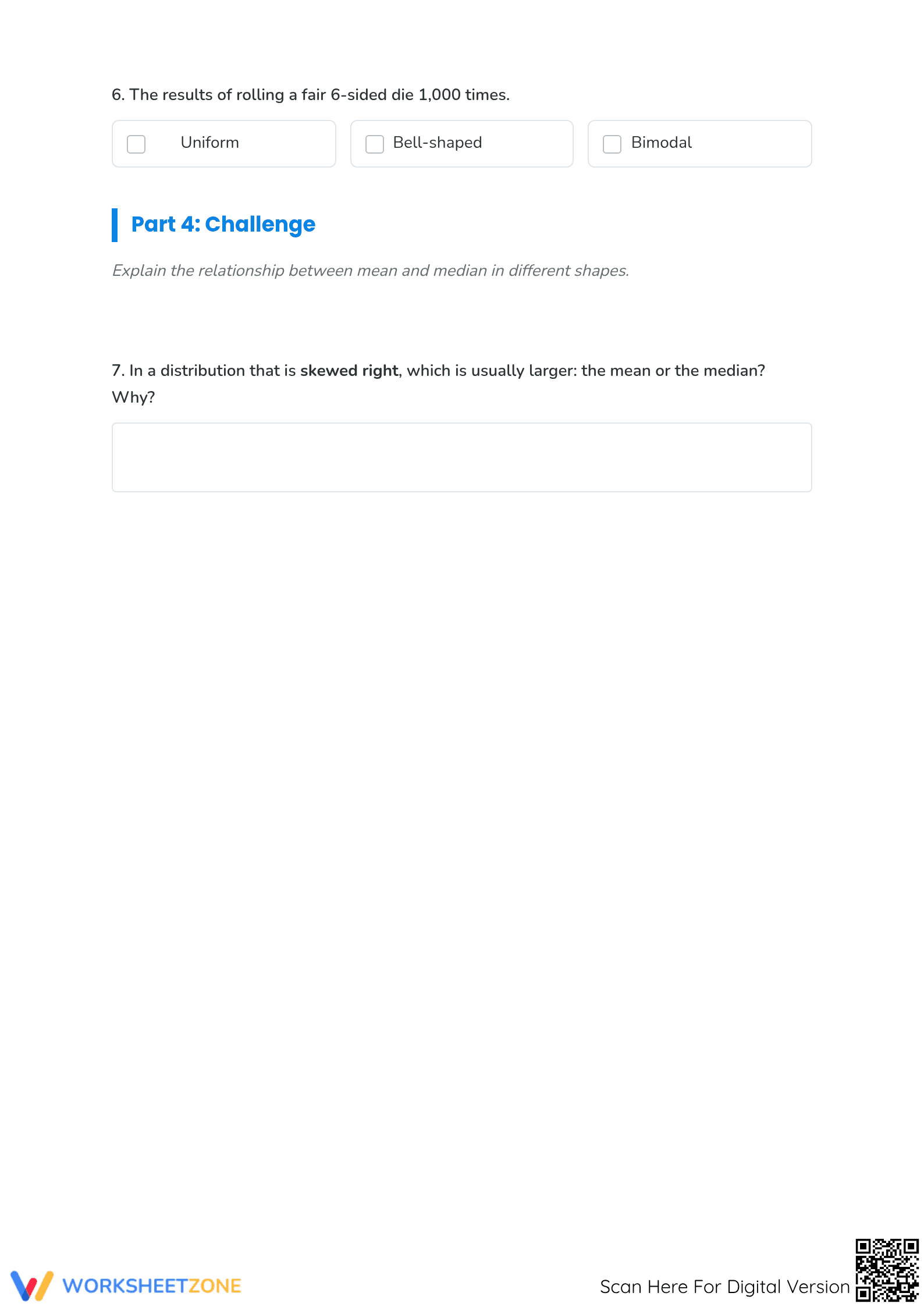
This comprehensive three-page PDF contains seven multi-part tasks designed to build statistical literacy. Page one introduces visual identification of shapes (symmetrical, skewed). Page two moves into matching exercises and real-world scenario applications, while page three challenges students with a higher-order thinking prompt regarding the mathematical relationship between measures of center. A full answer key is provided for immediate feedback.
Skill Progression
- Guided practice: Students begin by identifying specific distribution shapes and tails in Histograms A, B, and C with direct visual cues.
- Supported practice: The matching section and real-world scenarios bridge the gap between abstract graphs and practical data sets like ages or test scores.
- Independent practice: The final challenge task requires students to explain the logic behind skewed data distributions without visual scaffolding.
This worksheet follows a gradual-release model to ensure students move from basic recognition to conceptual mastery of data analysis.
Standards Alignment
This resource is aligned to 6.SP.B.2: "Understand that a set of data collected to answer a statistical question has a distribution which can be described by its center, spread, and overall shape." It also supports 6.SP.B.5c by asking students to describe patterns in context. Both standard codes can be copied directly into lesson plans, IEP goals, or district curriculum mapping tools.
How to Use It
Use this worksheet as a mid-unit formative assessment after students have learned the basic components of a histogram. Observe how students differentiate between "skewed left" and "skewed right"—a common point of confusion—to identify who needs a mini-lesson on tail direction. It typically takes students 30 minutes to complete thoroughly, making it an ideal individual classwork assignment.
Who It's For
This resource is tailored for Grade 6 general education students, but its visual nature makes it excellent for English Language Learners (ELLs) who benefit from graph-to-text matching. It pairs naturally with a data-collection project where students create their own histograms before using this sheet to analyze the resulting shapes and distributions.
Statistical literacy is foundational for Grade 6, specifically the ability to describe data distributions by shape, center, and spread as mandated by CCSS.MATH.CONTENT.6.SP.B.2. This worksheet targets these exact competencies through visual analysis and conceptual explanation. Research from RAND AIRS 2024 emphasizes that scaffolded visual aids in mathematics—particularly histograms—significantly improve a student's ability to transition from concrete data points to abstract statistical summaries. By requiring students to explain the relationship between mean and median in skewed distributions, the tasks move beyond rote identification toward deep conceptual understanding. This approach aligns with best practices for middle-grade mathematics, ensuring students are prepared for more complex probability and statistics in higher grades. The clear structure and inclusion of real-world scenarios provide the contextual relevance necessary for long-term retention of statistical concepts.


