


























Views
Plays
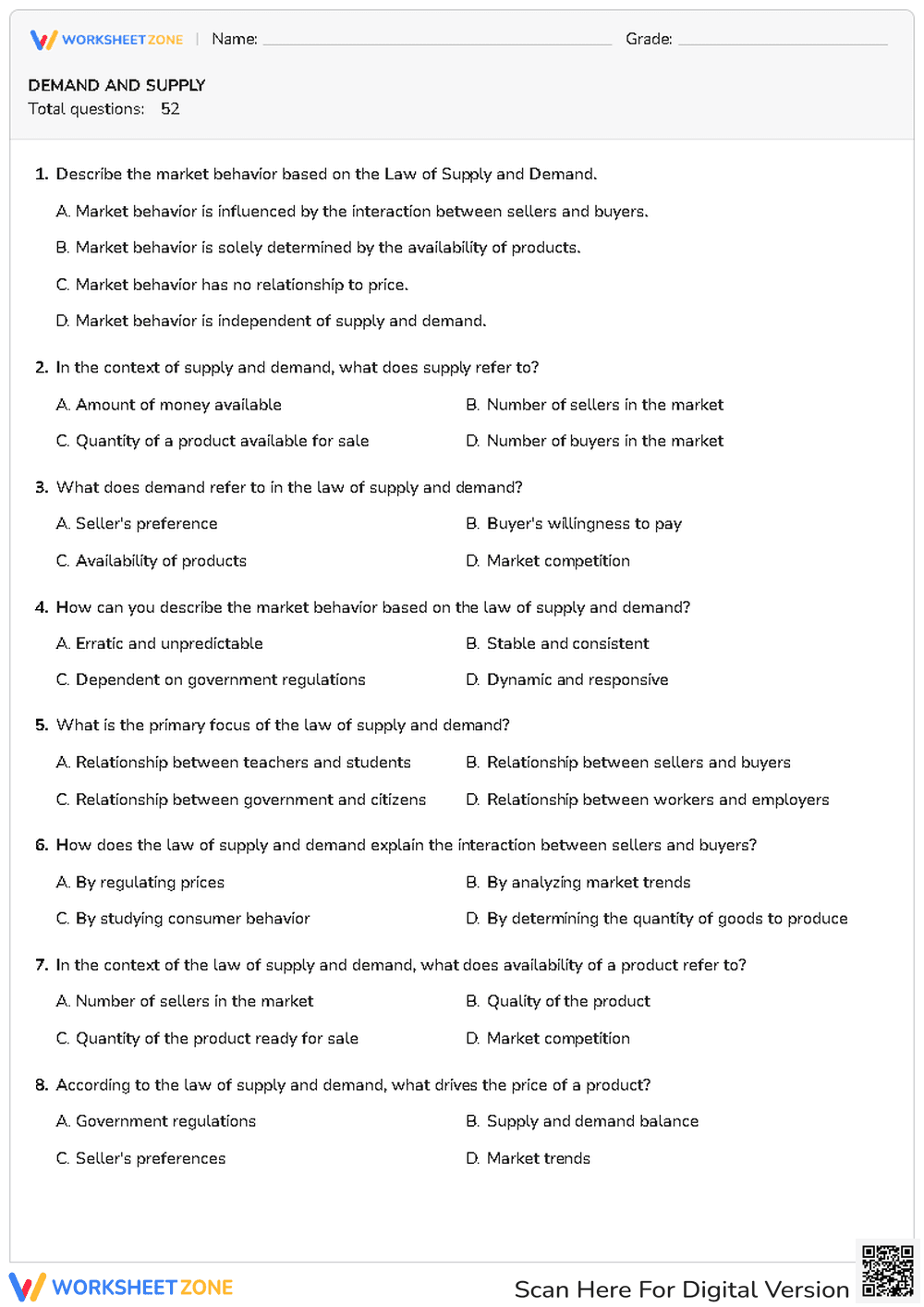


Demand and Supply Worksheet | Essential Grade 11-12 Econ
Paste this activity's link or code into your existing LMS (Google Classroom, Canvas, Teams, Schoology, Moodle, etc.).
Students can open and work on the activity right away, with no student login required.
You'll still be able to track student progress and results from your teacher account.
This Grade 11-12 economics worksheet provides a comprehensive assessment of market behavior through 52 targeted multiple-choice questions. Students will analyze the interaction between buyers and sellers, price determination, and the fundamental principles of market equilibrium. It is designed to solidify conceptual understanding before moving into complex graphical analysis.
At a Glance
- Grade: 11-12 · Subject: Economics
- Standard:
CCSS.ELA-LITERACY.RH.11-12.4— Determine the meaning of domain-specific words and phrases in an economic context- Skill Focus: Market Dynamics & Price Theory
- Format: 6 pages · 52 problems · Answer key included · PDF
- Best For: Unit review or formative assessment
- Time: 45–60 minutes
This extensive 6-page PDF contains 52 multiple-choice questions covering the breadth of supply and demand theory. The tasks range from defining basic terminology like surplus and shortage to predicting price fluctuations based on shifting consumer preferences. The clean layout ensures readability, and the consistent four-option format makes it ideal for automated grading or quick manual review.
Zero-Prep Workflow:
- Print: Select the 6-page document and print enough copies for your class in approximately 30 seconds.
- Distribute: Hand out the worksheets as a quiet bell-ringer or a formal mid-unit quiz in under 1 minute.
- Review: Use the included answer key to grade or facilitate a peer-review session to discuss common misconceptions.
Total teacher preparation time is under 2 minutes, making this an ideal resource for emergency sub plans or busy grading periods.
This resource is primarily aligned with CCSS.ELA-LITERACY.RH.11-12.4, which requires students to determine the meaning of symbols, key terms, and other domain-specific words and phrases as they are used in a technical context relevant to grades 11-12 texts. Additionally, it supports broader economic literacy goals regarding how markets function. Both standard codes can be copied directly into lesson plans, IEP goals, or district curriculum mapping tools.
Use this worksheet as a summative assessment at the conclusion of your introductory economics unit. The 52 questions provide enough data points to accurately gauge student mastery of price theory. Alternatively, assign specific pages as formative checks during direct instruction. Observe whether students struggle more with the supply side or demand side to tailor your next lecture. Completion typically takes 45 to 60 minutes.
This resource is tailored for high school juniors and seniors enrolled in General Economics, AP Microeconomics, or Civics courses. It provides necessary scaffolding for students who need clear, verbal descriptions of market shifts before transitioning to graphing. It pairs naturally with a standard supply and demand curve anchor chart or a textbook chapter on market equilibrium.
According to the RAND AIRS 2024 report, structured multiple-choice assessments in social studies help bridge the gap between vocabulary acquisition and conceptual application. This worksheet targets the CCSS.ELA-LITERACY.RH.11-12.4 standard by requiring students to distinguish between subtle economic shifts, such as the difference between a change in demand versus a change in quantity demanded. Research from Fisher & Frey (2014) suggests that high-volume practice with domain-specific terminology is essential for long-term retention in technical subjects like economics. By engaging with 52 distinct scenarios, students build the cognitive stamina required for college-level social science coursework. This resource provides a reliable metric for evaluating student readiness for more advanced macroeconomic modeling and policy analysis.


