




























1 / 2
0
Views
0
Downloads

0.0
0
Save
0 Likes
Share
Limiting Reactant Definition Worksheet
0 Views
0 Downloads

Paste this activity's link or code into your existing LMS (Google Classroom, Canvas, Teams, Schoology, Moodle, etc.).
Students can open and work on the activity right away, with no student login required.
You'll still be able to track student progress and results from your teacher account.
Information
Description
What It Is:
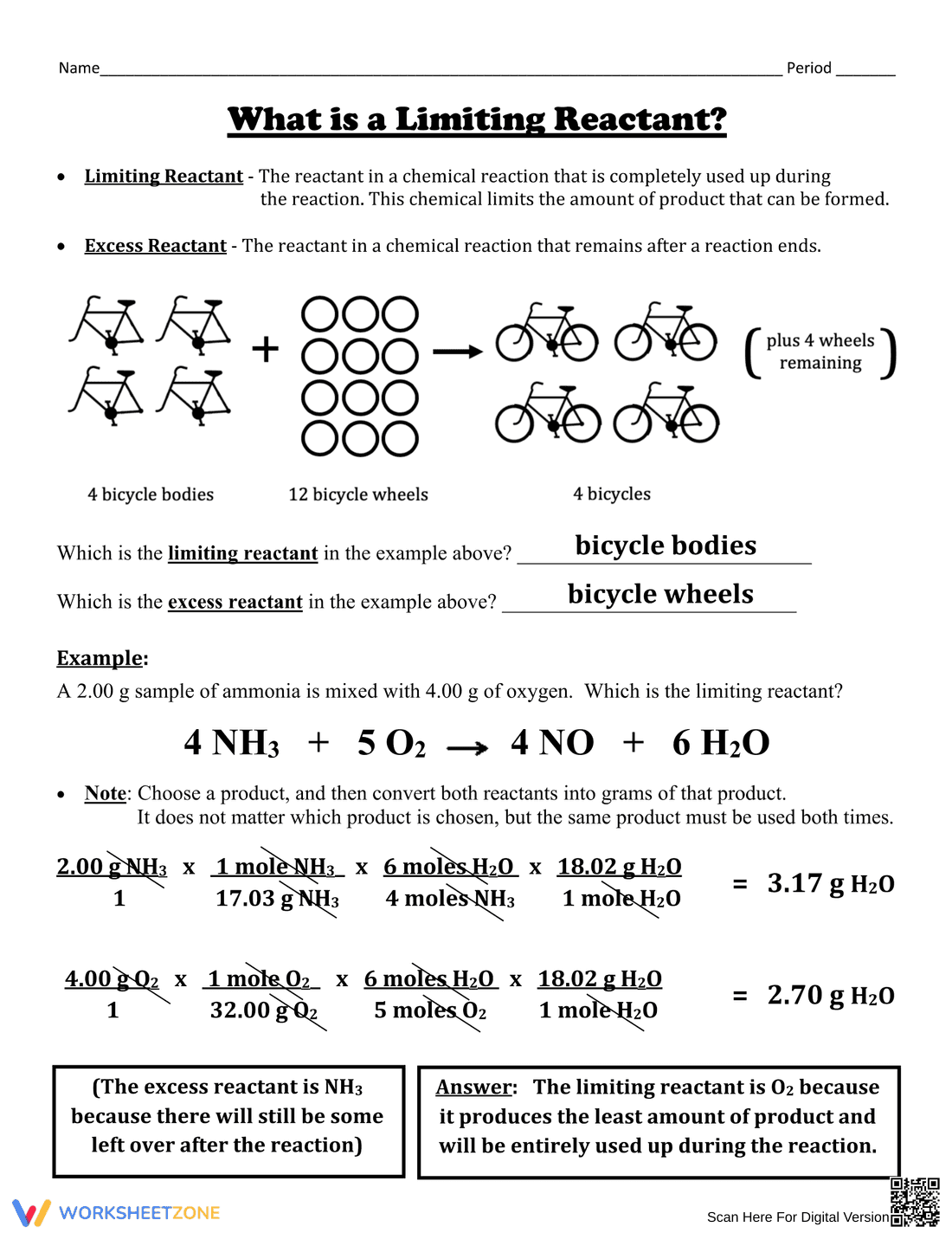
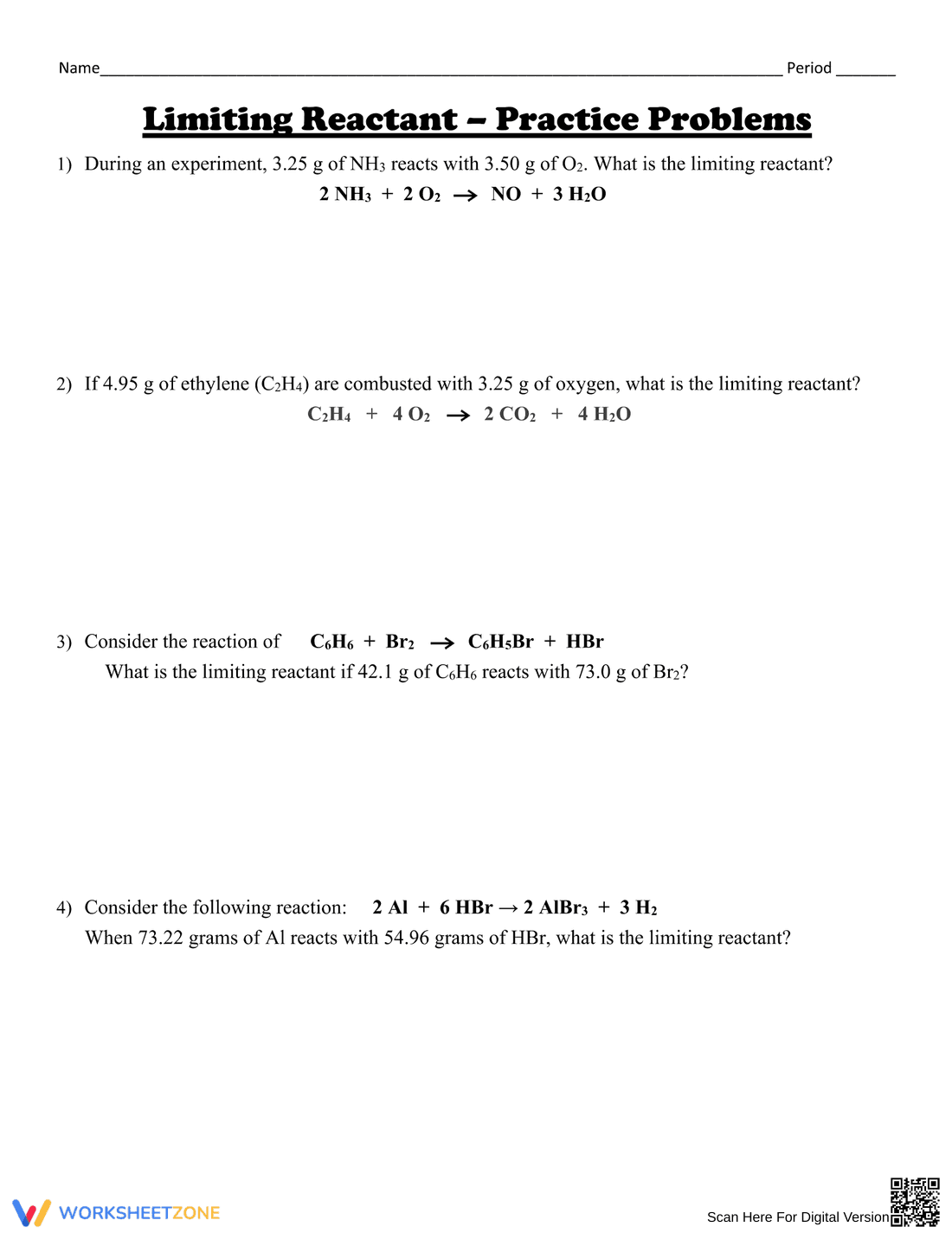
This is a chemistry worksheet focused on the concept of limiting reactants. It includes definitions of limiting and excess reactants, an analogy using bicycle parts (bodies and wheels) to illustrate the concept, and a stoichiometry problem involving the reaction of ammonia (NH3) and oxygen (O2) to produce nitrogen monoxide (NO) and water (H2O). The worksheet guides students through calculating the amount of product formed from each reactant to determine the limiting reactant.
Grade Level Suitability:
This worksheet is suitable for high school chemistry students, specifically grades 11-12. The concepts of stoichiometry, mole ratios, and limiting reactants are typically covered at this level, and the calculations require a solid understanding of these principles.
Why Use It:
This worksheet helps students understand the concept of limiting reactants through definitions, visual analogies, and practical problem-solving. It reinforces the ability to perform stoichiometric calculations and determine the limiting reactant in a chemical reaction, improving their problem-solving skills in chemistry.
How to Use It:
First, review the definitions of limiting and excess reactants. Next, work through the bicycle analogy to grasp the concept. Then, for the stoichiometry problem, follow the provided steps to convert grams of each reactant to grams of a chosen product (H2O in this case). Compare the amounts of product formed to identify the limiting reactant (the one that produces less product).
Target Users:
This worksheet is ideal for high school chemistry students, particularly those learning about stoichiometry and limiting reactants. It is also useful for teachers looking for practice problems and visual aids to explain this concept.
This is a chemistry worksheet focused on the concept of limiting reactants. It includes definitions of limiting and excess reactants, an analogy using bicycle parts (bodies and wheels) to illustrate the concept, and a stoichiometry problem involving the reaction of ammonia (NH3) and oxygen (O2) to produce nitrogen monoxide (NO) and water (H2O). The worksheet guides students through calculating the amount of product formed from each reactant to determine the limiting reactant.
Grade Level Suitability:
This worksheet is suitable for high school chemistry students, specifically grades 11-12. The concepts of stoichiometry, mole ratios, and limiting reactants are typically covered at this level, and the calculations require a solid understanding of these principles.
Why Use It:
This worksheet helps students understand the concept of limiting reactants through definitions, visual analogies, and practical problem-solving. It reinforces the ability to perform stoichiometric calculations and determine the limiting reactant in a chemical reaction, improving their problem-solving skills in chemistry.
How to Use It:
First, review the definitions of limiting and excess reactants. Next, work through the bicycle analogy to grasp the concept. Then, for the stoichiometry problem, follow the provided steps to convert grams of each reactant to grams of a chosen product (H2O in this case). Compare the amounts of product formed to identify the limiting reactant (the one that produces less product).
Target Users:
This worksheet is ideal for high school chemistry students, particularly those learning about stoichiometry and limiting reactants. It is also useful for teachers looking for practice problems and visual aids to explain this concept.


