


























Views
Downloads
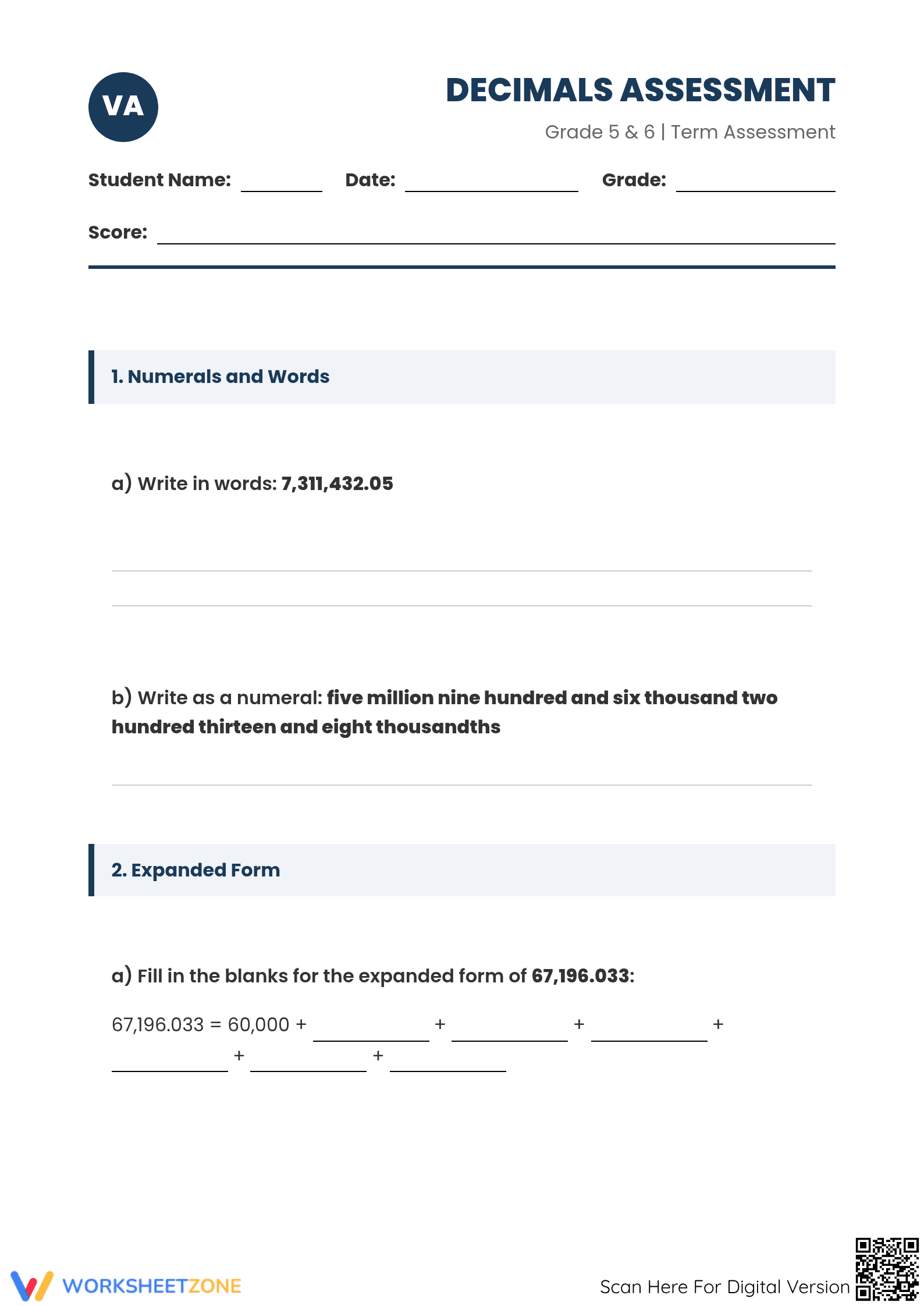



Complete 5.NBT.A.3 Decimal Review Worksheet - Grade 5 Aligned
Paste this activity's link or code into your existing LMS (Google Classroom, Canvas, Teams, Schoology, Moodle, etc.).
Students can open and work on the activity right away, with no student login required.
You'll still be able to track student progress and results from your teacher account.
This Grade 5 decimal assessment provides a comprehensive evaluation of student proficiency in reading, writing, and comparing decimals to the thousandths place. By covering place value identification, expanded form, and basic operations, the resource ensures students reach the mastery required by national standards while identifying specific areas for remediation or extension.
At a Glance
- Grade: 5 · Subject: Math
- Standard:
CCSS.MATH.CONTENT.5.NBT.A.3— Read, write, and compare decimals to thousandths using base-ten numerals and expanded form- Skill Focus: Comprehensive Decimal Literacy and Operations
- Format: 5 pages · 66 problems · Answer key included · PDF
- Best For: Summative end-of-unit assessment and mastery tracking
- Time: 45–60 minutes
Inside this 5-page PDF, teachers will find 66 structured problems organized into ten distinct sections. The tasks range from matching written words to decimals and identifying place value to complex operations involving addition, subtraction, multiplication, and division. A complete answer key is provided to facilitate rapid grading and provide students with immediate feedback on their performance across all skill areas.
This assessment provides evidence of student mastery by tracking performance across critical tiers. Initial sections verify knowledge of decimal nomenclature, while middle sections assess the ability to compare and round accurately. Final sections demand operational application, allowing educators to map student scores directly to sub-skills for IEP progress notes or report card reporting.
The primary focus of this worksheet is CCSS.MATH.CONTENT.5.NBT.A.3: "Read, write, and compare decimals to thousandths." It also provides significant support for CCSS.MATH.CONTENT.5.NBT.B.7, focusing on adding, subtracting, multiplying, and dividing decimals to hundredths. Both standard codes can be copied directly into lesson plans, IEP goals, or district curriculum mapping tools to ensure instructional alignment.
This resource is best used as a summative assessment after direct instruction on decimal place value and operations. During the session, teachers can observe student strategies for ordering decimals and rounding to identify common misconceptions about place value. Expect students to complete the full 5-page set in approximately 50 minutes, making it an ideal tool for formal gradebook entries or data-driven instruction planning.
This worksheet is designed for Grade 5 and Grade 6 students who are solidifying their understanding of the base-ten system. It serves as an excellent diagnostic tool for students in higher grades who struggle with decimal notation. For optimal results, pair this assessment with visual anchor charts or base-ten block manipulatives to support students who require additional concrete scaffolding during the testing process.
Effective mathematics instruction requires a balanced approach to procedural fluency and conceptual understanding, as highlighted in the RAND AIRS 2024 report on curriculum alignment. This Grade 5 assessment addresses both domains by requiring students to translate between different forms of decimal representation while demonstrating accuracy in calculation. By utilizing 66 targeted tasks, the worksheet provides enough data points to satisfy the requirements for evidence-based progress monitoring. The inclusion of the CCSS.MATH.CONTENT.5.NBT.A.3 standard ensures that students are practicing at the appropriate depth of knowledge for their grade level. Research from Fisher & Frey (2014) emphasizes the importance of utilizing comprehensive assessments to guide the gradual release of responsibility. Educators can use the results of this assessment to determine which students have achieved independence and which require further guided practice. The structured layout minimizes cognitive load, allowing students to focus on the mathematical concepts being evaluated.


