




























Views
Downloads

5.NBT.B.7 Decimal Assessment — Grade 5 Aligned Worksheet

Paste this activity's link or code into your existing LMS (Google Classroom, Canvas, Teams, Schoology, Moodle, etc.).
Students can open and work on the activity right away, with no student login required.
You'll still be able to track student progress and results from your teacher account.
Mastering decimals requires conceptual understanding and procedural fluency. This Grade 5 Decimal Assessment evaluates student proficiency across place value, comparison, rounding, and operations. By utilizing this printable resource, educators can pinpoint specific learning gaps and ensure students achieve the mathematical precision required for upper elementary success and future algebraic readiness.
At a Glance
- Grade: 5 · Subject: Decimals
- Standard:
CCSS.MATH.CONTENT.5.NBT.B.7— Add, subtract, multiply, and divide decimals to hundredths using concrete models.- Skill Focus: Decimal operations and place value
- Format: 5 pages · 35 problems · Answer key included · PDF
- Best For: End-of-unit summative assessment
- Time: 45–60 minutes
What's Inside
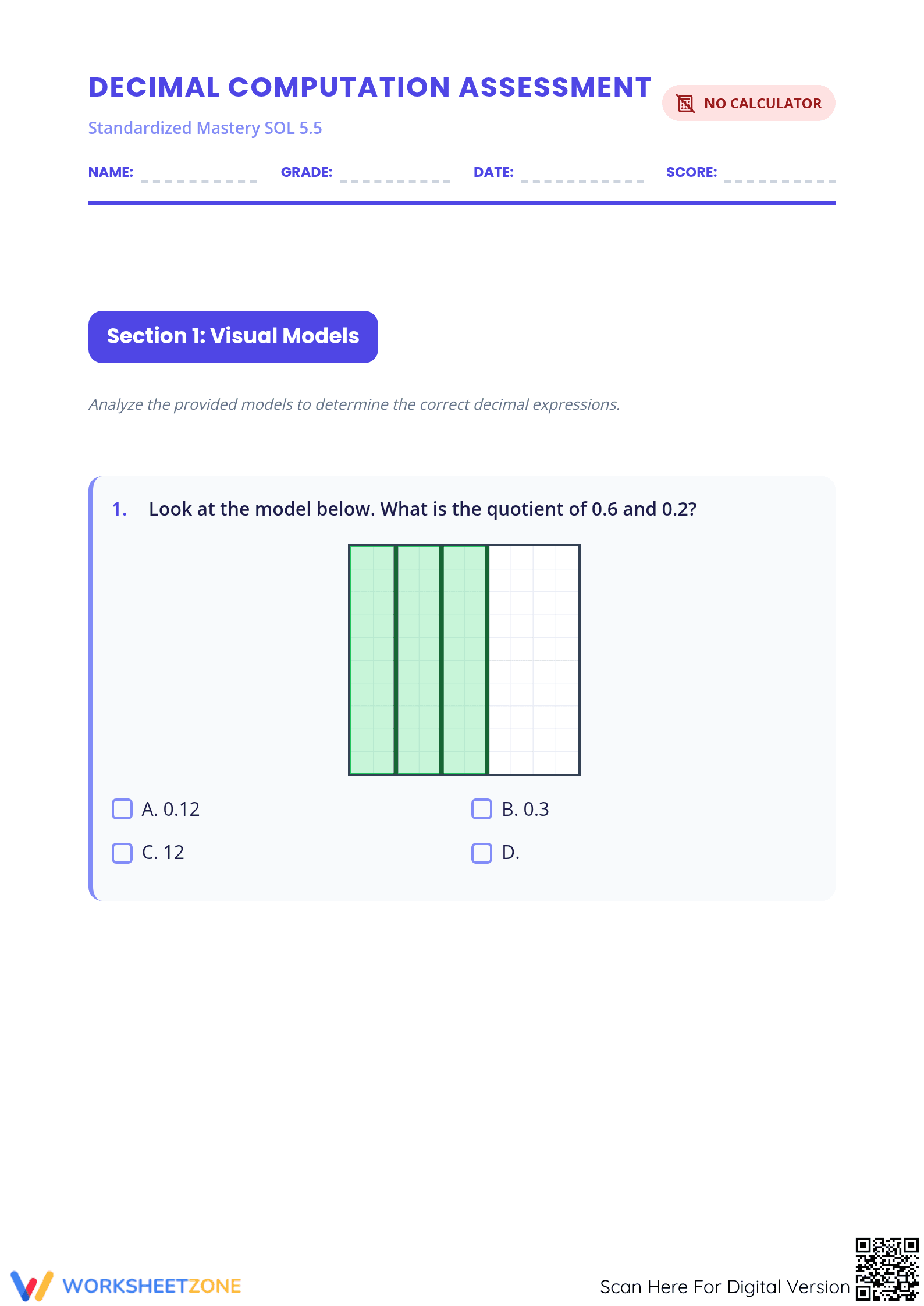
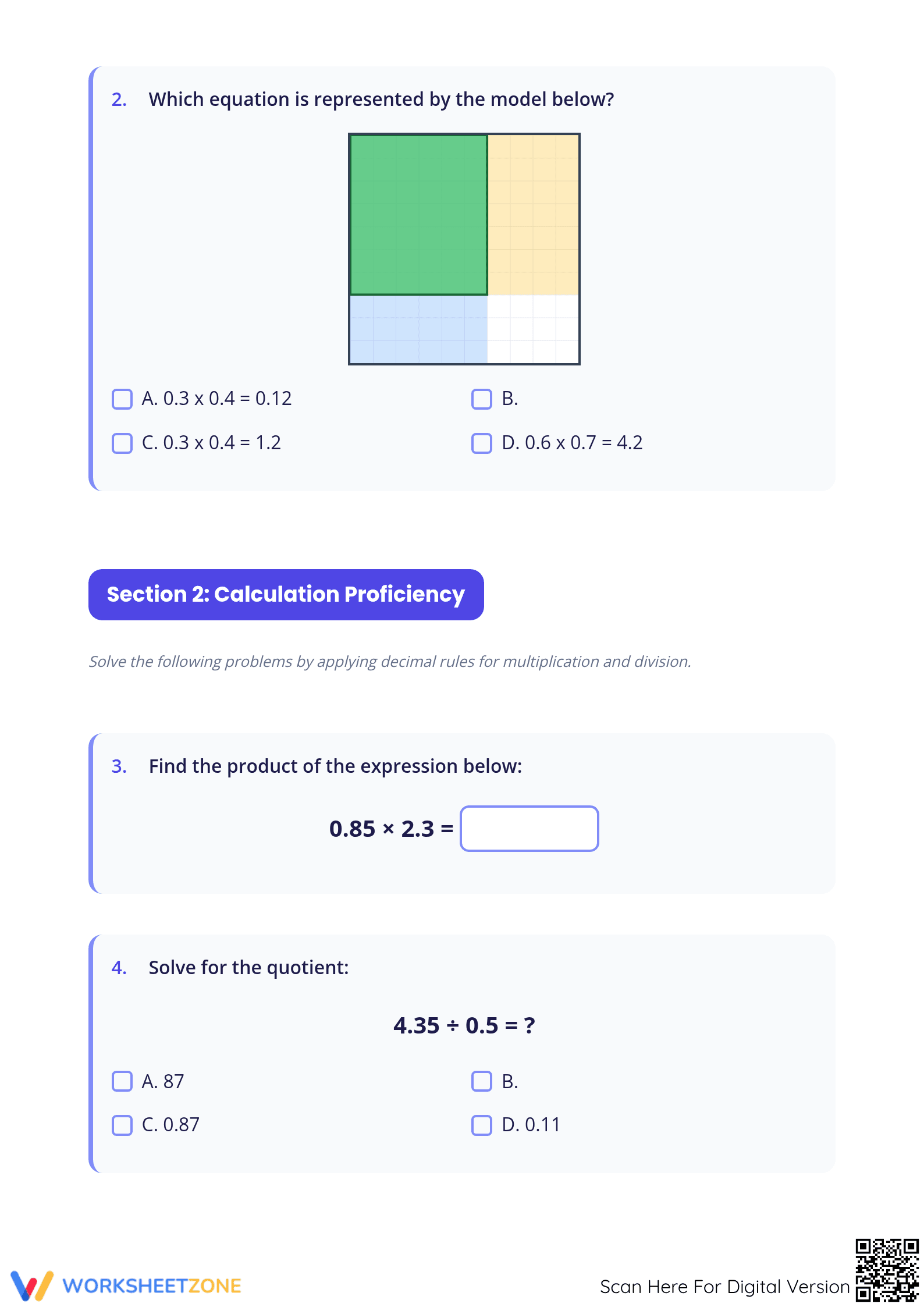
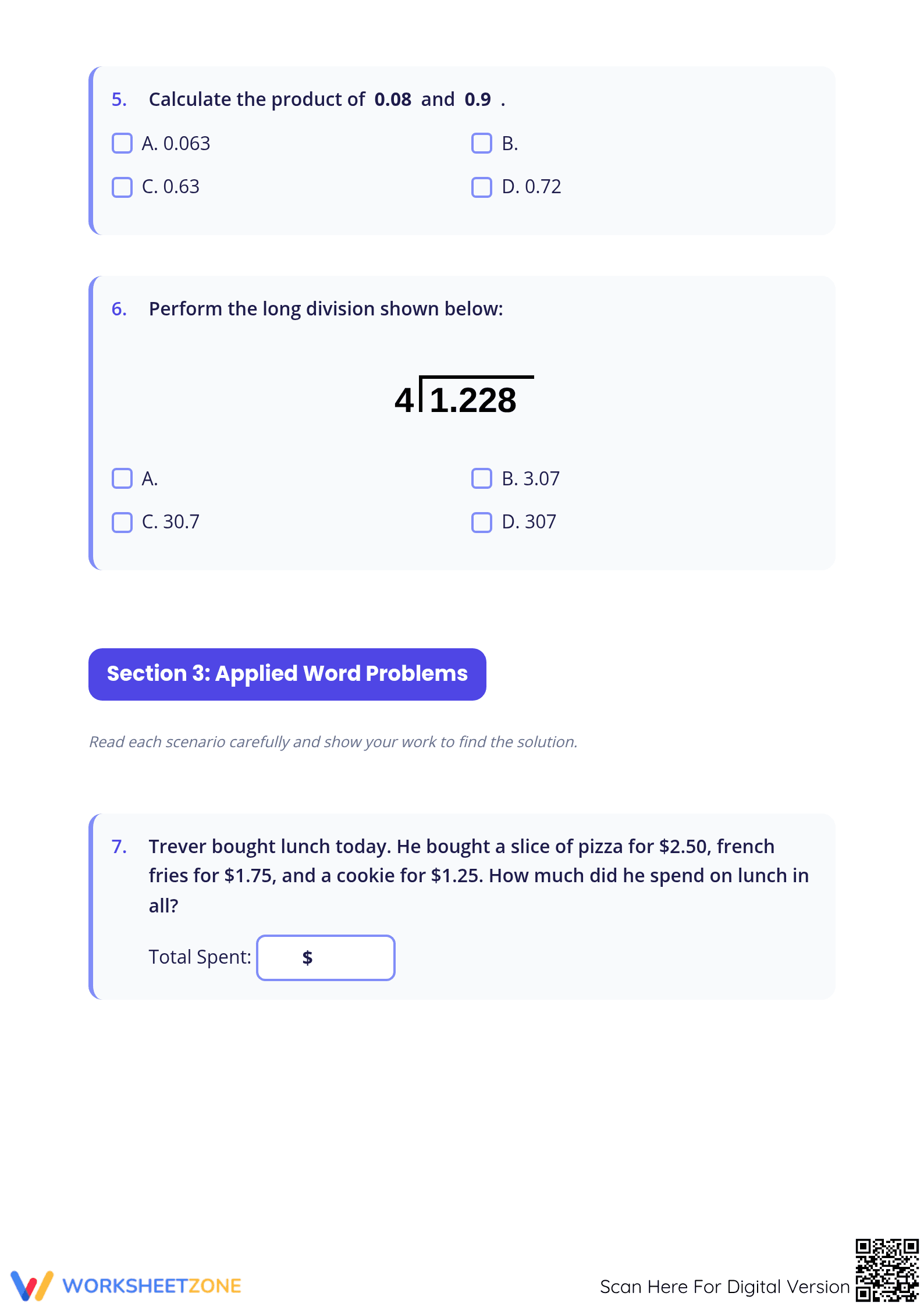
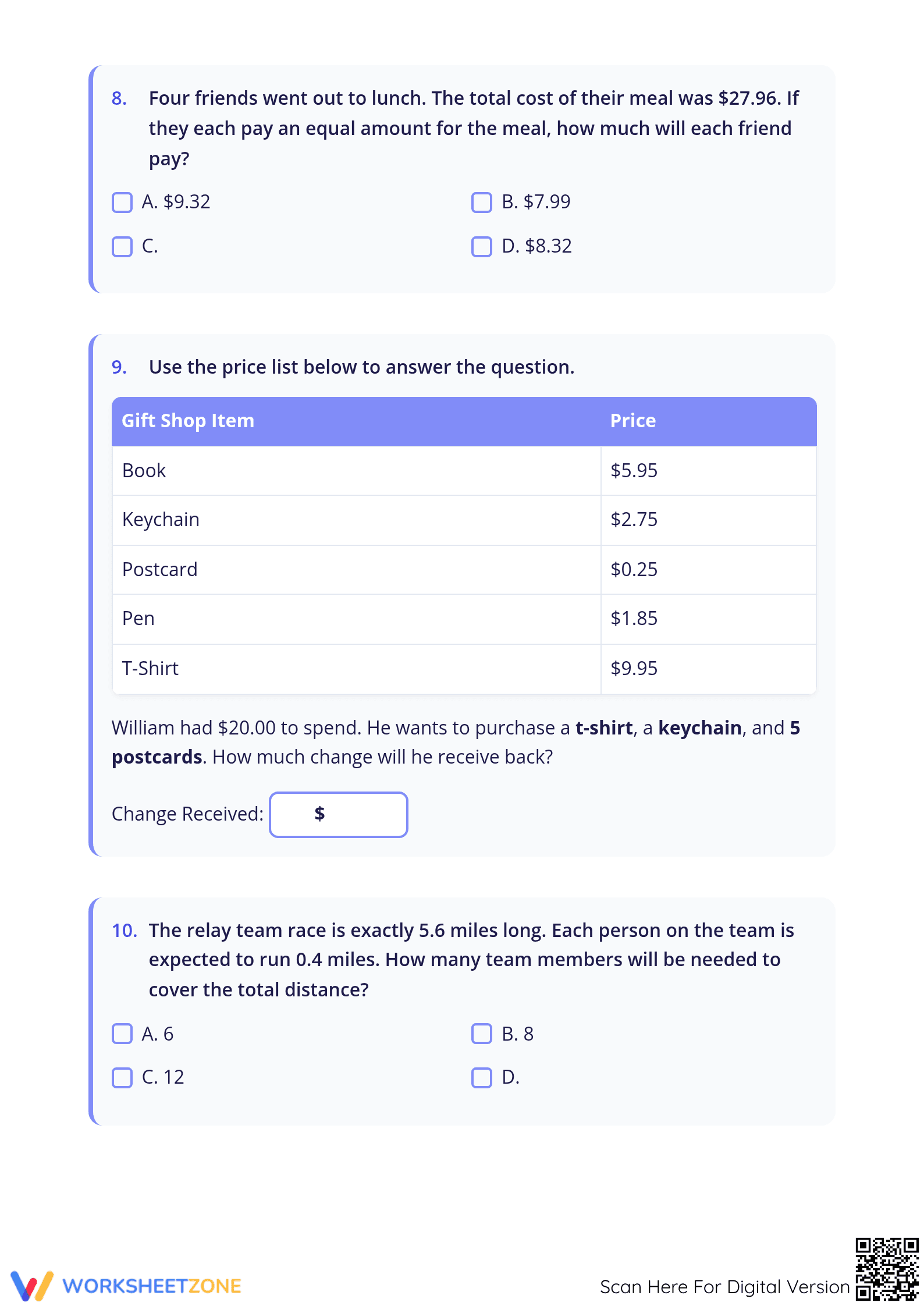
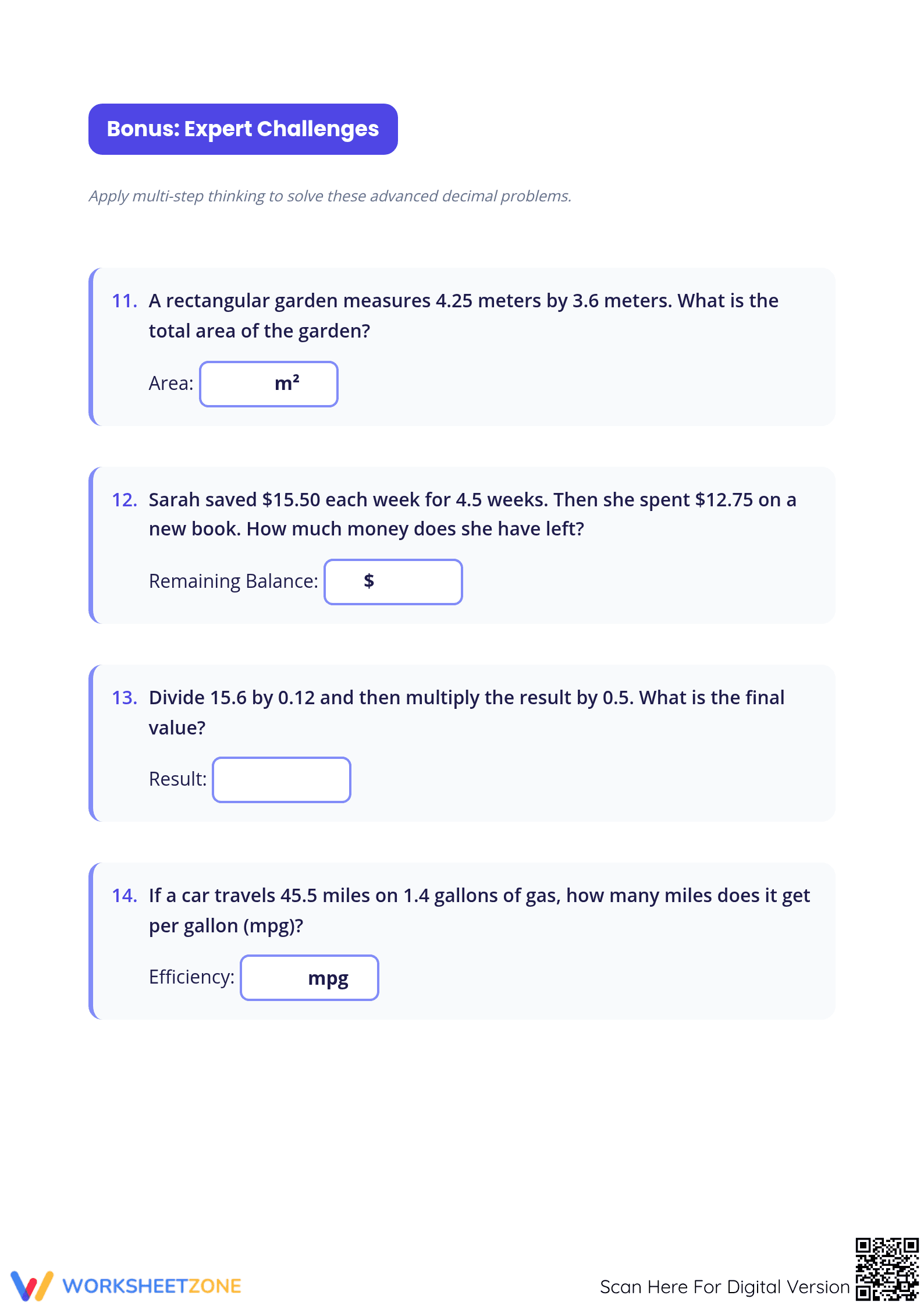
This five-page packet provides a thorough diagnostic of decimal competency. It is organized into six sections: Section A features 10 multiple-choice questions on fundamental concepts. Sections B through D cover comparing, rounding, and place value with 5 problems each. Section E provides 5 computational problems for addition and subtraction, while Section F challenges students with 5 multi-step word problems. A full answer key is included for immediate feedback.
Mastery Evidence
This assessment maps tasks to specific NBT domain sub-skills. Section F serves as a high-level mastery check, requiring students to translate real-world scenarios into mathematical expressions. Educators can identify whether a student is "Approaching," "Meeting," or "Exceeding" the standard based on their success across the tiered sections. Scores can be entered directly into gradebooks or IEP progress notes to document student growth over time.
Standards Alignment
The primary focus is CCSS.MATH.CONTENT.5.NBT.B.7: "Add, subtract, multiply, and divide decimals to hundredths." It also supports 5.NBT.A.3 (comparing decimals) and 5.NBT.A.4 (rounding). These standard codes can be copied directly into lesson plans, IEP goals, or district curriculum mapping tools to ensure instructional alignment and accountability. The assessment ensures that students are meeting the rigorous demands of the core curriculum.
How to Use It
Utilize this resource as a summative assessment after a decimals unit. For a formative approach, administer one section daily as an exit ticket. Observe student transitions from computation in Section E to contextual word problems in Section F; difficulty here often signals a need for more literacy-based math instruction. Expected completion time is 50 minutes, making it suitable for a standard class period.
Who It's For
This assessment is tailored for Grade 5 students, but works well for Grade 6 review or Grade 4 extension. It is ideal for general education, resource rooms, and home-schooling environments. Pair this with a decimal anchor chart to support students during initial practice phases before formal testing. It provides the necessary scaffolding to support diverse learners in achieving mastery of complex decimal concepts.
The integration of multiple decimal fluencies within a single assessment aligns with the "Rigors of the Common Core" framework, which emphasizes the balance of conceptual understanding and procedural skill. According to the NAEP 2022 Mathematics Framework, proficiency in decimal operations is a critical predictor of readiness for middle school algebraic reasoning. Fisher & Frey (2014) highlight that such comprehensive checks serve as essential checkpoints in the gradual release of responsibility model, moving students toward independent mastery. This assessment provides 35 data points necessary for educators to make informed instructional pivots. Research from ScienceDirect TpT Analysis suggests that structured, multi-section assessments reduce student testing anxiety by providing clear transitions between task types while maintaining academic rigor. This resource ensures that students are prepared for the increasing complexity of rational number operations in higher grades.


