


























Views
Downloads



Multiplying Fractions Word Problems | Grade 6 Essential
Paste this activity's link or code into your existing LMS (Google Classroom, Canvas, Teams, Schoology, Moodle, etc.).
Students can open and work on the activity right away, with no student login required.
You'll still be able to track student progress and results from your teacher account.
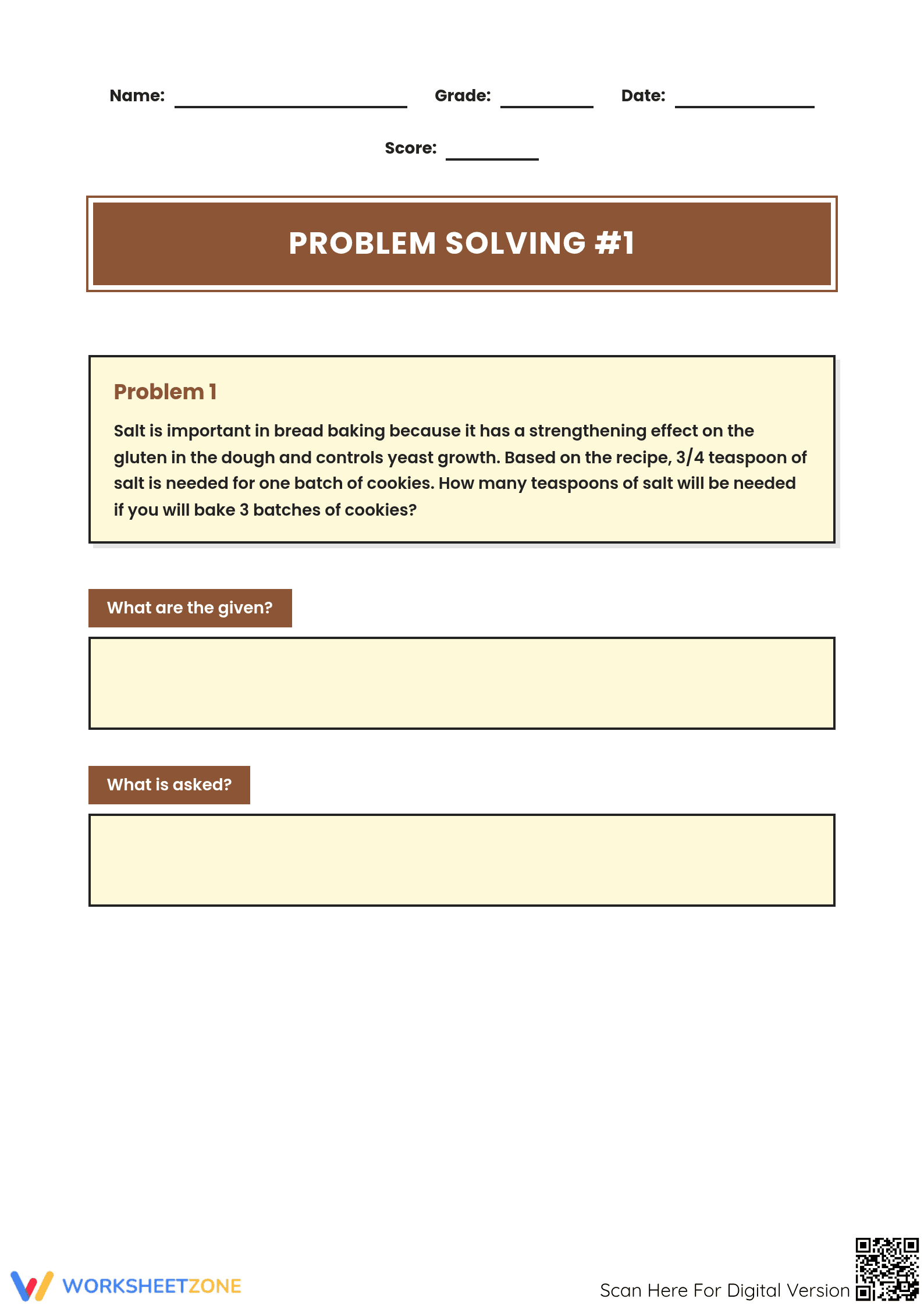
This comprehensive Grade 6-7 math worksheet provides targeted practice for students mastering the multiplication of fractions through 25 varied word problems. By applying operations to real-world scenarios—ranging from recipes to measurement—learners develop the conceptual understanding required for procedural fluency. Students will translate verbal descriptions into mathematical expressions to find accurate solutions.
At a Glance
- Grade: 6 · Subject: Math
- Standard:
CCSS.MATH.CONTENT.5.NF.B.6— Solve real world problems involving multiplication of fractions and mixed numbers- Skill Focus: Multi-step fraction multiplication
- Format: 5 pages · 25 problems · Answer key included · PDF
- Best For: Homework, independent practice, or test prep
- Time: 40–50 minutes
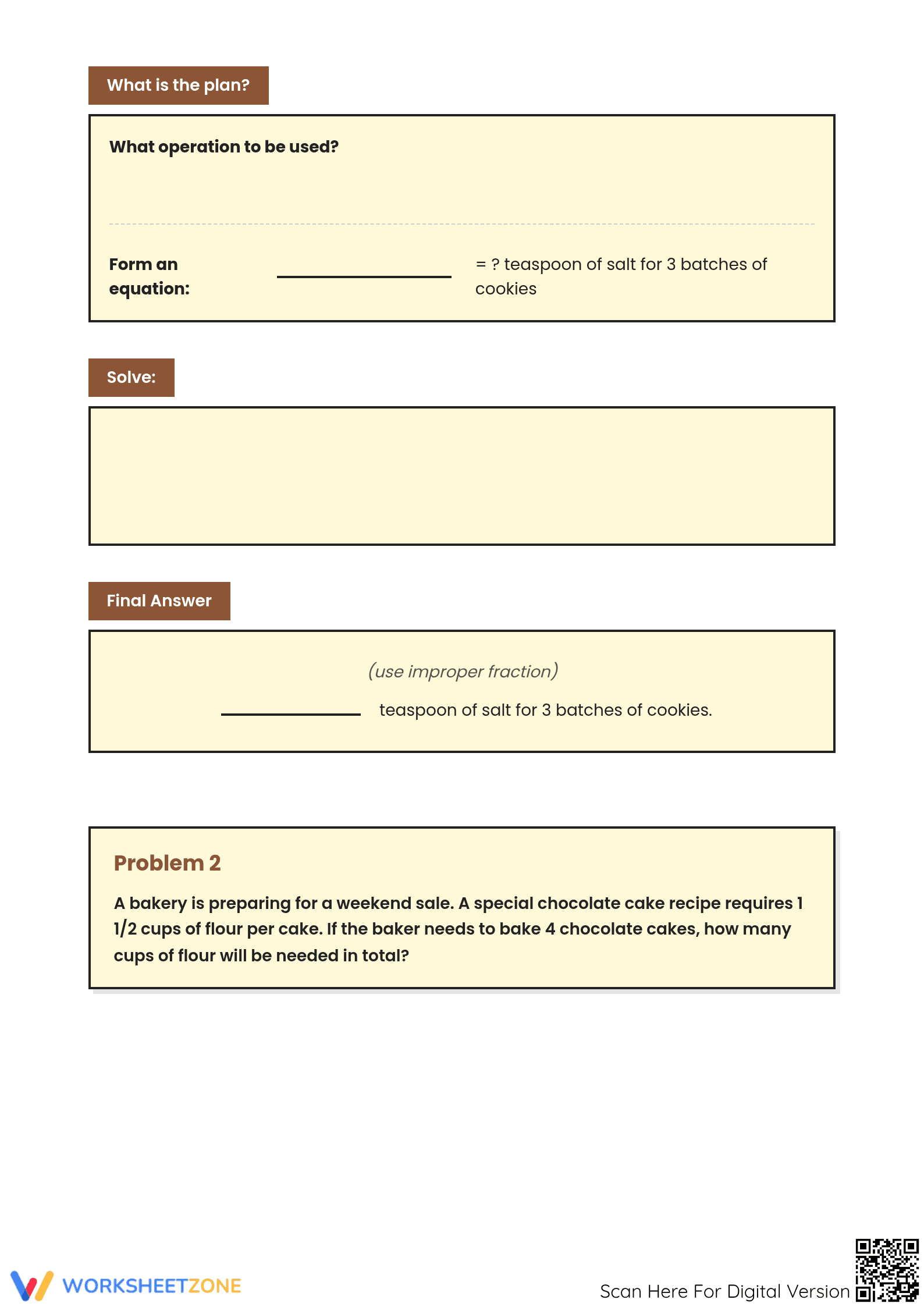
This five-page packet features 25 unique word problems that require students to multiply fractions and whole numbers. The layout is clean and spacious, allowing students enough room to show their work and set up their equations. A full answer key is included to facilitate quick grading or self-correction, making it ideal for both classroom and remote learning environments.
Skill Progression
- Guided practice: The initial problems use simple unit fractions and small whole numbers to build student confidence in setting up the multiplication models.
- Supported practice: Middle tasks introduce mixed numbers and larger denominators, requiring students to simplify results and check for reasonableness.
- Independent practice: The final "Challenge" problems require multi-step reasoning where students must apply multiple operations or interpret complex scenarios.
The sequence follows a gradual-release model, moving from direct computation within a context to higher-order problem-solving demands through consistent repetition.
Standards Alignment
This resource is aligned to CCSS.MATH.CONTENT.5.NF.B.6: "Solve real world problems involving multiplication of fractions and mixed numbers, e.g., by using visual fraction models or equations to represent the problem." While categorized for Grade 6 and 7 review, it focuses on the essential transition from simple operations to complex application. Both standard codes can be copied directly into lesson plans, IEP goals, or district curriculum mapping tools.
How to Use It
Use this worksheet as a summative assessment after completing a unit on fraction operations to gauge individual student mastery. Alternatively, assign specific pages as a "Problem of the Day" during the first ten minutes of class to provide consistent, low-stakes formative assessment. Teachers should observe whether students are drawing visual models or jumping straight to the algorithm to identify those needing additional support.
Who It's For
This packet is designed for Grade 6 and 7 students who need to strengthen their fluency with rational numbers. It serves as an excellent resource for Title I math intervention groups or as a supplementary set for students who have completed their core curriculum tasks. It pairs naturally with a visual anchor chart displaying fraction-of-a-set models or direct instruction lessons.
According to recent NAEP data, students often struggle most with applying fraction operations to verbal contexts rather than isolated computation. This worksheet addresses that gap by providing 25 rigorous scenarios that demand translation from text to expression. Research by Fisher & Frey (2014) highlights that intentional, scaffolded word problem practice is critical for developing the mathematical literacy required for high school algebra. By focusing on standard CCSS.MATH.CONTENT.5.NF.B.6, this resource ensures that learners are not merely calculating, but are interpreting what the product of two fractions represents in a tangible environment. The inclusion of multi-step "Challenge" tasks ensures that learners are pushed toward the Depth of Knowledge levels expected in state-level standardized assessments. This self-contained practice set is optimized for instructional consistency across diverse classroom settings and can be easily integrated into digital platforms or traditional print-based portfolios for long-term progress monitoring.


