


























1 / 2
0
Views
0
Downloads

0.0
0
Save
0 Likes
Share
Studying Darwin's Finches
0 Views
0 Downloads
Paste this activity's link or code into your existing LMS (Google Classroom, Canvas, Teams, Schoology, Moodle, etc.).
Students can open and work on the activity right away, with no student login required.
You'll still be able to track student progress and results from your teacher account.
Information
Description
What It Is:
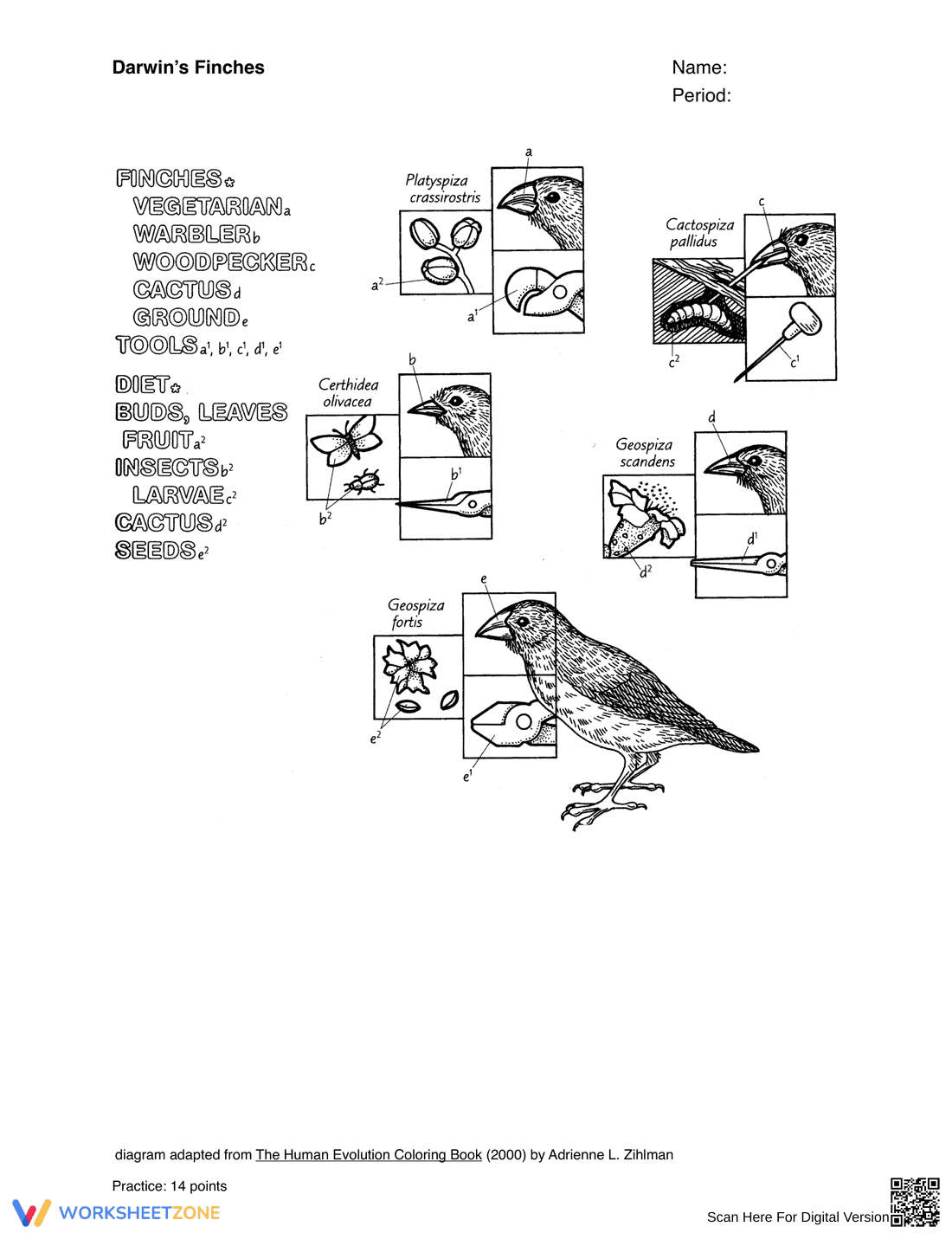
This is an educational worksheet focusing on Darwin's Finches. It features illustrations of different finch species (Platyspiza crassirostris, Cactospiza pallidus, Certhidea olivacea, Geospiza scandens, and Geospiza fortis) and their corresponding food sources and beak shapes. The worksheet includes a list of terms like 'finches,' 'vegetarian,' 'warbler,' 'woodpecker,' 'cactus,' 'ground,' 'tools,' and 'diet,' 'buds,' 'leaves,' 'fruit,' 'insects,' 'larvae,' 'cactus,' and 'seeds.' The task appears to be matching the finch's beak and diet to its species.
Grade Level Suitability:
This worksheet is suitable for grades 6-9, potentially even higher depending on the curriculum. The content requires understanding of evolutionary adaptation, natural selection, and the relationship between an organism's structure and function.
Why Use It:
This worksheet reinforces understanding of Darwin's theory of evolution by natural selection. It helps students visualize how different beak shapes are adapted to different food sources, illustrating the concept of adaptive radiation in Darwin's finches. It promotes critical thinking and observation skills.
How to Use It:
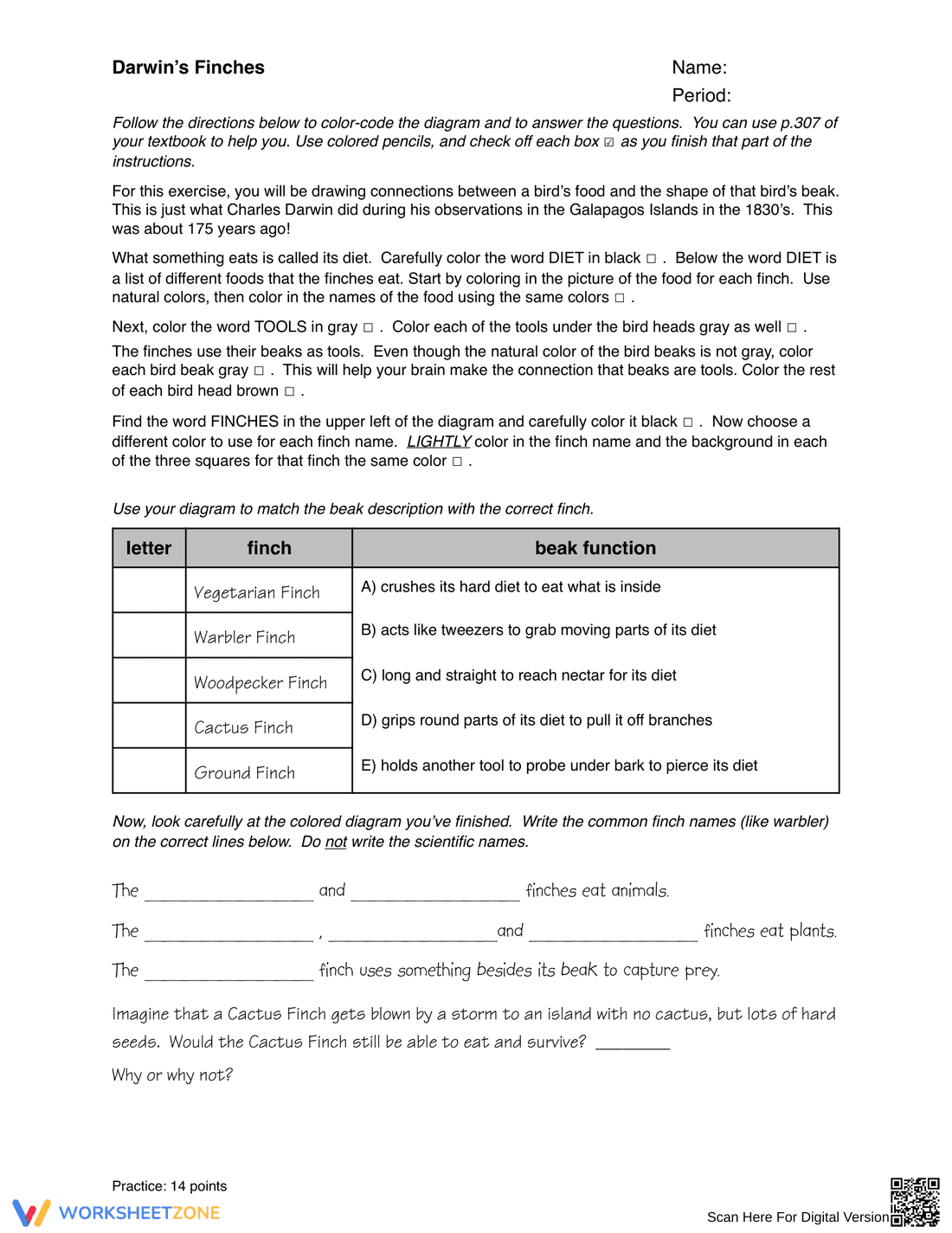
Students should use the provided word list and illustrations to match each finch species with its appropriate food source and beak type. They can draw lines connecting the bird, food, and beak. The worksheet can be used as an individual assignment, a group activity, or a homework assignment.
Target Users:
This worksheet is designed for middle school and high school science students studying evolution, adaptation, and natural selection. It is also suitable for teachers looking for engaging activities to teach these concepts.
This is an educational worksheet focusing on Darwin's Finches. It features illustrations of different finch species (Platyspiza crassirostris, Cactospiza pallidus, Certhidea olivacea, Geospiza scandens, and Geospiza fortis) and their corresponding food sources and beak shapes. The worksheet includes a list of terms like 'finches,' 'vegetarian,' 'warbler,' 'woodpecker,' 'cactus,' 'ground,' 'tools,' and 'diet,' 'buds,' 'leaves,' 'fruit,' 'insects,' 'larvae,' 'cactus,' and 'seeds.' The task appears to be matching the finch's beak and diet to its species.
Grade Level Suitability:
This worksheet is suitable for grades 6-9, potentially even higher depending on the curriculum. The content requires understanding of evolutionary adaptation, natural selection, and the relationship between an organism's structure and function.
Why Use It:
This worksheet reinforces understanding of Darwin's theory of evolution by natural selection. It helps students visualize how different beak shapes are adapted to different food sources, illustrating the concept of adaptive radiation in Darwin's finches. It promotes critical thinking and observation skills.
How to Use It:
Students should use the provided word list and illustrations to match each finch species with its appropriate food source and beak type. They can draw lines connecting the bird, food, and beak. The worksheet can be used as an individual assignment, a group activity, or a homework assignment.
Target Users:
This worksheet is designed for middle school and high school science students studying evolution, adaptation, and natural selection. It is also suitable for teachers looking for engaging activities to teach these concepts.


