


























1 / 5
0
Views
0
Downloads


0.0
0
Save
0 Likes
Share
Adaptive Traits of Darwin's Finches
0 Views
0 Downloads
Paste this activity's link or code into your existing LMS (Google Classroom, Canvas, Teams, Schoology, Moodle, etc.).
Students can open and work on the activity right away, with no student login required.
You'll still be able to track student progress and results from your teacher account.
Information
Description
What It Is:
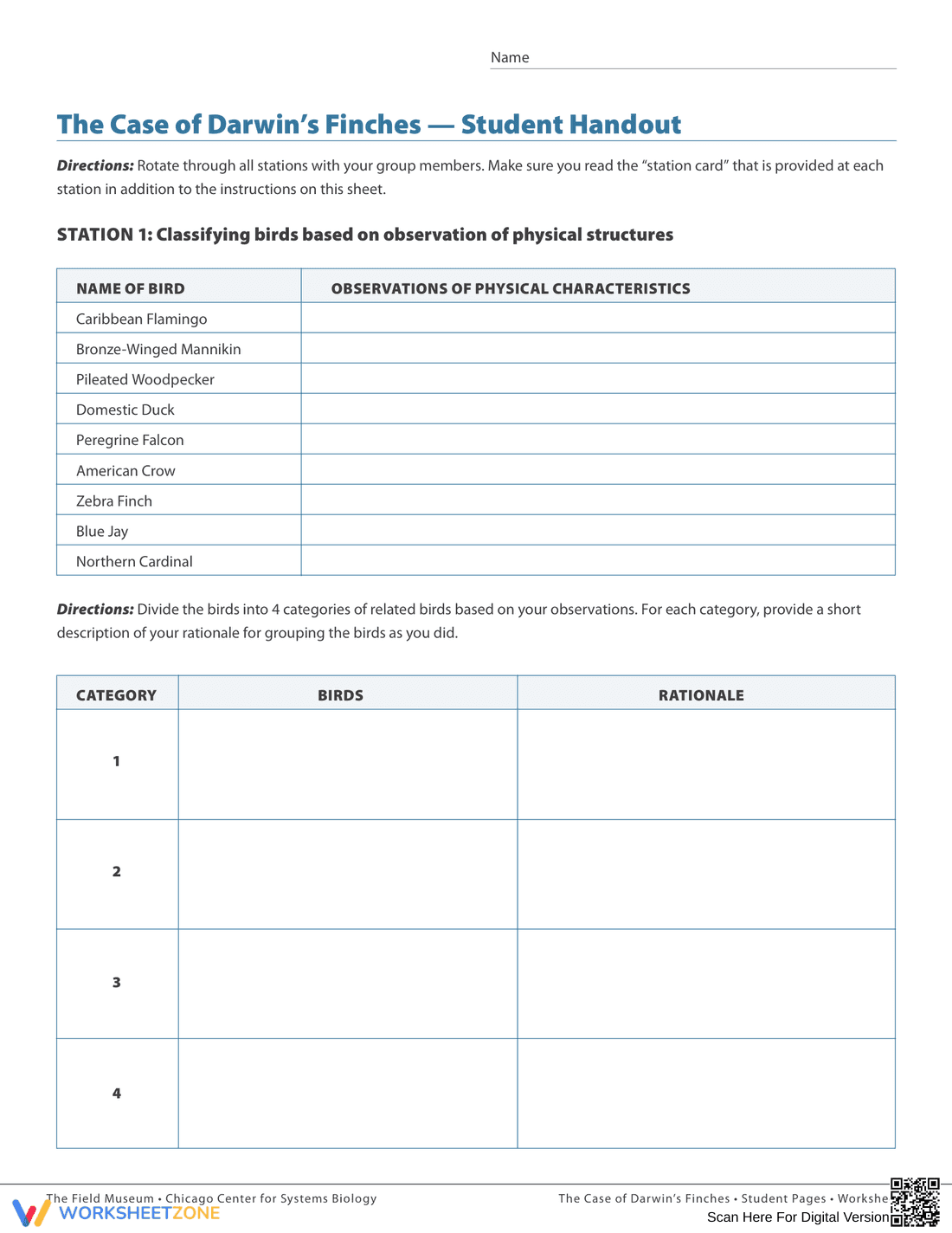
This is a student handout titled 'The Case of Darwin's Finches'. It includes an activity focused on classifying birds based on observations of their physical characteristics. The worksheet provides a table to record observations for various bird species (Caribbean Flamingo, Bronze-Winged Mannikin, Pileated Woodpecker, Domestic Duck, Peregrine Falcon, American Crow, Zebra Finch, Blue Jay, and Northern Cardinal). A second table requires students to divide the birds into 4 categories, listing the birds in each category and providing a rationale for their grouping.
Grade Level Suitability:
This worksheet is suitable for middle school (grades 6-8) and early high school (grade 9-10) students. It requires observation skills, classification abilities, and the ability to provide written justifications, which are skills typically developed in these grade levels.
Why Use It:
This worksheet helps students develop observation skills, practice classifying organisms based on physical characteristics, and improve their ability to provide scientific reasoning. It reinforces concepts related to adaptation, evolution, and biodiversity, particularly within the context of Darwin's finches. It encourages critical thinking and scientific argumentation.
How to Use It:
Students should first observe the physical characteristics of each bird species listed (either through images, videos, or real-life observation). They should record these observations in the provided table. Next, students should divide the birds into four categories based on their observations, listing the birds in each category and providing a clear and logical rationale for their grouping.
Target Users:
This worksheet is designed for science students in middle school and early high school, particularly those studying biology, ecology, or evolution. It is also suitable for teachers looking for hands-on activities to teach classification, adaptation, and Darwin's finches.
This is a student handout titled 'The Case of Darwin's Finches'. It includes an activity focused on classifying birds based on observations of their physical characteristics. The worksheet provides a table to record observations for various bird species (Caribbean Flamingo, Bronze-Winged Mannikin, Pileated Woodpecker, Domestic Duck, Peregrine Falcon, American Crow, Zebra Finch, Blue Jay, and Northern Cardinal). A second table requires students to divide the birds into 4 categories, listing the birds in each category and providing a rationale for their grouping.
Grade Level Suitability:
This worksheet is suitable for middle school (grades 6-8) and early high school (grade 9-10) students. It requires observation skills, classification abilities, and the ability to provide written justifications, which are skills typically developed in these grade levels.
Why Use It:
This worksheet helps students develop observation skills, practice classifying organisms based on physical characteristics, and improve their ability to provide scientific reasoning. It reinforces concepts related to adaptation, evolution, and biodiversity, particularly within the context of Darwin's finches. It encourages critical thinking and scientific argumentation.
How to Use It:
Students should first observe the physical characteristics of each bird species listed (either through images, videos, or real-life observation). They should record these observations in the provided table. Next, students should divide the birds into four categories based on their observations, listing the birds in each category and providing a clear and logical rationale for their grouping.
Target Users:
This worksheet is designed for science students in middle school and early high school, particularly those studying biology, ecology, or evolution. It is also suitable for teachers looking for hands-on activities to teach classification, adaptation, and Darwin's finches.


