




























1 / 2
0
Views
0
Downloads

0.0
0
Save
0 Likes
Share
Exploring Darwin's Finches Evolution
0 Views
0 Downloads

Paste this activity's link or code into your existing LMS (Google Classroom, Canvas, Teams, Schoology, Moodle, etc.).
Students can open and work on the activity right away, with no student login required.
You'll still be able to track student progress and results from your teacher account.
Information
Description
What It Is:
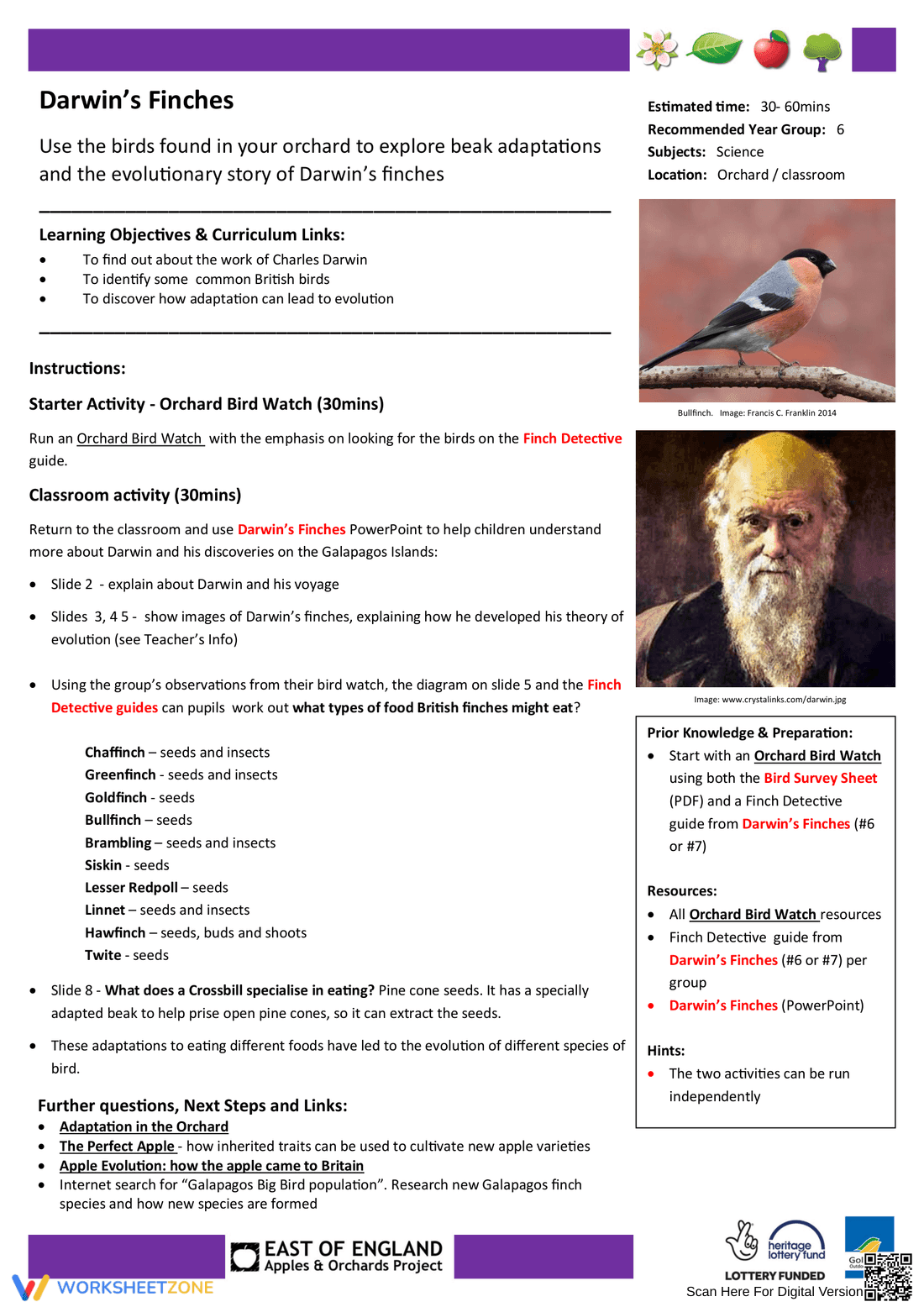
This is an educational worksheet titled 'Darwin's Finches.' It guides students to explore beak adaptations and the evolutionary story of Darwin's finches. The worksheet includes a starter activity involving an 'Orchard Bird Watch' and a classroom activity using a 'Darwin's Finches' PowerPoint. It also prompts students to identify the types of food British finches might eat based on observations and detective guides. It lists different birds and their food preferences (seeds, insects, buds, shoots) and includes further questions and links to other related topics such as apple varieties and Galapagos finch species.
Grade Level Suitability:
Based on the scientific concepts and activities, this worksheet appears suitable for upper elementary (Grade 5-6) and middle school (Grade 7-8) students. The content requires some understanding of evolution, adaptation, and scientific observation, making it appropriate for these grade levels.
Why Use It:
This worksheet provides a hands-on approach to learning about Darwin's finches and evolutionary adaptation. It combines outdoor observation with classroom activities to enhance understanding. It promotes critical thinking by asking students to connect beak shapes with food sources and encourages further research and exploration of related topics.
How to Use It:
Begin with the 'Orchard Bird Watch' activity, focusing on observing birds in the orchard. Then, return to the classroom and use the 'Darwin's Finches' PowerPoint to discuss Darwin's discoveries. Use the 'Finch Detective' guides and observations to determine the types of food different finches might eat. Explore the further questions and links provided for additional learning.
Target Users:
This worksheet is designed for science teachers and students studying evolution, adaptation, and ornithology. It's also beneficial for students interested in learning about Charles Darwin and his discoveries. The worksheet is suited for both classroom and outdoor learning environments.
This is an educational worksheet titled 'Darwin's Finches.' It guides students to explore beak adaptations and the evolutionary story of Darwin's finches. The worksheet includes a starter activity involving an 'Orchard Bird Watch' and a classroom activity using a 'Darwin's Finches' PowerPoint. It also prompts students to identify the types of food British finches might eat based on observations and detective guides. It lists different birds and their food preferences (seeds, insects, buds, shoots) and includes further questions and links to other related topics such as apple varieties and Galapagos finch species.
Grade Level Suitability:
Based on the scientific concepts and activities, this worksheet appears suitable for upper elementary (Grade 5-6) and middle school (Grade 7-8) students. The content requires some understanding of evolution, adaptation, and scientific observation, making it appropriate for these grade levels.
Why Use It:
This worksheet provides a hands-on approach to learning about Darwin's finches and evolutionary adaptation. It combines outdoor observation with classroom activities to enhance understanding. It promotes critical thinking by asking students to connect beak shapes with food sources and encourages further research and exploration of related topics.
How to Use It:
Begin with the 'Orchard Bird Watch' activity, focusing on observing birds in the orchard. Then, return to the classroom and use the 'Darwin's Finches' PowerPoint to discuss Darwin's discoveries. Use the 'Finch Detective' guides and observations to determine the types of food different finches might eat. Explore the further questions and links provided for additional learning.
Target Users:
This worksheet is designed for science teachers and students studying evolution, adaptation, and ornithology. It's also beneficial for students interested in learning about Charles Darwin and his discoveries. The worksheet is suited for both classroom and outdoor learning environments.


