




























0
Views
0
Downloads

0.0
0
Save
0 Likes
Share
Darwin's Finches: Evolution Worksheet for Biology
0 Views
0 Downloads

Paste this activity's link or code into your existing LMS (Google Classroom, Canvas, Teams, Schoology, Moodle, etc.).
Students can open and work on the activity right away, with no student login required.
You'll still be able to track student progress and results from your teacher account.
Information
Description
What It Is:
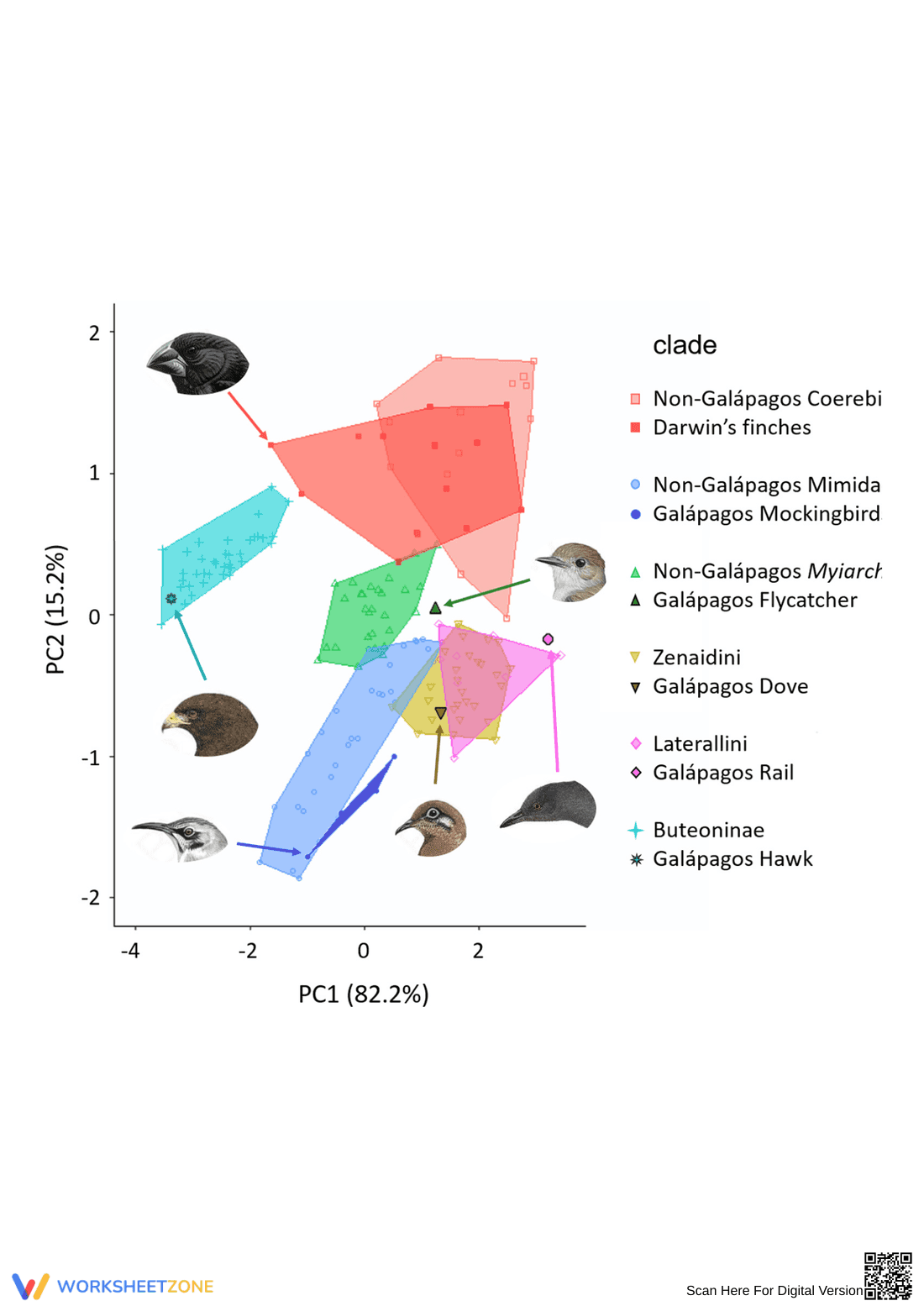
This is a cladogram-style diagram displaying the relationship between different bird species, particularly those found in the Galapagos Islands. It shows the relationships of birds such as Darwin's finches, Galapagos Mockingbird, Galapagos Dove, Galapagos Hawk, and others. The chart uses PC1 (82.2%) and PC2 (15.2%) as axes and uses colored polygons to group different clades of birds.
Grade Level Suitability:
This worksheet is suitable for high school (Grades 9-12) and introductory college-level biology courses. The content requires an understanding of evolutionary biology, cladograms, and potentially principal component analysis (PCA).
Why Use It:
This resource helps students visualize the evolutionary relationships between different bird species, understand the concept of clades, and interpret data presented in a graphical format. It can be used to illustrate the principles of adaptation, speciation, and biodiversity.
How to Use It:
Students can use this diagram to identify different bird clades, analyze the relationships between them, and discuss the evolutionary processes that might have led to these relationships. They can compare and contrast the characteristics of different bird species within and between clades. The diagram can also be used as a starting point for research projects on Galapagos birds.
Target Users:
This worksheet is designed for high school biology students, college students studying evolutionary biology or ecology, and educators looking for visual aids to teach cladistics and evolutionary relationships.
This is a cladogram-style diagram displaying the relationship between different bird species, particularly those found in the Galapagos Islands. It shows the relationships of birds such as Darwin's finches, Galapagos Mockingbird, Galapagos Dove, Galapagos Hawk, and others. The chart uses PC1 (82.2%) and PC2 (15.2%) as axes and uses colored polygons to group different clades of birds.
Grade Level Suitability:
This worksheet is suitable for high school (Grades 9-12) and introductory college-level biology courses. The content requires an understanding of evolutionary biology, cladograms, and potentially principal component analysis (PCA).
Why Use It:
This resource helps students visualize the evolutionary relationships between different bird species, understand the concept of clades, and interpret data presented in a graphical format. It can be used to illustrate the principles of adaptation, speciation, and biodiversity.
How to Use It:
Students can use this diagram to identify different bird clades, analyze the relationships between them, and discuss the evolutionary processes that might have led to these relationships. They can compare and contrast the characteristics of different bird species within and between clades. The diagram can also be used as a starting point for research projects on Galapagos birds.
Target Users:
This worksheet is designed for high school biology students, college students studying evolutionary biology or ecology, and educators looking for visual aids to teach cladistics and evolutionary relationships.


