


























1 / 3
0
Views
0
Downloads

0.0
0
Save
0 Likes
Share
Dalton's Law of Partial Pressure
0 Views
0 Downloads
Paste this activity's link or code into your existing LMS (Google Classroom, Canvas, Teams, Schoology, Moodle, etc.).
Students can open and work on the activity right away, with no student login required.
You'll still be able to track student progress and results from your teacher account.
Information
Description
What It Is:
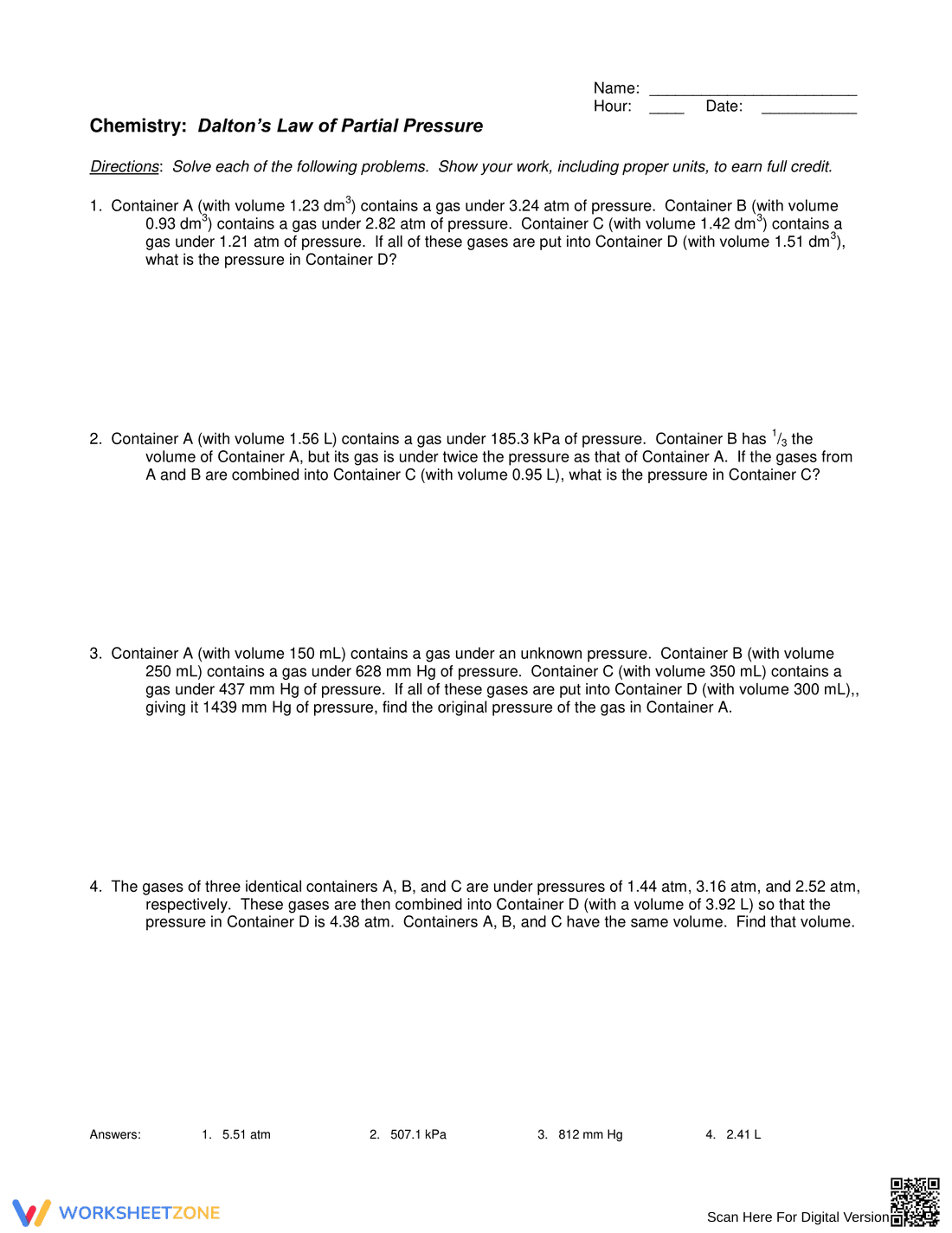
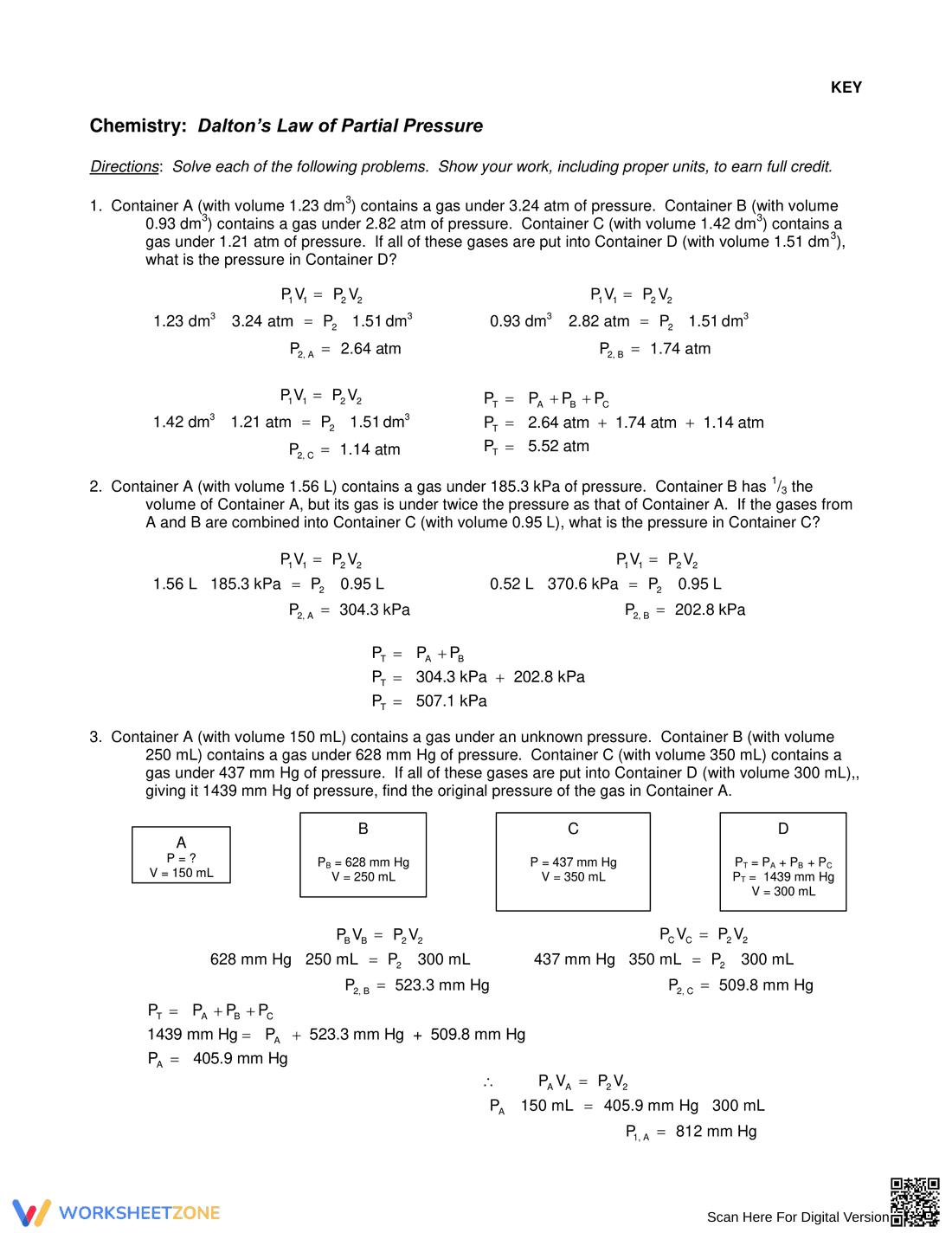
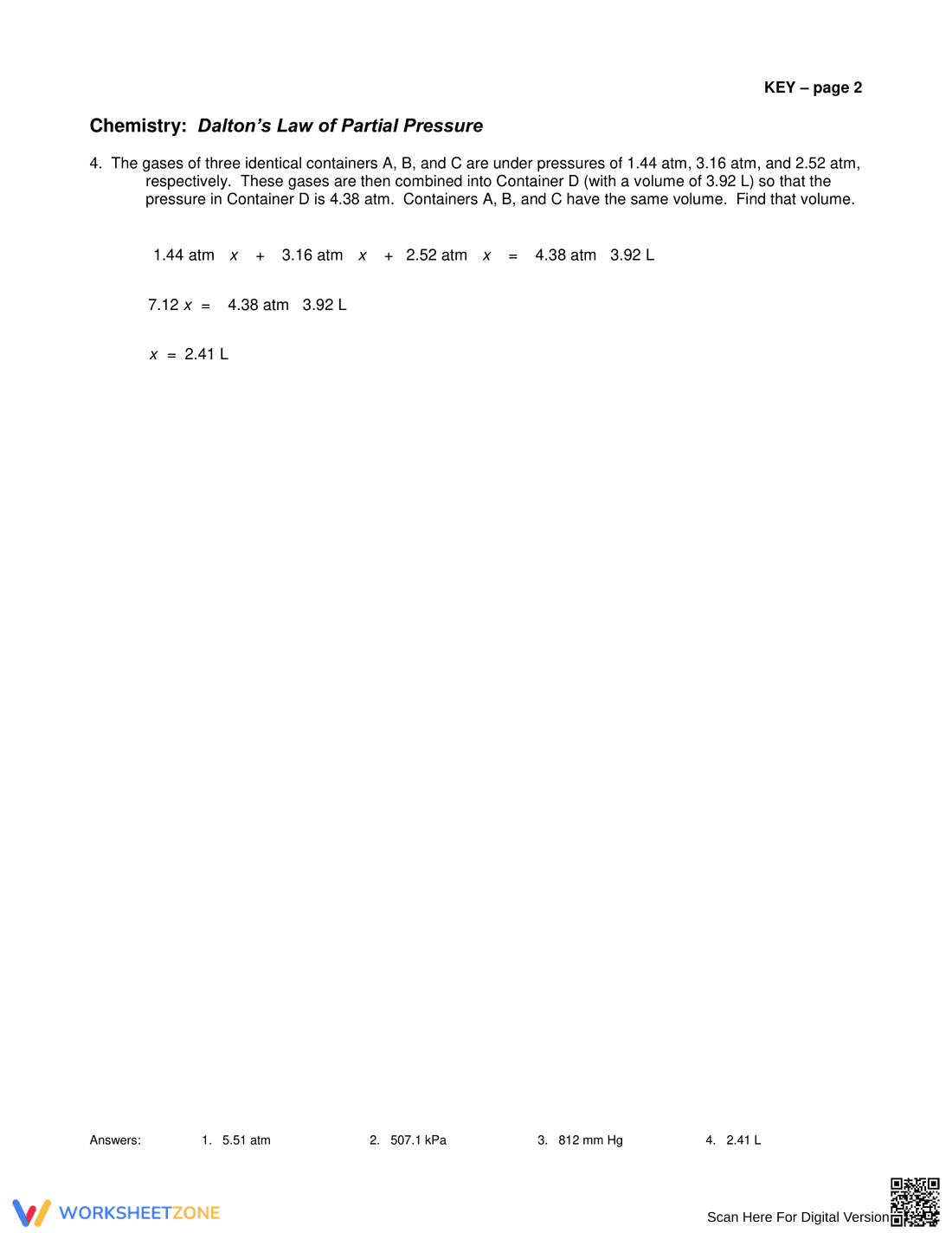
This is a chemistry worksheet focused on Dalton's Law of Partial Pressures. It presents four quantitative problems involving the calculation of partial pressures in different containers, with varying volumes and initial pressures. Students are instructed to show their work and include proper units.
Grade Level Suitability:
Suitable for high school students, specifically grades 11-12, or introductory college chemistry courses. The problems require an understanding of gas laws, unit conversions, and algebraic manipulation, which are typically covered in these grades.
Why Use It:
This worksheet provides practice in applying Dalton's Law of Partial Pressures to solve quantitative problems. It reinforces the concepts of pressure, volume, and their relationships in gas mixtures. It also develops problem-solving skills and the ability to perform unit conversions.
How to Use It:
Students should read each problem carefully, identify the given information (volumes and pressures), and apply Dalton's Law (Ptotal = P1 + P2 + ...). They need to show all steps of their calculations, including unit conversions, and provide the final answer with the correct units.
Target Users:
High school chemistry students, college students in introductory chemistry courses, and teachers looking for practice problems on Dalton's Law of Partial Pressures.
This is a chemistry worksheet focused on Dalton's Law of Partial Pressures. It presents four quantitative problems involving the calculation of partial pressures in different containers, with varying volumes and initial pressures. Students are instructed to show their work and include proper units.
Grade Level Suitability:
Suitable for high school students, specifically grades 11-12, or introductory college chemistry courses. The problems require an understanding of gas laws, unit conversions, and algebraic manipulation, which are typically covered in these grades.
Why Use It:
This worksheet provides practice in applying Dalton's Law of Partial Pressures to solve quantitative problems. It reinforces the concepts of pressure, volume, and their relationships in gas mixtures. It also develops problem-solving skills and the ability to perform unit conversions.
How to Use It:
Students should read each problem carefully, identify the given information (volumes and pressures), and apply Dalton's Law (Ptotal = P1 + P2 + ...). They need to show all steps of their calculations, including unit conversions, and provide the final answer with the correct units.
Target Users:
High school chemistry students, college students in introductory chemistry courses, and teachers looking for practice problems on Dalton's Law of Partial Pressures.


