


























Views
Downloads


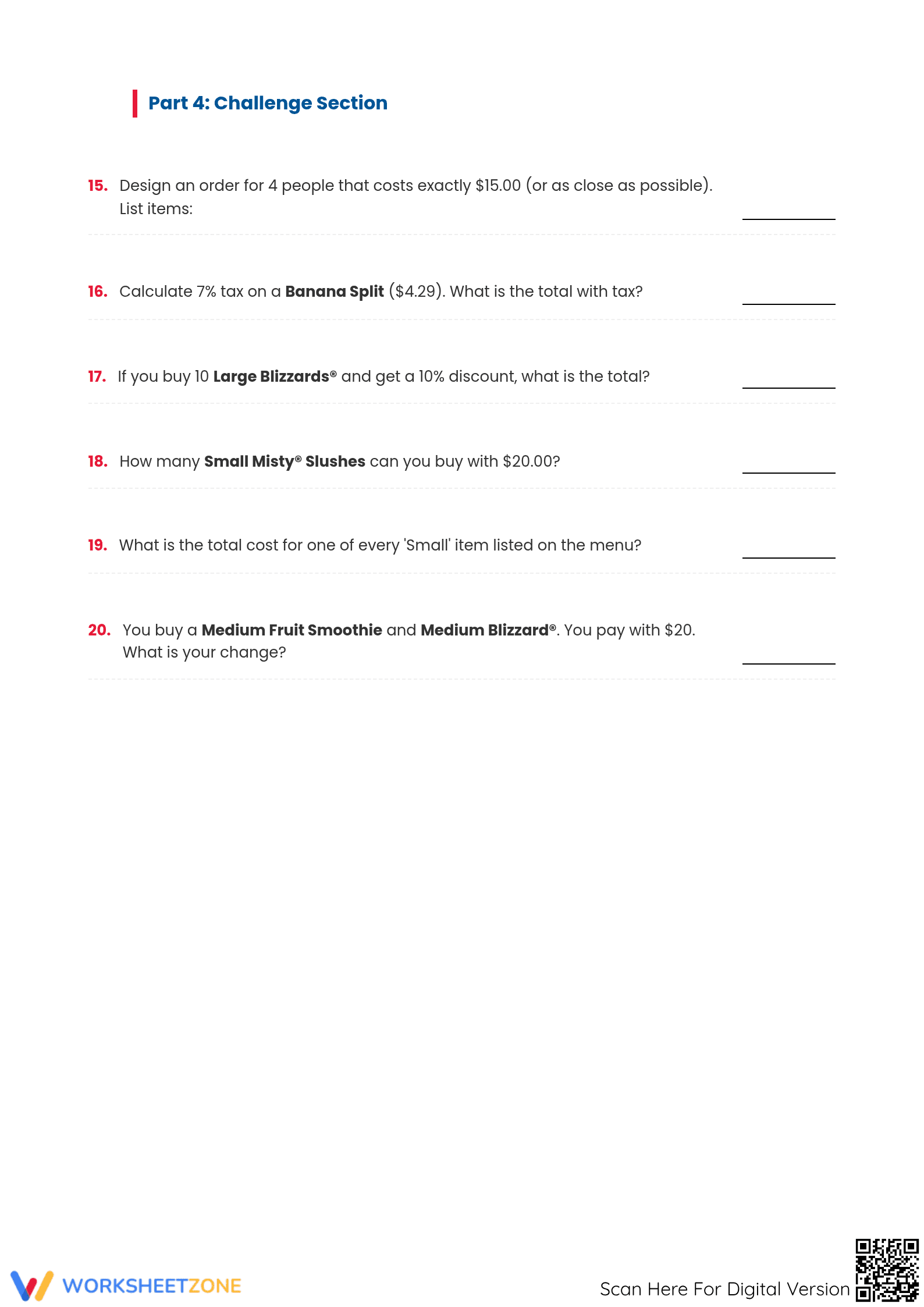

Grade 5 Menu Math — Printable No-Prep Worksheet
Paste this activity's link or code into your existing LMS (Google Classroom, Canvas, Teams, Schoology, Moodle, etc.).
Students can open and work on the activity right away, with no student login required.
You'll still be able to track student progress and results from your teacher account.
This real-world math worksheet helps students in Grade 5 and up practice calculating costs using a familiar menu. Students work through 30 multi-step problems, applying decimal addition and multiplication to find totals. It's a practical resource for building functional math and financial literacy skills.
At a Glance
- Grade: 5–8 · Subject: Math (Life Skills)
- Standard:
CCSS.MATH.CONTENT.5.NBT.B.7— Add, subtract, multiply, and divide decimals to hundredths.- Skill Focus: Calculating money totals, decimal operations
- Format: 3 pages · 30 problems · Answer key included · PDF
- Best For: Independent practice, life skills units, sub plans
- Time: 20–30 minutes
What's Inside
This resource contains a three-page printable worksheet featuring a realistic food menu. Across the three pages, students are given 30 unique order scenarios where they must calculate the total cost. A complete, easy-to-use answer key is provided for all 30 problems, making grading fast and simple.
A Zero-Prep Workflow
This worksheet is ready to use in minutes. The workflow is simple:
- Print (1 min): Print the three student pages and the answer key. No complex assembly needed.
- Distribute (1 min): The directions are self-contained, allowing for minimal teacher instruction.
- Review (5 mins): Use the answer key to quickly review answers or allow for student self-checking.
Standards Alignment
This worksheet is directly aligned with CCSS math standard CCSS.MATH.CONTENT.5.NBT.B.7, which focuses on performing operations with multi-digit whole numbers and with decimals to hundredths. It provides an application-based context for this essential skill. Both standard codes can be copied directly into lesson plans, IEP goals, or district curriculum mapping tools.
How to Use It
Use this worksheet as independent practice after a lesson on decimal operations to check for application. It also serves as a great pre-assessment to gauge students' existing comfort with money calculations before a financial literacy unit. For a formative assessment, circulate as students work to observe their strategies. Are they aligning decimals correctly? Most students will complete the worksheet in 20 to 30 minutes.
Who It's For
This resource is for students in grades 5-8 working on decimal operations and functional math skills. It is highly effective for learners who benefit from concrete, relatable examples, such as in a special education setting. The clear layout makes it accessible. Pair this worksheet with a lesson on budgeting or an anchor chart showing decimal place value to reinforce concepts.
Proficiency with decimal operations is a critical step toward financial capability. This worksheet, aligned with CCSS.MATH.CONTENT.5.NBT.B.7, provides focused practice on the procedural fluency needed to solve real-world problems involving money. It connects abstract mathematical procedures to tangible scenarios by asking students to calculate totals from a menu. Research consistently shows the importance of such applied problem-solving. The RAND AIRS 2024 report stresses that mathematics instruction should build connections between concepts and applications, ensuring students know how to perform a calculation and when to use it. This resource supports that goal by grounding decimal multiplication and addition in the practical context of ordering food. It is a valuable tool for building both mathematical competence and functional independence.


