




























Views
Downloads

Curved Lines Tracing: Printable Preschool Worksheet

Paste this activity's link or code into your existing LMS (Google Classroom, Canvas, Teams, Schoology, Moodle, etc.).
Students can open and work on the activity right away, with no student login required.
You'll still be able to track student progress and results from your teacher account.
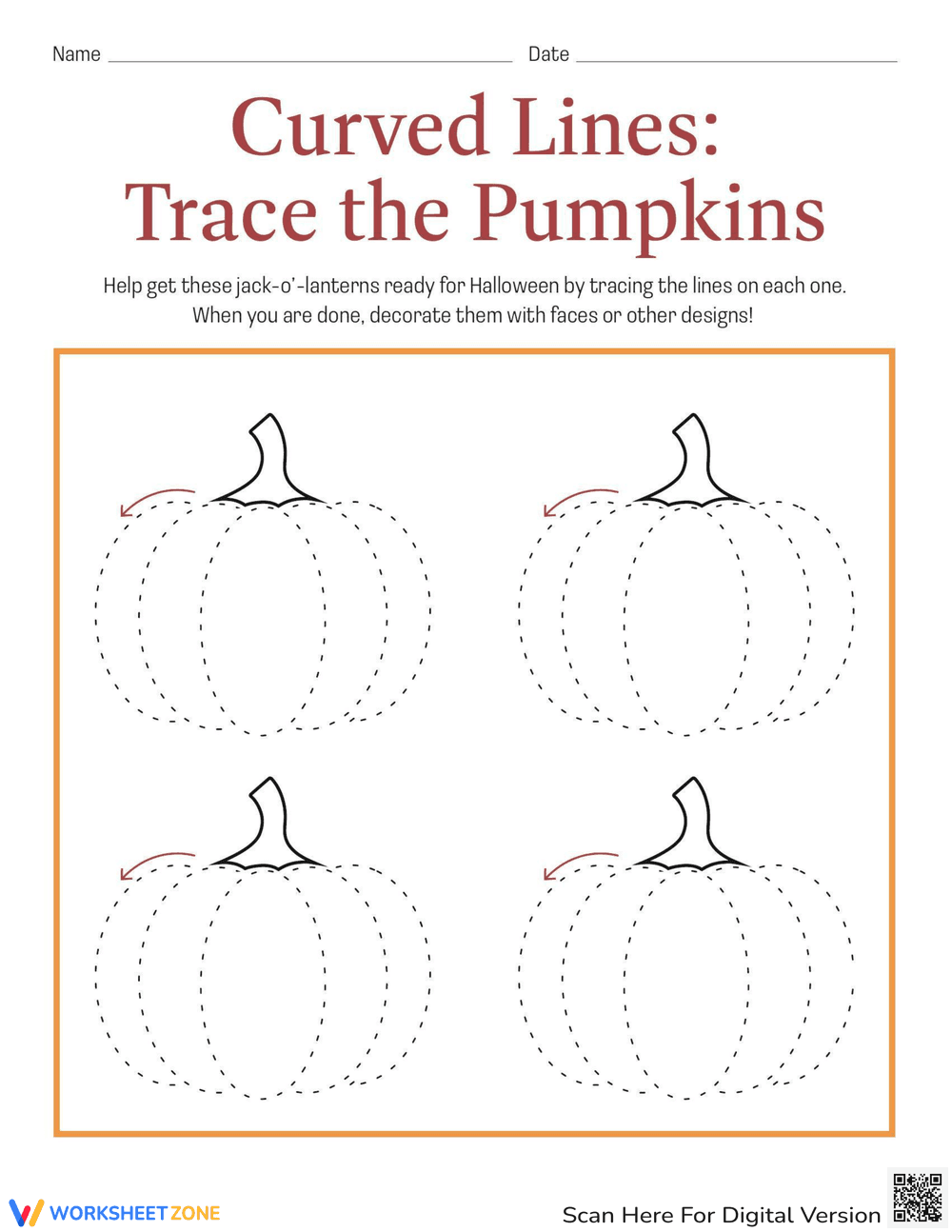
This printable preschool tracing worksheet helps early learners develop essential fine motor control by tracing curved lines on four festive pumpkins. Students practice pencil grip and directional tracking, preparing them for future handwriting success. This seasonal activity combines skill development with creative coloring.
At a Glance
- Grade: Preschool · Subject: Early Literacy
- Standard:
CCSS.ELA-LITERACY.RF.K.1.A— Follow words from left to right, top to bottom- Skill Focus: Curved line tracing and pencil control
- Format: 1 page · 4 tasks · No answer key required · PDF
- Best For: Morning work or fine motor practice
- Time: 10–15 minutes
This resource features a single-page layout containing four large pumpkin illustrations. Each pumpkin has dashed curved lines with directional arrows to guide the child's pencil strokes. The clean design minimizes visual distractions, allowing young learners to focus entirely on pencil control. Once tracing is complete, children can color the pumpkins or draw creative jack-o'-lantern faces.
Zero-Prep Workflow
This worksheet is designed for immediate classroom integration. First, print the single-page PDF, which takes less than one minute. Second, distribute the sheets to students along with pencils, requiring about one minute of setup. Third, review the completed worksheets visually as students color, taking only a few seconds per child. The entire preparation process takes under two minutes, making this ideal for emergency sub plans or morning arrival routines.
Standards Alignment
This activity aligns with the foundational print concepts in CCSS.ELA-LITERACY.RF.K.1.A, focusing on understanding that print is read and written from left to right and top to bottom. By following the directional arrows, students build the muscle memory necessary for formal writing. Both standard codes can be copied directly into lesson plans, IEP goals, or district curriculum mapping tools.
How to Use It
Use this worksheet during small-group instruction to observe pencil grip. Alternatively, assign it as an independent center activity during an autumn theme. For formative assessment, watch if students follow the directional arrows or struggle with the curved trajectory, noting who needs additional pre-writing support. The activity typically takes 10 to 15 minutes to complete.
Who It's For
This resource is tailored for preschoolers and kindergarteners developing early writing skills. It is also suitable for occupational therapy sessions targeting fine motor delays. Pair this worksheet with a read-aloud book about pumpkins or a direct instruction lesson on shapes to create a cohesive thematic unit.
This pre-writing worksheet supports early childhood physical development and print awareness. According to research from Fisher & Frey (2014), structured visual scaffolds like dashed lines and directional arrows help young learners transition from guided tracing to independent drawing. The task targets fine motor coordination, which is a critical predictor of later writing readiness. By practicing curved strokes, children build the specific hand muscles required to form letters like 'O', 'C', and 'U'. This resource aligns with standard CCSS.ELA-LITERACY.RF.K.1.A, helping educators track early print concepts and motor control. The simple layout ensures students remain focused on the physical task of pencil manipulation without cognitive overload. Teachers can easily integrate this tool into daily routines to support early literacy development.


