


























Views
Downloads

Cursive Letter Z Practice | Essential Kindergarten Guide
Paste this activity's link or code into your existing LMS (Google Classroom, Canvas, Teams, Schoology, Moodle, etc.).
Students can open and work on the activity right away, with no student login required.
You'll still be able to track student progress and results from your teacher account.
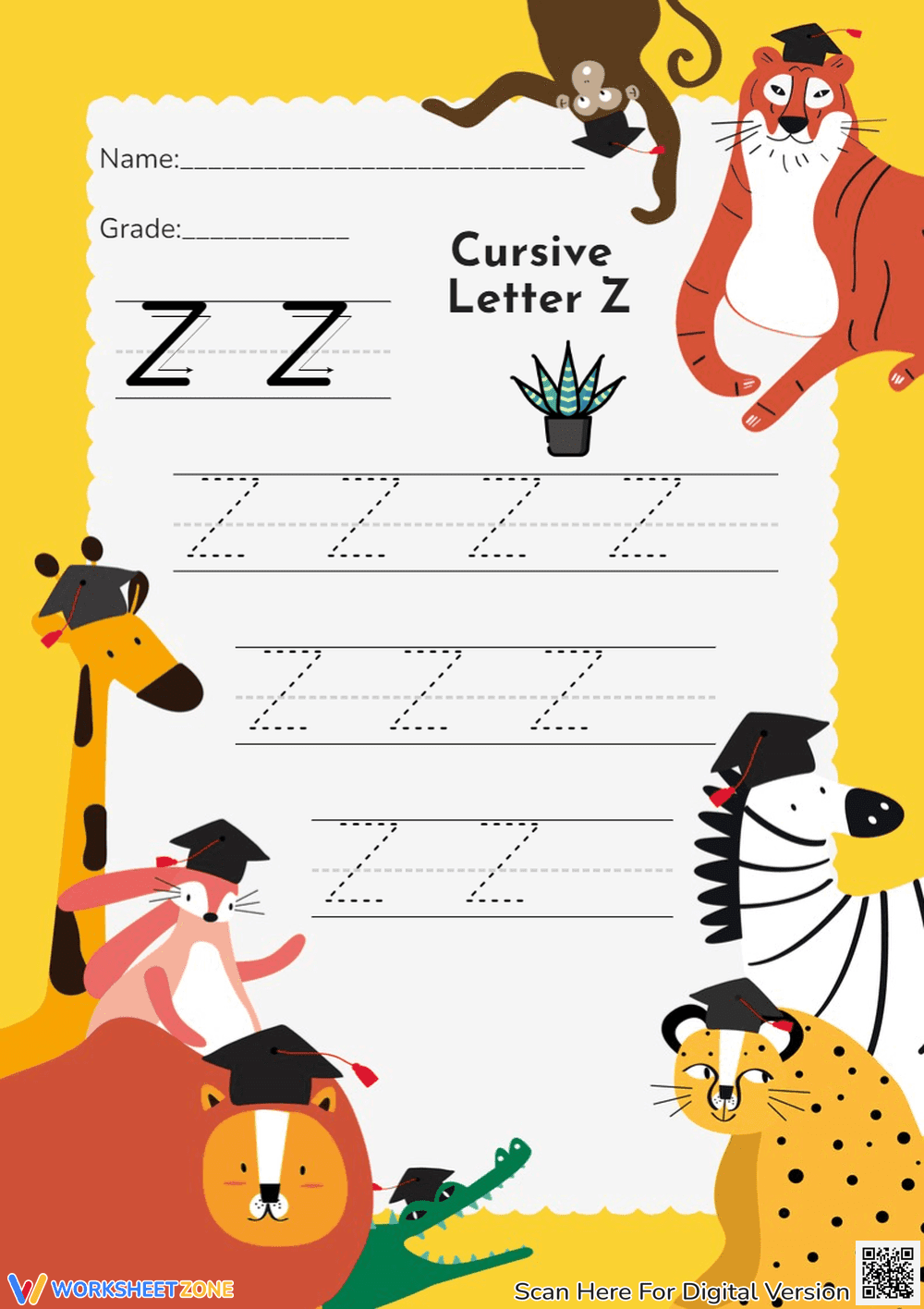
This Kindergarten cursive letter Z worksheet provides a structured environment for students to master the complex curves of uppercase cursive formation. By focusing on a single character, learners develop the muscle memory required for fluid handwriting. This resource ensures students achieve consistent letter height and slant through guided tracing paths.
At a Glance
- Grade: Kindergarten · Subject: Handwriting
- Standard:
CCSS.ELA-LITERACY.L.K.1.A— Print many upper- and lowercase letters with proper formation and spacing- Skill Focus: Cursive Letter Z Formation
- Format: 1 page · 9 tracing tasks · No-prep · PDF
- Best For: Daily morning work or handwriting centers
- Time: 5–10 minutes
The worksheet features a clean, zoo-themed layout designed to engage young learners without causing visual distraction. It includes one large exemplar for visual reference followed by three rows of dashed-line tracing guides. The 1-page PDF format is optimized for high-contrast printing, ensuring the directional arrows and dotted lines remain clear for students during independent work.
This resource is designed for a zero-prep classroom workflow. Teachers can print the single-page PDF in less than 30 seconds. Distribution takes approximately 1 minute during transition periods. Reviewing student work is instantaneous, as the tracing paths provide immediate visual feedback on stroke accuracy. Total teacher preparation time is under 2 minutes, making it an ideal sub-plan addition for literacy blocks.
Aligned to CCSS.ELA-LITERACY.L.K.1.A, this worksheet focuses on the foundational requirement to "Print many upper- and lowercase letters." While specifically targeting cursive, it supports the broader linguistic goal of letter recognition and production. Both standard codes can be copied directly into lesson plans, IEP goals, or district curriculum mapping tools to document student progress in fine motor development.
Use this worksheet during the "You Do" phase of a gradual release handwriting lesson. After demonstrating the stroke sequence on a whiteboard, assign this page for independent practice. It also serves as an effective formative assessment tool; observe students to see if they begin the 'Z' at the correct midline or header point. Completion typically takes 5 to 10 minutes depending on the student's motor control level.
This practice sheet is tailored for Kindergarten students and advanced Preschoolers ready for cursive introduction. It is particularly beneficial for students requiring fine motor intervention or occupational therapy support. Pair this with a cursive alphabet anchor chart or a tactile sand-tray activity to reinforce the letter's unique shape before moving to paper-based practice.
According to Fisher & Frey (2014), the gradual release of responsibility is most effective when students have access to high-quality, scaffolded practice materials that isolate specific skills. This worksheet isolates the cursive letter Z, providing 9 specific tracing opportunities to build the neural pathways necessary for automaticity in writing. Research from the NAEP suggests that students who develop early handwriting fluency are better equipped to focus on higher-order compositional tasks in later grades. By utilizing standard CCSS.ELA-LITERACY.L.K.1.A, educators ensure that even early cursive exposure remains grounded in rigorous literacy frameworks. The inclusion of visual cues and repetitive tracing paths aligns with evidence-based practices for motor skill acquisition in early childhood education. This resource provides the necessary repetition to move from guided imitation to independent production of complex characters.


