


























Views
Plays

Critical Literacy Worksheet | Grade 11 Essential Guide
Paste this activity's link or code into your existing LMS (Google Classroom, Canvas, Teams, Schoology, Moodle, etc.).
Students can open and work on the activity right away, with no student login required.
You'll still be able to track student progress and results from your teacher account.
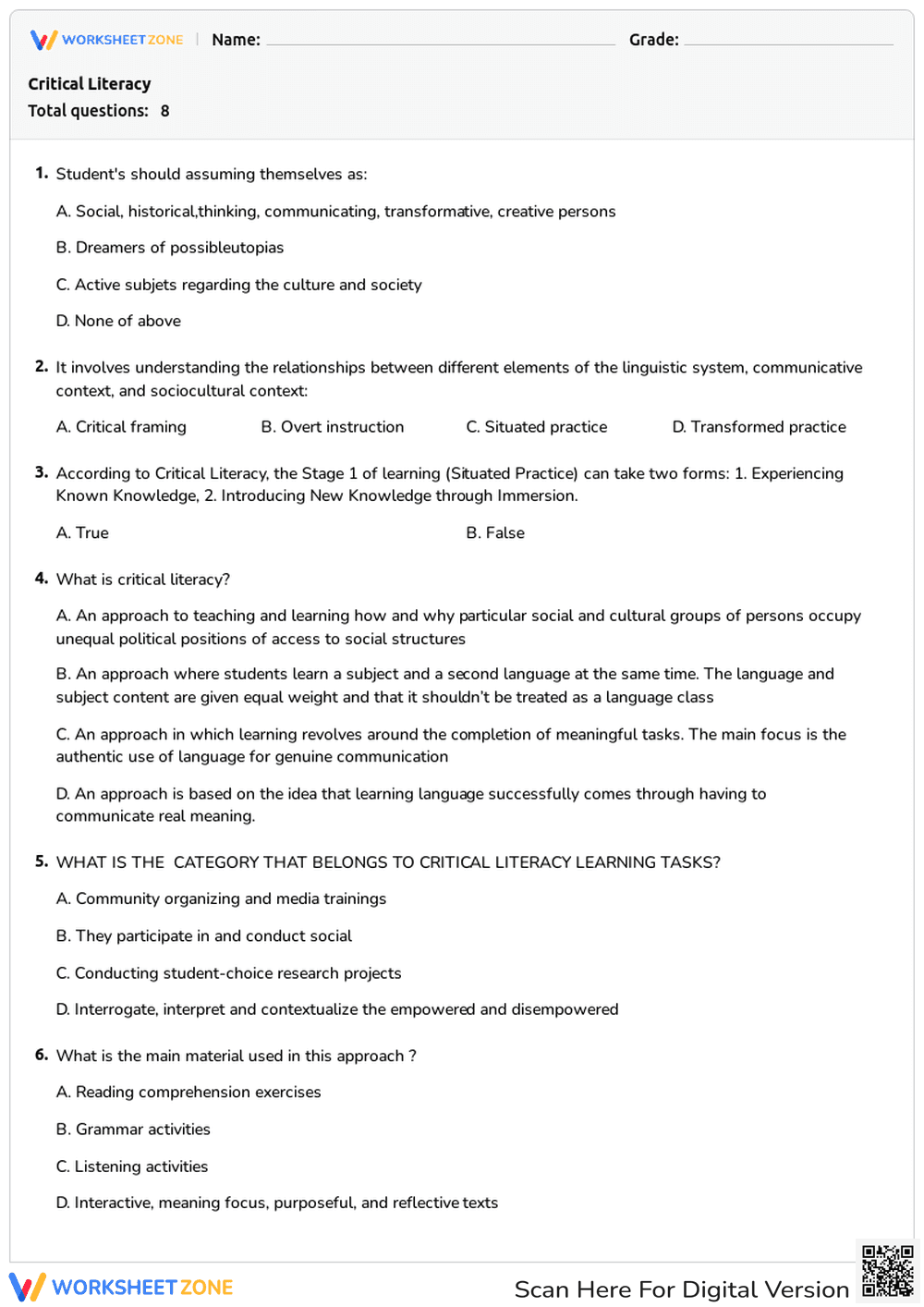
This Grade 11 Critical Literacy worksheet provides a structured assessment for students to evaluate their understanding of how texts function within social and cultural power structures. By focusing on the active role of the reader, students learn to move beyond surface-level comprehension to deconstruct the underlying messages and communicative contexts of various media. This resource ensures students can identify the relationships between linguistic systems and sociocultural positions.
At a Glance
- Grade: 11 · Subject: ELA
- Standard:
CCSS.ELA-LITERACY.RI.11-12.6— Determine an author's point of view or purpose and analyze rhetorical effectiveness- Skill Focus: Critical Literacy & Pedagogy
- Format: 2 pages · 8 problems · Answer key included · PDF
- Best For: Formative assessment or introductory quiz
- Time: 15–20 minutes
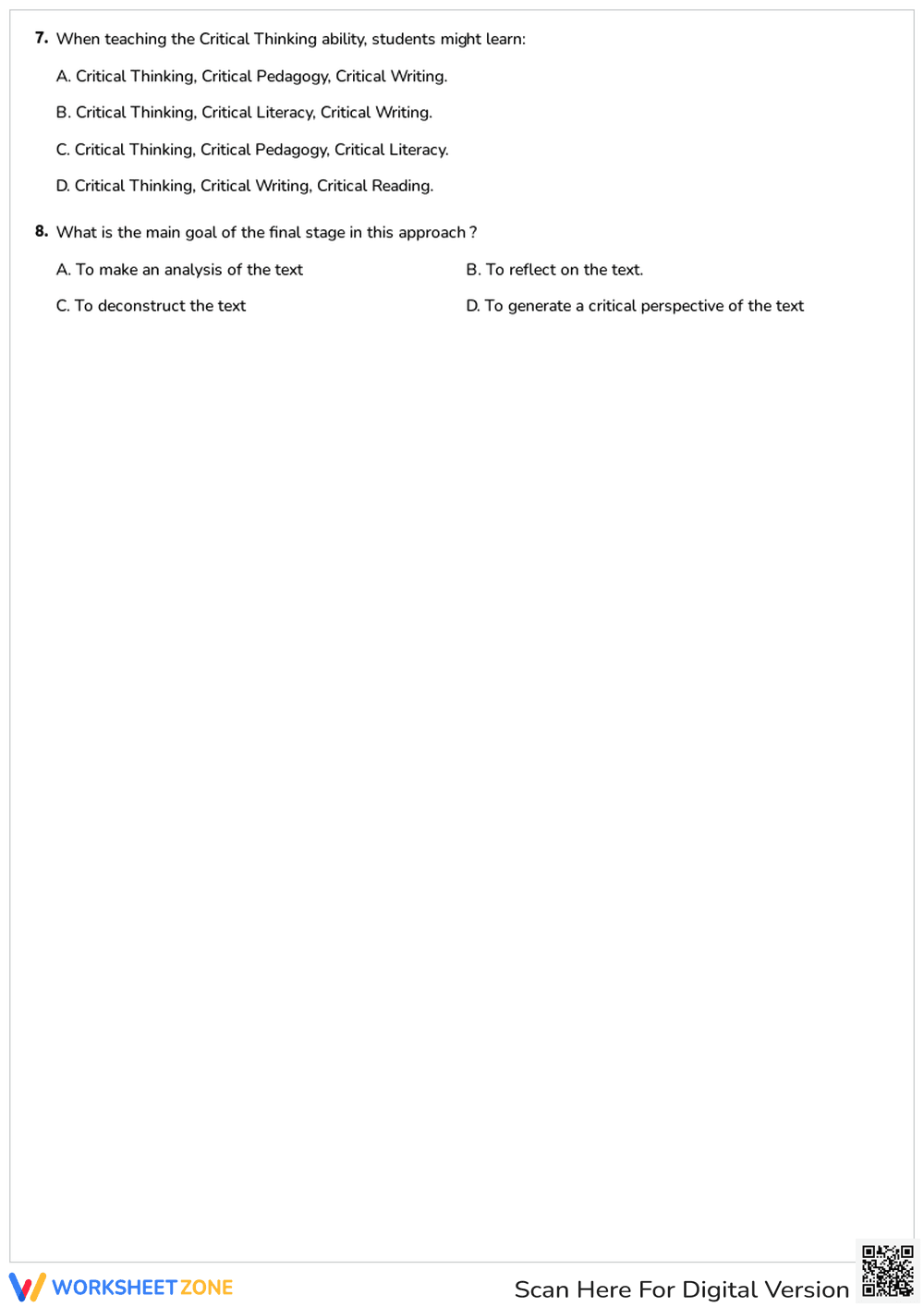
What's Inside: This two-page PDF features 8 high-level multiple-choice questions designed to test conceptual knowledge of critical literacy frameworks. The tasks cover essential terminology such as situated practice, critical framing, and the final stages of text deconstruction. The layout is clean and professional, providing ample space for student names and grades, with a clear focus on reflective and purposeful text analysis.
Zero-Prep Workflow: This resource is designed for immediate classroom implementation. First, print the two-page document (1 minute). Next, distribute the quiz to students as a bell-ringer or exit ticket to gauge their understanding of critical pedagogy (1 minute). Finally, review the answers using the included key to provide immediate feedback on student mastery of complex sociocultural concepts (5 minutes). This makes it an ideal choice for unexpected sub plans or quick checks for understanding.
Standards Alignment: This worksheet aligns primarily with `CCSS.ELA-LITERACY.RI.11-12.6`, which requires students to determine an author's point of view or purpose in a text and analyze how style and content contribute to its power. It also supports standards related to evaluating the premises and evidence in complex informational texts. Both standard codes can be copied directly into lesson plans, IEP goals, or district curriculum mapping tools.
How to Use It: Use this worksheet during the introductory phase of a media literacy or rhetoric unit to establish a baseline of student knowledge. It serves as an excellent formative assessment tool after a lecture on critical theory. Teachers should observe whether students can distinguish between "situated practice" and "critical framing" to identify which learners may need additional scaffolding with academic vocabulary. Completion typically takes 15 to 20 minutes.
Who It's For: This resource is tailored for Grade 11 and 12 students in ELA, AP Language, or Social Studies courses. It is particularly effective for learners who are beginning to explore the intersection of language and social justice. Pair this worksheet with a contemporary news article or a persuasive essay to allow students to apply these theoretical concepts to a real-world text immediately after the quiz.
Critical literacy is a fundamental component of modern secondary education, as it empowers students to interrogate the power dynamics inherent in all forms of communication. According to Fisher & Frey (2014), the ability to deconstruct texts and understand the sociocultural context is vital for developing independent thinkers who can participate actively in a democratic society. This worksheet addresses the need for structured practice in identifying how social and cultural groups occupy unequal positions of access within social structures. By utilizing 8 targeted questions, the resource ensures that students are not merely passive recipients of information but are instead trained to be active subjects of their culture. The focus on interactive and reflective texts aligns with current research suggesting that critical thinking skills are best developed through the interrogation of empowered and disempowered narratives. This alignment with CCSS.ELA-LITERACY.RI.11-12.6 provides a rigorous framework for academic success.


