


























Views
Downloads

Crack the Code 3: Essential Vocabulary & Logic Worksheet
Paste this activity's link or code into your existing LMS (Google Classroom, Canvas, Teams, Schoology, Moodle, etc.).
Students can open and work on the activity right away, with no student login required.
You'll still be able to track student progress and results from your teacher account.
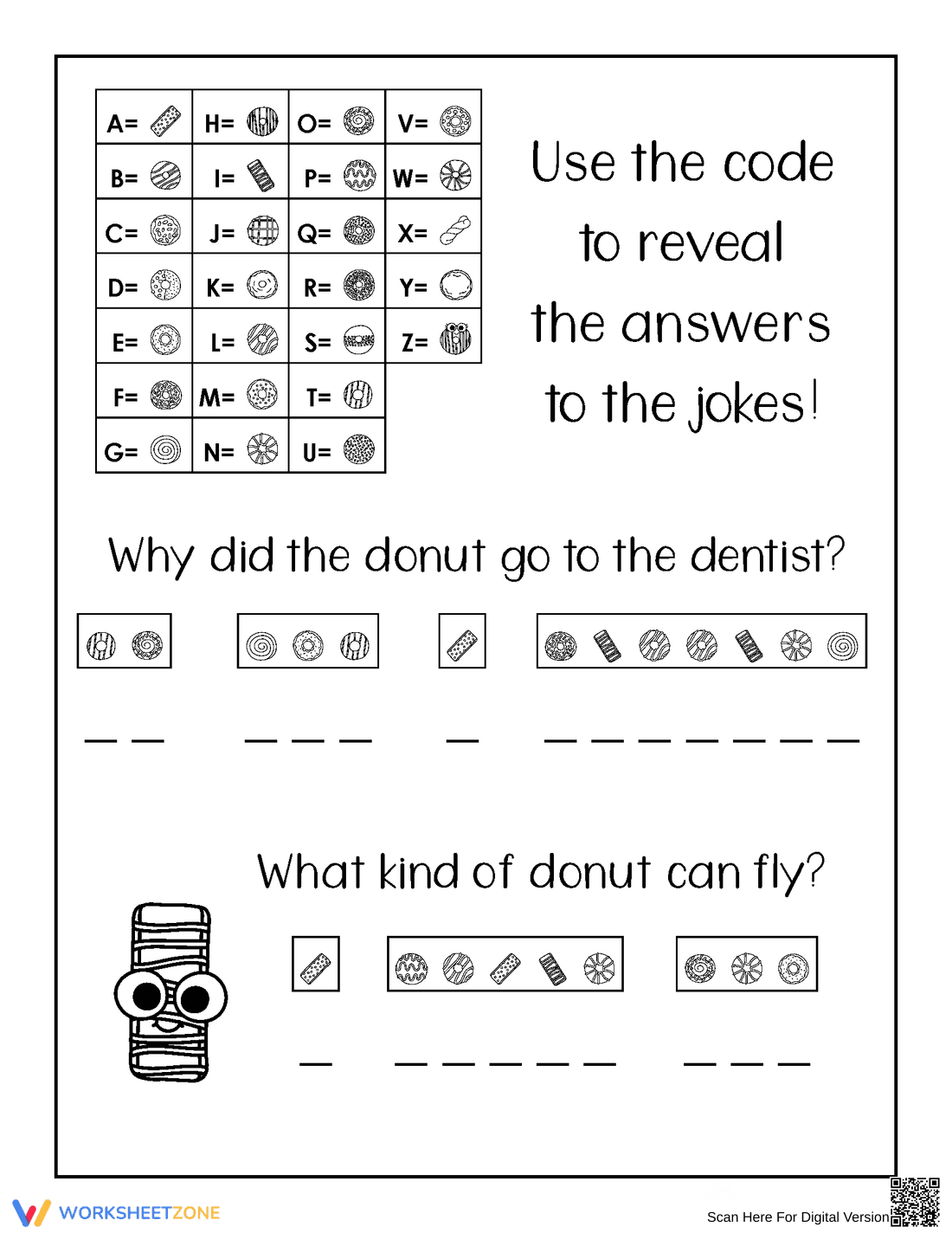
This Grade 7-9 English worksheet challenges students to decode donut-themed riddles using a symbol-to-letter key. By engaging in this pattern recognition task, learners strengthen their spelling accuracy and cognitive flexibility. It provides a fun, low-stakes environment for students to apply linguistic logic to solve humorous word puzzles.
At a Glance
- Grade: 7-9 · Subject: English
- Standard:
CCSS.ELA-LITERACY.L.7.4— Determine the meaning of words and phrases through context and decoding- Skill Focus: Symbol-to-letter decoding
- Format: 1 page · 2 riddles · Answer key included · PDF
- Best For: Warm-ups, early finishers, or sub plans
- Time: 10–15 minutes
Inside this single-page PDF, students will find a comprehensive symbol key where each letter of the alphabet is represented by a unique donut graphic. Below the key are two specific riddles with blank lines for letter placement. The layout is clean and high-contrast, ensuring that the visual symbols are easy to distinguish for all learners.
Zero-Prep Workflow
- Print: Select the single-page PDF and print enough copies for your class (30 seconds).
- Distribute: Hand out the sheets as students enter the room or finish a primary task (1 minute).
- Review: Go over the solved riddles as a whole class to check for spelling and logic (2 minutes).
Total teacher preparation time is under two minutes, making this an ideal resource for unexpected schedule changes or sub plans.
This resource aligns with CCSS.ELA-LITERACY.L.7.4, which focuses on determining or clarifying the meaning of unknown and multiple-meaning words and phrases. While the primary task is decoding, it reinforces the structural components of English spelling and word formation. This standard code can be copied directly into lesson plans, IEP goals, or district curriculum mapping tools.
Use this worksheet as a "bell-ringer" to settle the class during the first ten minutes of a period. It also serves as an excellent formative assessment for observation; teachers can identify students who struggle with visual tracking or pattern recognition. Expect most middle school students to complete both riddles within 12 minutes of focused work.
This activity is ideal for general education students in grades 7 through 9, as well as English Language Learners (ELL) who benefit from visual-to-text associations. It pairs naturally with a vocabulary anchor chart or a direct instruction lesson on word roots and suffixes. The donut theme provides a relatable, non-intimidating entry point for reluctant readers.
According to the RAND AIRS 2024 report on supplemental instructional materials, gamified decoding tasks like those found in this worksheet significantly increase student engagement in secondary literacy blocks. By utilizing the CCSS.ELA-LITERACY.L.7.4 framework, this resource bridges the gap between rote spelling practice and cognitive problem-solving. The use of symbol-to-letter mapping requires students to maintain high levels of attention to detail, a prerequisite for complex textual analysis. Research indicates that these brief, high-interest activities can reduce transition friction in middle school classrooms by providing immediate, achievable goals. This worksheet offers a structured approach to linguistic logic that supports broader literacy development across the curriculum. Educators can rely on this tool to provide consistent, standards-aligned practice that fits into any instructional schedule without requiring extensive setup or specialized materials.


