


























0
Views
0
Downloads

0.0
0
Save
0 Likes
Share
Practice Counting Objects Worksheet
0 Views
0 Downloads
Paste this activity's link or code into your existing LMS (Google Classroom, Canvas, Teams, Schoology, Moodle, etc.).
Students can open and work on the activity right away, with no student login required.
You'll still be able to track student progress and results from your teacher account.
Information
Description
What It Is:
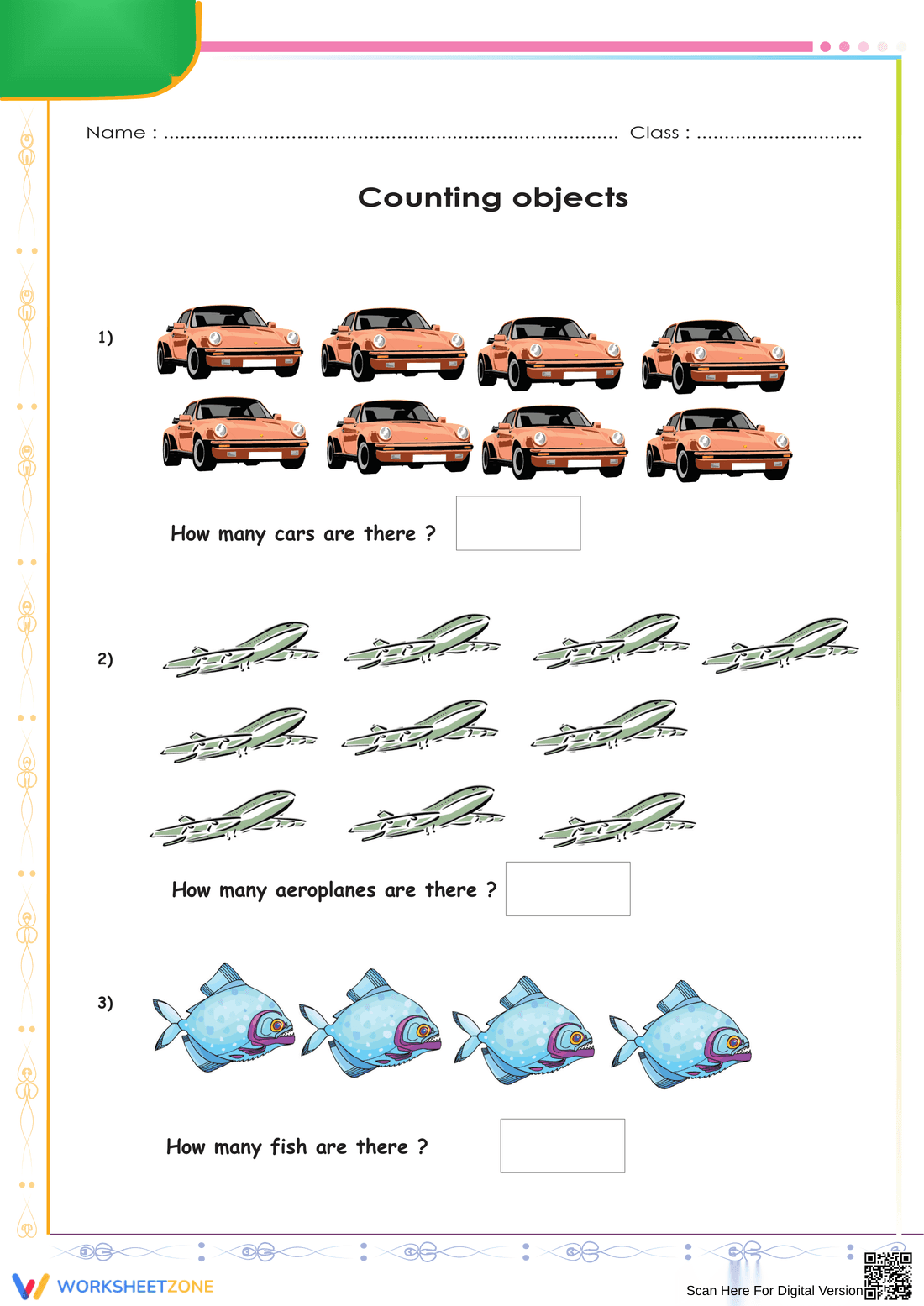
This is a counting worksheet for young children. It features three sections, each displaying a different set of objects: cars, airplanes, and fish. Under each set of objects, there is a question 'How many [object] are there?' followed by a blank space for the child to write the answer. There are 8 cars, 12 airplanes, and 4 fish.
Grade Level Suitability:
This worksheet is suitable for Pre-K and Kindergarten. The counting task involves relatively small numbers and uses visually engaging objects, making it appropriate for children learning basic number recognition and counting skills.
Why Use It:
This worksheet helps develop early numeracy skills, specifically counting and number recognition. It reinforces the one-to-one correspondence principle and helps children associate numbers with quantities of objects. It improves visual discrimination and attention to detail.
How to Use It:
Instruct the child to count the number of objects in each row. Encourage them to point to each object as they count. Then, have them write the corresponding number in the blank space provided after the question.
Target Users:
The target users are preschool and kindergarten children learning to count and recognize numbers. It is also suitable for children with learning disabilities who need extra practice with basic counting skills.
This is a counting worksheet for young children. It features three sections, each displaying a different set of objects: cars, airplanes, and fish. Under each set of objects, there is a question 'How many [object] are there?' followed by a blank space for the child to write the answer. There are 8 cars, 12 airplanes, and 4 fish.
Grade Level Suitability:
This worksheet is suitable for Pre-K and Kindergarten. The counting task involves relatively small numbers and uses visually engaging objects, making it appropriate for children learning basic number recognition and counting skills.
Why Use It:
This worksheet helps develop early numeracy skills, specifically counting and number recognition. It reinforces the one-to-one correspondence principle and helps children associate numbers with quantities of objects. It improves visual discrimination and attention to detail.
How to Use It:
Instruct the child to count the number of objects in each row. Encourage them to point to each object as they count. Then, have them write the corresponding number in the blank space provided after the question.
Target Users:
The target users are preschool and kindergarten children learning to count and recognize numbers. It is also suitable for children with learning disabilities who need extra practice with basic counting skills.


