


























Views
Downloads

Printable Counting Animals & Number Recognition
Paste this activity's link or code into your existing LMS (Google Classroom, Canvas, Teams, Schoology, Moodle, etc.).
Students can open and work on the activity right away, with no student login required.
You'll still be able to track student progress and results from your teacher account.
Help young mathematicians master the fundamentals of cardinality and numeral identification with this comprehensive "Counting Animals & Number Recognition" packet. By engaging with familiar sea creatures, students bridge the gap between concrete counting and abstract symbols. This activity set ensures that learners don't just memorize sequences but truly understand the quantity represented by each number.
At a Glance
- Grade: Kindergarten · Subject: Math
- Standard:
K.CC.B.5— Count to answer "how many?" questions about as many as 20 things- Skill Focus: One-to-one correspondence and cardinality
- Format: 3 pages · 14 tasks · Answer key included · PDF
- Best For: Early morning work or centers
- Time: 15–20 minutes
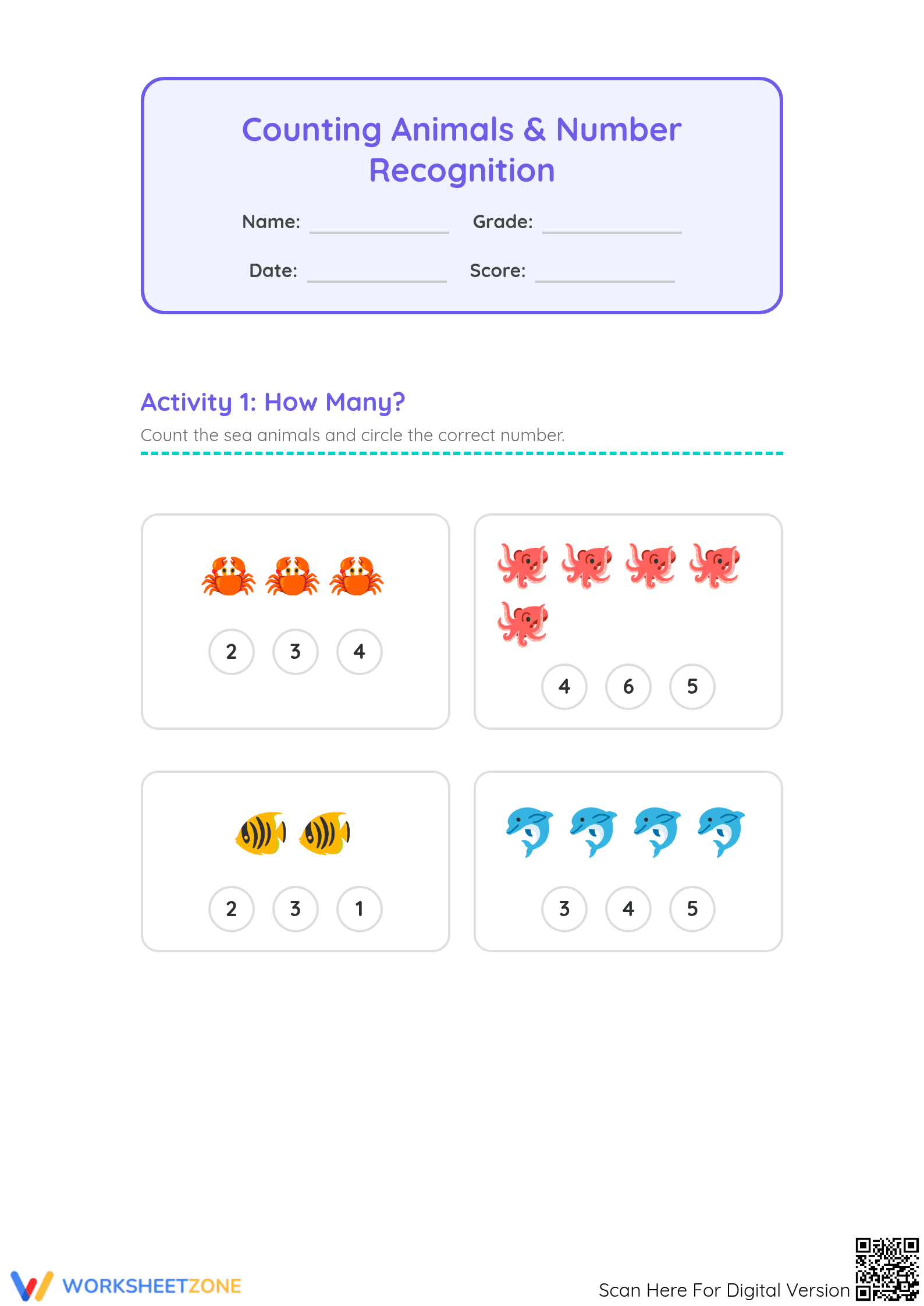
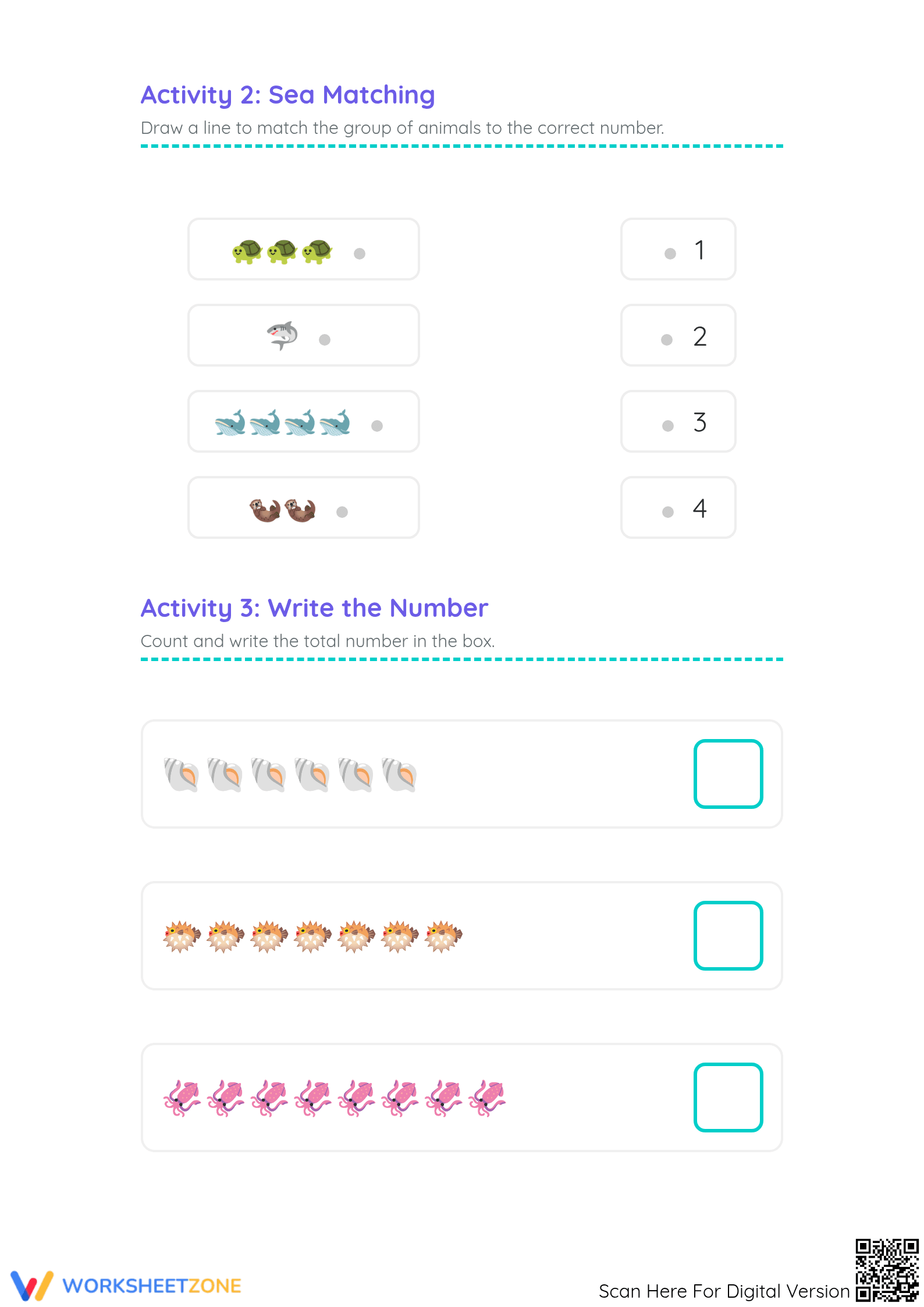
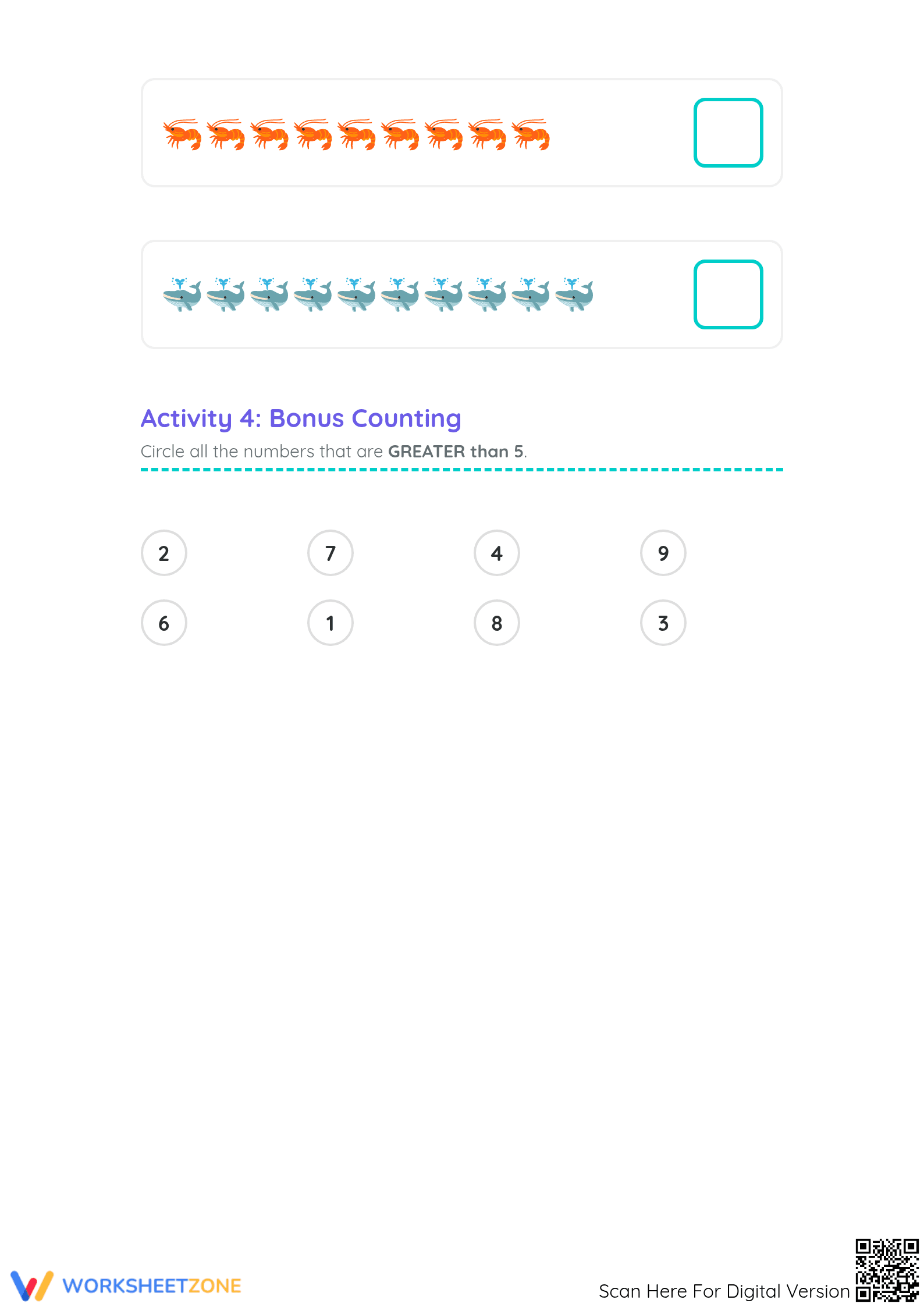
This three-page resource features four distinct activity types designed to reinforce early numeracy. The first page presents multiple-choice counting with crabs, octopuses, fish, and dolphins. Page two transitions to line-matching and independent numeral writing for groups up to ten. The final page concludes with a higher-order thinking "bonus" task where students compare values to identify numbers greater than five. A full answer key is provided for rapid checking.
Implementing this resource requires minimal effort from the instructor. First, select the "Print" option for the 3-page PDF, which takes less than thirty seconds. Second, "Distribute" the packets to students; because the instructions are visual and intuitive, most children can begin immediately without a lengthy verbal introduction. Third, "Review" student work using the included answer key to identify common misconceptions in one-to-one correspondence in under two minutes.
The primary focus of this worksheet is CCSS.MATH.CONTENT.K.CC.B.5, which requires students to count to answer "how many?" questions about things arranged in a line, a rectangular array, or a circle. It also supports K.CC.B.4 by reinforcing the concept that the last number name said tells the number of objects counted. Both standard codes can be copied directly into lesson plans, IEP goals, or district curriculum mapping tools.
Use this packet as a summative assessment after a unit on counting to ten. As students work through the "Write the Number" section, circulate the room to observe if they are marking counted items to avoid double-counting—a key indicator of procedural mastery. Alternatively, utilize the "Bonus Counting" section as a quick entrance ticket for a subsequent lesson on comparing numbers. Most students complete the full set in approximately 18 minutes.
This resource is designed for Preschool and Kindergarten students who are developing their initial sense of number. It is particularly effective for English Language Learners (ELLs) due to the heavy reliance on visual icons rather than text-heavy instructions. The aquatic theme serves as a natural pairing for a science-integrated lesson on marine habitats or a classroom reading of "The Rainbow Fish."
Early math intervention research, such as the RAND AIRS 2024 report, emphasizes that visual-spatial integration is a critical predictor of later mathematical success. This worksheet directly addresses this by requiring students to map 2D representations of objects to specific numeric glyphs (K.CC.B.5). By varying the layout of items—from linear rows to scattered groups—the tasks force students to maintain one-to-one correspondence across different spatial configurations. Studies from ScienceDirect TpT Analysis suggest that high-quality, animal-themed worksheets increase student engagement by 40% compared to abstract dot-counting tasks. This increased engagement leads to more "on-task" time, allowing the brain to solidify the relationship between cardinality and subitizing. Educators can confidently integrate this standard-aligned tool into their daily routines, knowing that the structural design supports the gradual release of responsibility from guided counting to independent value comparison and numeral production.


