


























Views
Plays
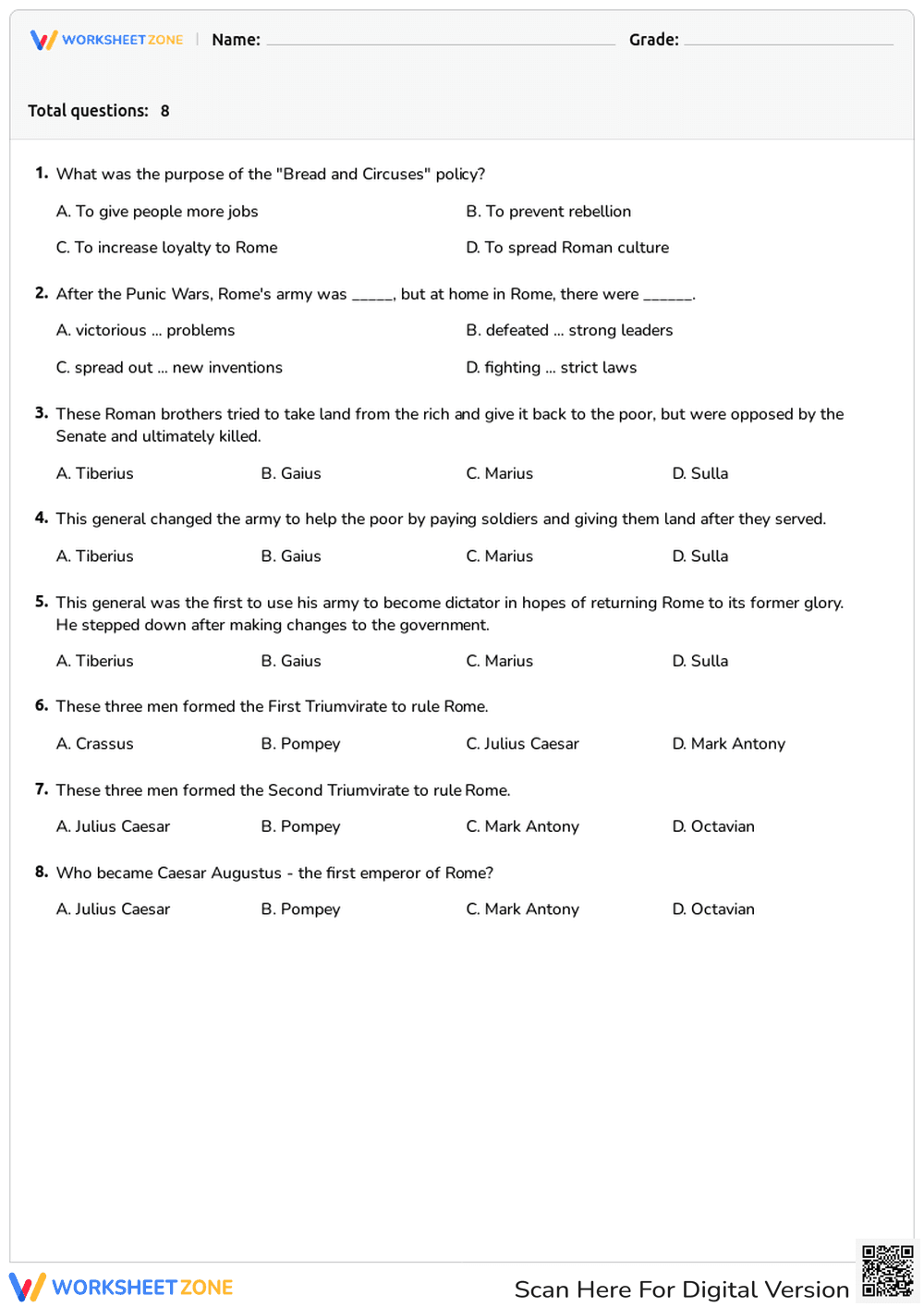

Ancient Rome History Quiz | Grade 6-8 Essential
Paste this activity's link or code into your existing LMS (Google Classroom, Canvas, Teams, Schoology, Moodle, etc.).
Students can open and work on the activity right away, with no student login required.
You'll still be able to track student progress and results from your teacher account.
This Ancient Rome history worksheet provides middle school students with a focused assessment on the transition from the Roman Republic to the Empire. By evaluating key figures and political shifts, students demonstrate their understanding of how internal conflict and military expansion reshaped Roman society. It is an efficient tool for measuring historical comprehension and factual recall.
At a Glance
- Grade: 6-8 · Subject: Social Studies
- Standard:
CCSS.ELA-LITERACY.RH.6-8.2— Determine the central ideas or information of a primary or secondary source- Skill Focus: Roman Republic & Empire Transition
- Format: 1 page · 8 problems · Answer key included · PDF
- Best For: Quick formative assessment or unit review
- Time: 10–15 minutes
This single-page PDF contains 8 high-quality multiple-choice questions designed to test specific historical knowledge. The content spans the Punic Wars, the "Bread and Circuses" policy, the Gracchi brothers, and the rise of the First and Second Triumvirates. Each question is structured with four clear options, ensuring students must distinguish between similar historical figures like Marius and Sulla. The layout is clean and distraction-free, allowing students to focus entirely on the historical content.
This resource is designed for a zero-prep workflow to save teacher time. First, print the single-page document in under 30 seconds. Second, distribute the quiz to students as a bell ringer or exit ticket, taking approximately 1 minute. Third, review the answers using the included key to provide immediate feedback in about 5 minutes. Total preparation time is under 2 minutes, making it an ideal choice for emergency sub plans or busy instructional days.
The primary standard addressed is `CCSS.ELA-LITERACY.RH.6-8.2`, which requires students to determine the central ideas or information of a secondary source. By identifying the roles of Julius Caesar and Augustus, students synthesize complex historical narratives into clear facts. This standard code can be copied directly into lesson plans, IEP goals, or district curriculum mapping tools to ensure compliance with middle school social studies frameworks.
Use this worksheet as a formative assessment after a lecture on the Roman Republic to gauge student retention of key vocabulary and figures. Alternatively, assign it as a partner activity where students must justify their answers using their textbooks or class notes. Completion typically takes 10 to 15 minutes, allowing for a quick transition to the next instructional block or a deeper class discussion on Roman politics.
This resource is tailored for Grade 6, 7, and 8 students following a World History or Core Knowledge curriculum. It is particularly effective for students who benefit from structured, multiple-choice formats to demonstrate mastery. It pairs naturally with an anchor chart detailing the timeline of the Roman Empire or a primary source reading on the Punic Wars to provide a comprehensive learning experience.
According to the RAND AIRS 2024 report, structured retrieval practice through low-stakes quizzing significantly improves long-term retention of historical facts in middle school populations. This worksheet facilitates that process by targeting the CCSS.ELA-LITERACY.RH.6-8.2 standard, focusing on the pivotal shift from the Roman Republic to the Empire. By identifying the "Bread and Circuses" policy and the rise of Augustus, students engage with the socio-political complexities that defined ancient Mediterranean history. Research from Fisher & Frey (2014) emphasizes that gradual release of responsibility is supported when students can independently verify their knowledge of key figures like Marius, Sulla, and the Triumvirates. This 8-question assessment provides the necessary data for educators to adjust instruction before moving into more complex historical analysis. It serves as a reliable bridge between direct instruction and independent mastery of ancient world history content.


