


























Views
Plays

Printable Coordinate Plane Review | Grade 6 Math
Paste this activity's link or code into your existing LMS (Google Classroom, Canvas, Teams, Schoology, Moodle, etc.).
Students can open and work on the activity right away, with no student login required.
You'll still be able to track student progress and results from your teacher account.
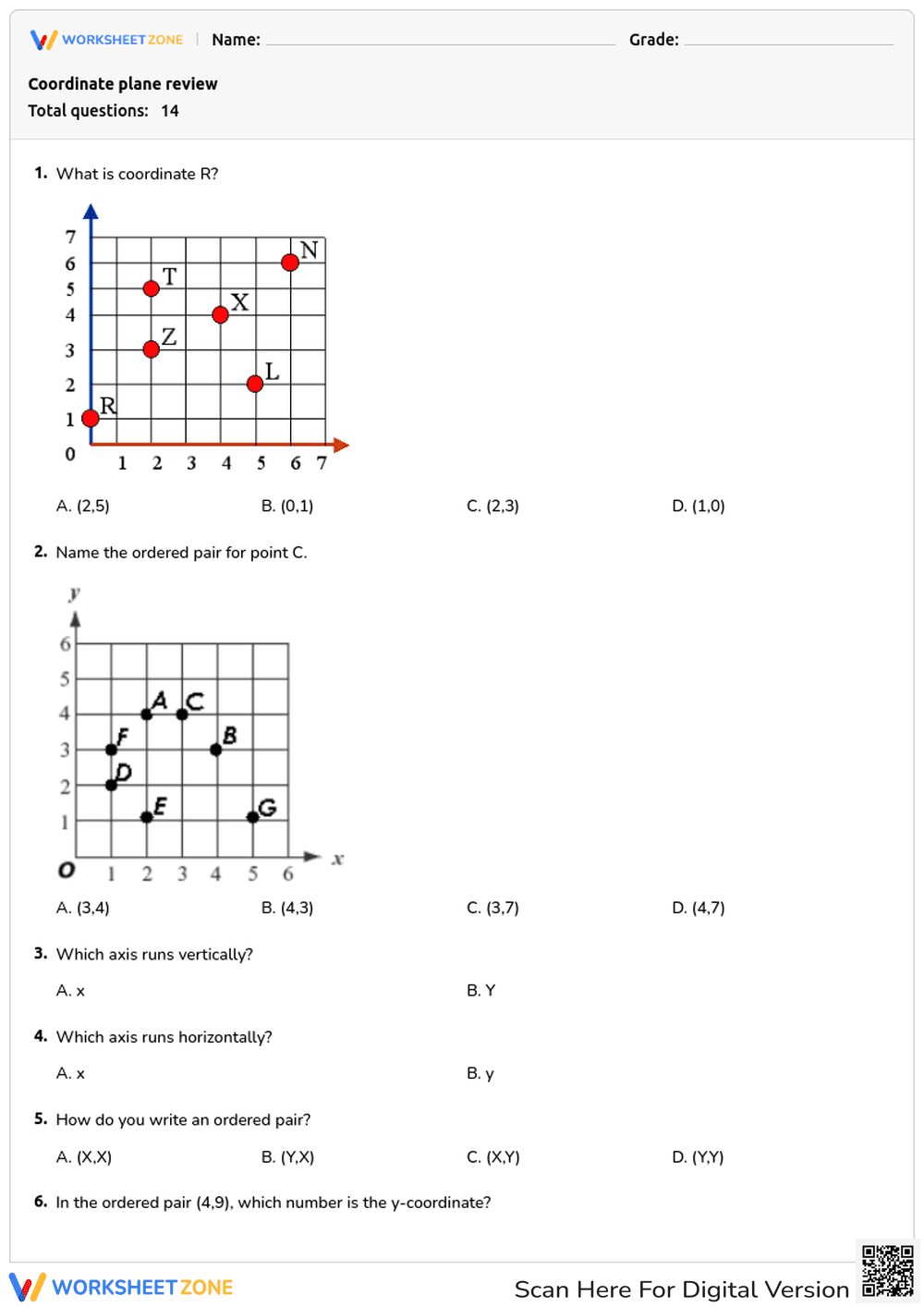
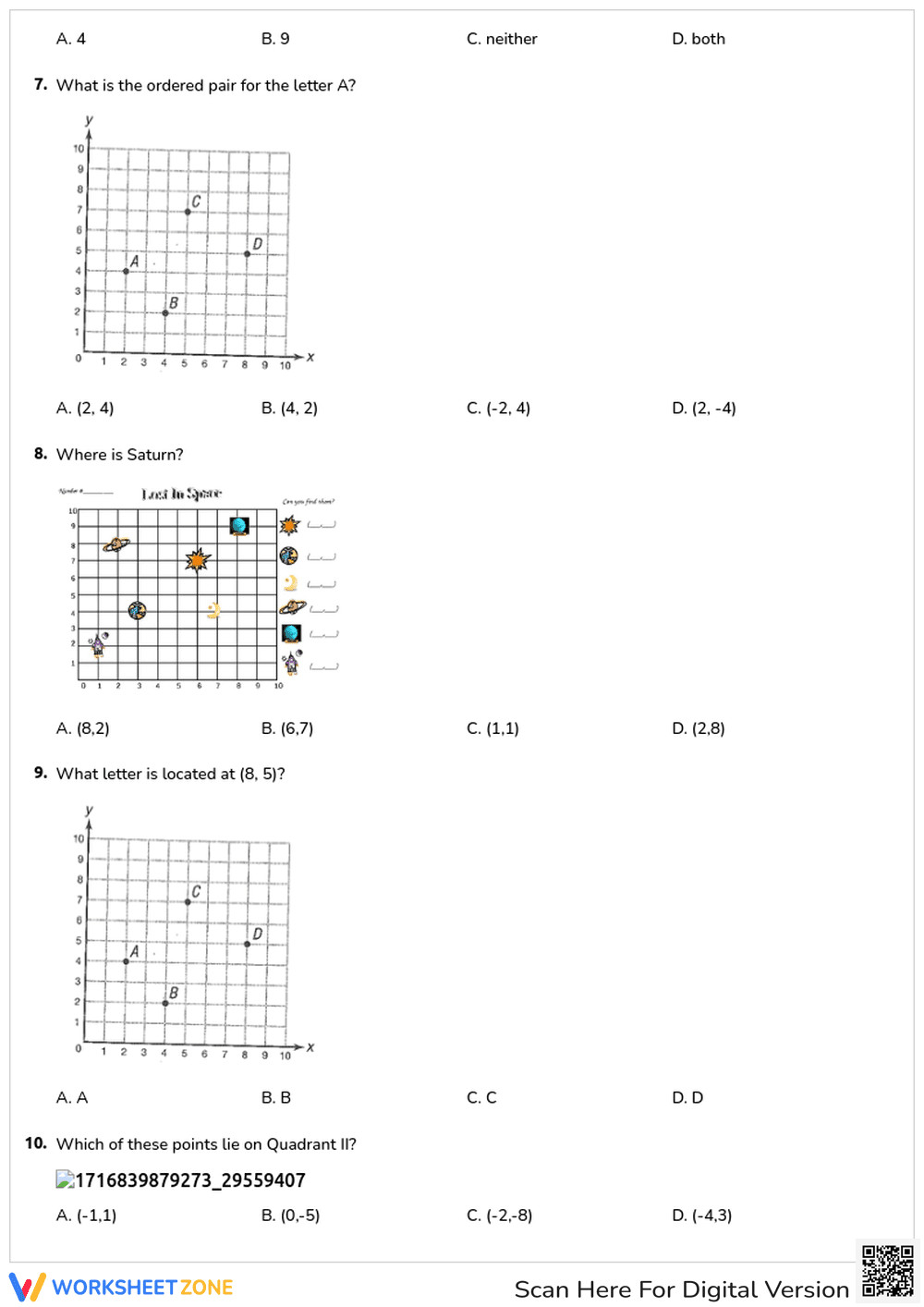
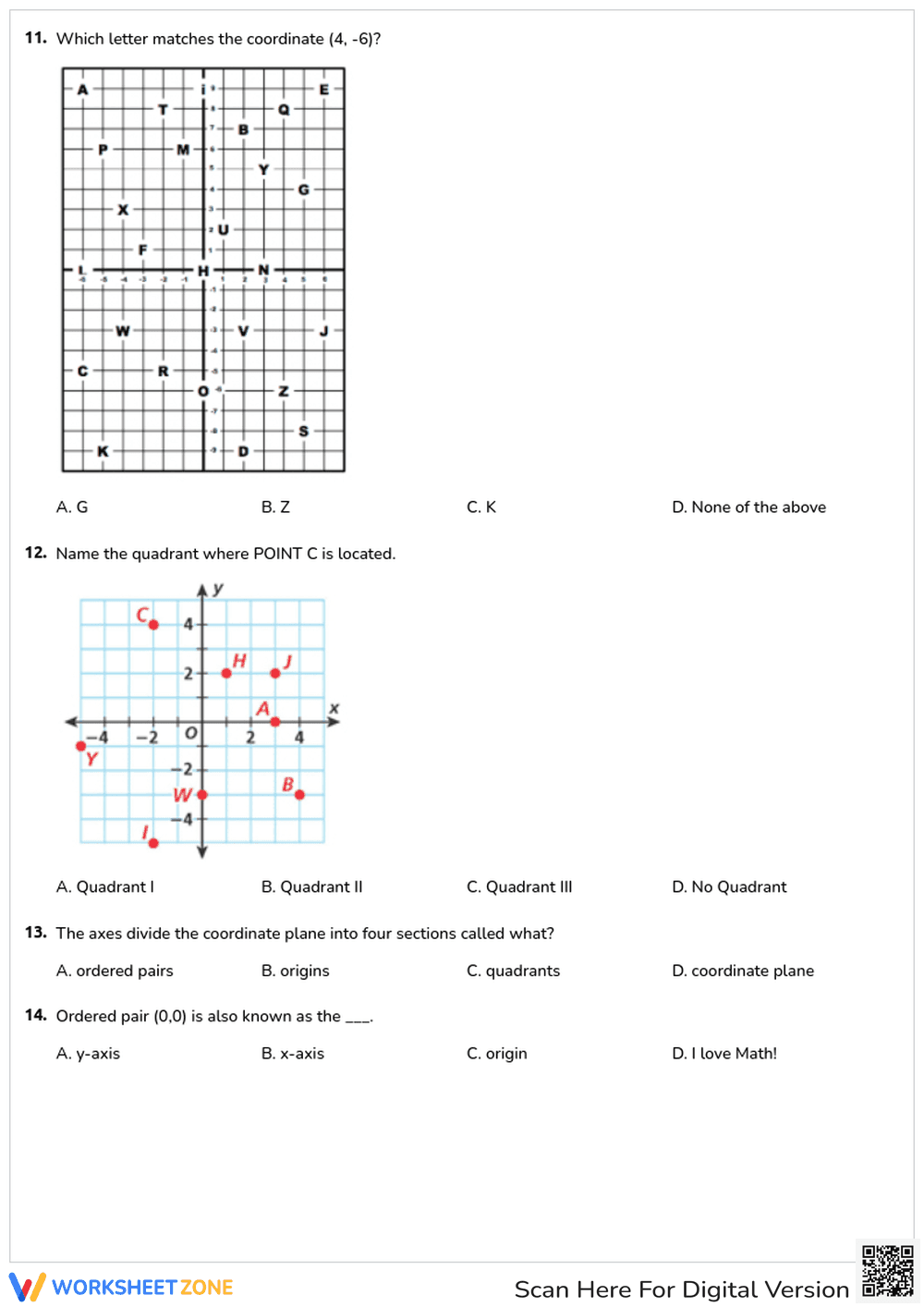
This comprehensive coordinate plane review worksheet provides students with targeted practice in identifying and plotting ordered pairs across all four quadrants. By engaging with these structured multiple-choice questions, learners will solidify their understanding of the x-axis, y-axis, origin, and quadrant locations to build a strong foundation for advanced algebra.
At a Glance
- Grade: 6 · Subject: Math
- Standard:
CCSS.MATH.CONTENT.6.NS.C.8— Graph points in all four quadrants to solve problems- Skill Focus: Coordinate Plane and Ordered Pairs
- Format: 3 pages · 14 problems · Answer key included · PDF
- Best For: End-of-unit review or assessment
- Time: 15–20 minutes
Inside this resource, educators will find a three-page assessment featuring 14 carefully sequenced multiple-choice questions. The tasks require students to analyze visual graphs, identify specific coordinates, determine the correct quadrant for given points, and recall essential vocabulary such as the origin and axes. A complete answer key is included to ensure quick and accurate grading.
- Guided practice: The initial questions focus on foundational vocabulary and identifying single points on a provided graph, offering a low-barrier entry point.
- Supported practice: Students transition to analyzing multi-point graphs and determining the exact ordered pairs for specific labeled locations.
- Independent practice: The final tasks challenge learners to apply their knowledge of all four quadrants, including negative coordinates, demonstrating full mastery. This gradual-release approach ensures students confidently progress from basic recall to independent application.
This worksheet is strictly aligned to CCSS.MATH.CONTENT.6.NS.C.8: Solve real-world and mathematical problems by graphing points in all four quadrants of the coordinate plane. It also supports foundational geometry and number system skills by reinforcing the structure of the x- and y-axes. Both standard codes can be copied directly into lesson plans, IEP goals, or district curriculum mapping tools.
Deploy this worksheet as a formative assessment after direct instruction on the coordinate plane to gauge student comprehension. It also serves perfectly as an independent practice activity or homework assignment. While students work, teachers can observe whether learners are correctly identifying the x-coordinate before the y-coordinate—a common stumbling block. Expect most students to complete the 14 questions within 15 to 20 minutes.
This resource is designed for sixth-grade math students mastering the number system, though it serves as an excellent review for seventh and eighth graders preparing for linear equations. For students needing extra support, pair this worksheet with a labeled anchor chart displaying the four quadrants and the signs associated with each. It naturally complements any introductory lesson on graphing ordered pairs.
Mastering the coordinate plane is a critical stepping stone for middle school mathematics and future algebraic reasoning. Aligned with CCSS.MATH.CONTENT.6.NS.C.8, this resource helps students graph points in all four quadrants to solve problems. According to EdReports 2024, instructional materials that provide explicit, visual practice with coordinate graphing significantly improve students' ability to transition from concrete number lines to abstract algebraic functions. By repeatedly interacting with visual models and vocabulary questions, learners internalize the spatial relationships required for higher-level math. This targeted practice ensures that foundational gaps are closed early, preventing misconceptions when students eventually encounter slope, functions, and complex linear equations. Providing structured, multiple-choice formats allows for immediate feedback and accurate assessment of student proficiency in this essential mathematical domain, ensuring readiness for advanced coursework.


