


























Views
Downloads
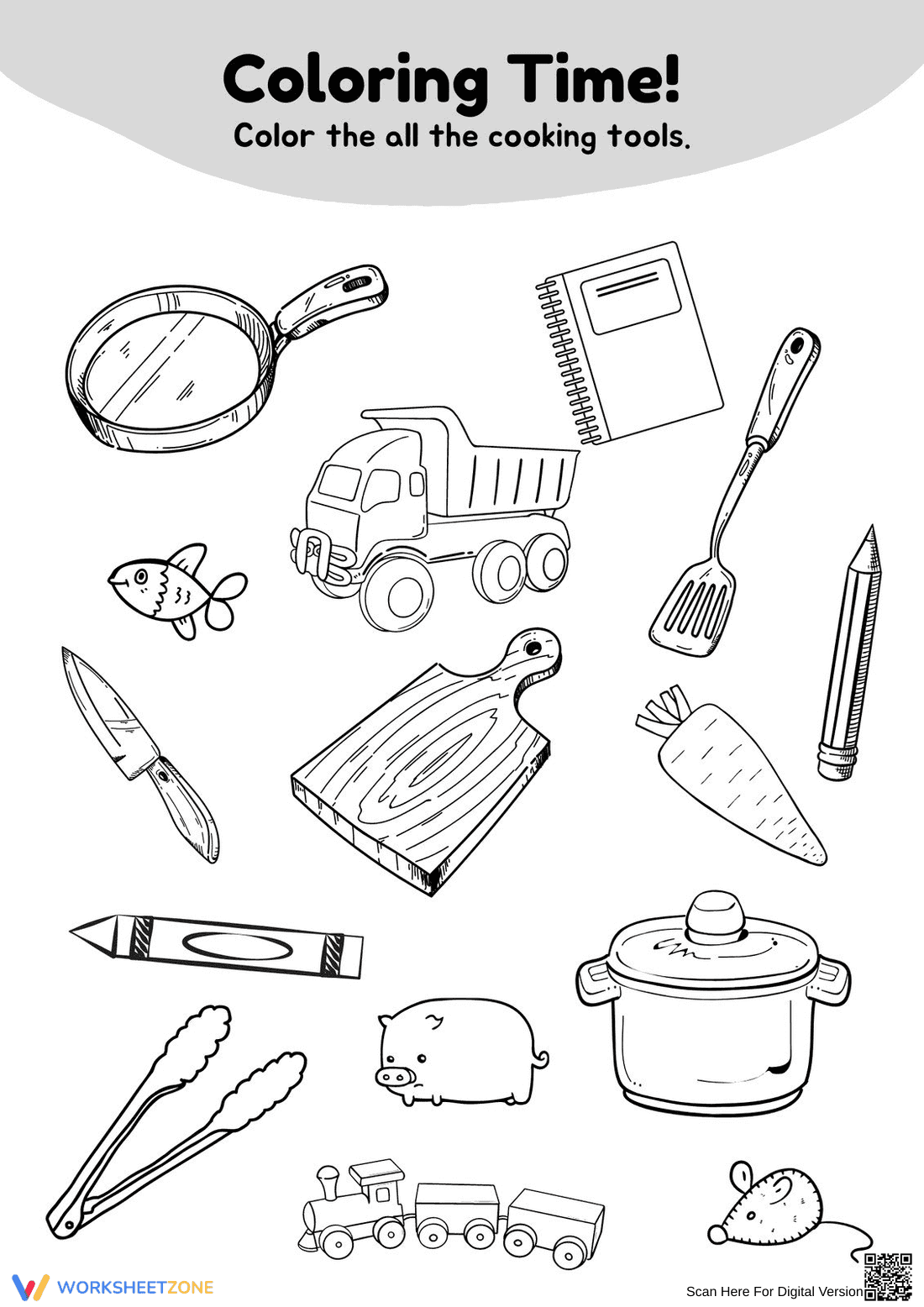

Printable Cooking Tools Coloring Worksheet | Grade K
Paste this activity's link or code into your existing LMS (Google Classroom, Canvas, Teams, Schoology, Moodle, etc.).
Students can open and work on the activity right away, with no student login required.
You'll still be able to track student progress and results from your teacher account.
This printable Kindergarten vocabulary worksheet helps students practice categorization and fine motor skills by identifying cooking tools among various everyday objects. By evaluating each item and coloring only the correct ones, young learners reinforce their understanding of specific categories while engaging in a fun, hands-on activity.
At a Glance
- Grade: K · Subject: ELA
- Standard:
CCSS.ELA-LITERACY.L.K.5.A— Sort common objects into categories- Skill Focus: Categorization and Vocabulary
- Format: 1 page · 15 problems · No answer key · PDF
- Best For: Independent practice or centers
- Time: 10–15 minutes
Inside this single-page resource, students will find a collection of fifteen distinct line-art illustrations featuring a mix of household items, animals, toys, and kitchen utensils. The straightforward layout presents clear, recognizable images such as a frying pan, a toy truck, a pencil, and a cutting board. Students are tasked with visually scanning the page, determining which items belong in a kitchen setting, and coloring those specific objects.
Zero-Prep Workflow
This resource is designed for immediate classroom implementation with minimal teacher preparation.
- Print (1 minute): Simply download the PDF and print the required number of copies. The black-and-white design ensures low ink consumption.
- Distribute (1 minute): Hand out the worksheets along with crayons, markers, or colored pencils. The instructions are simple enough for young learners to grasp quickly.
- Review (3 minutes): Quickly scan student work to check for understanding. Total teacher prep time is under two minutes, making this an excellent option for emergency sub plans or quick morning work.
Standards Alignment
This worksheet aligns with CCSS.ELA-LITERACY.L.K.5.A, which requires students to sort common objects into categories to gain a sense of the concepts the categories represent. By distinguishing cooking tools from toys and animals, students actively apply this foundational cognitive skill. Both standard codes can be copied directly into lesson plans, IEP goals, or district curriculum mapping tools.
How to Use It
This coloring activity works exceptionally well as an independent literacy center or a quiet morning warm-up before direct instruction begins. Teachers can also use it as a quick formative assessment during a thematic unit on food, community helpers, or household items. While students are working, observe whether they correctly skip non-cooking items like the toy train or the pig, which provides immediate insight into their categorization skills. Expected completion time is between 10 and 15 minutes.
Who It's For
This worksheet is primarily designed for Kindergarten students developing early vocabulary and sorting abilities. It is also highly beneficial for Pre-K learners needing fine motor practice or English Language Learners (ELLs) building basic English noun recognition. Pair this activity with a read-aloud about cooking or a physical sorting game using real classroom objects to reinforce the concept.
Early childhood education emphasizes the importance of categorization as a foundational cognitive skill. According to Fisher & Frey (2014), providing students with structured opportunities to sort and classify objects significantly enhances their vocabulary acquisition and conceptual understanding. This worksheet directly supports CCSS.ELA-LITERACY.L.K.5.A by asking students to sort common objects into categories, specifically identifying cooking tools among unrelated items. By integrating fine motor practice through coloring with cognitive sorting tasks, educators can create a multimodal learning experience that reinforces memory retention. Activities that require students to visually discriminate and group items based on shared attributes build the critical thinking pathways necessary for later reading comprehension and mathematical logic. This resource offers a developmentally appropriate, research-backed method for strengthening these essential early literacy and cognitive skills in young learners.


