




























Views
Downloads

Converting Fractions to Decimals | Essential Grade 7 Math

Paste this activity's link or code into your existing LMS (Google Classroom, Canvas, Teams, Schoology, Moodle, etc.).
Students can open and work on the activity right away, with no student login required.
You'll still be able to track student progress and results from your teacher account.
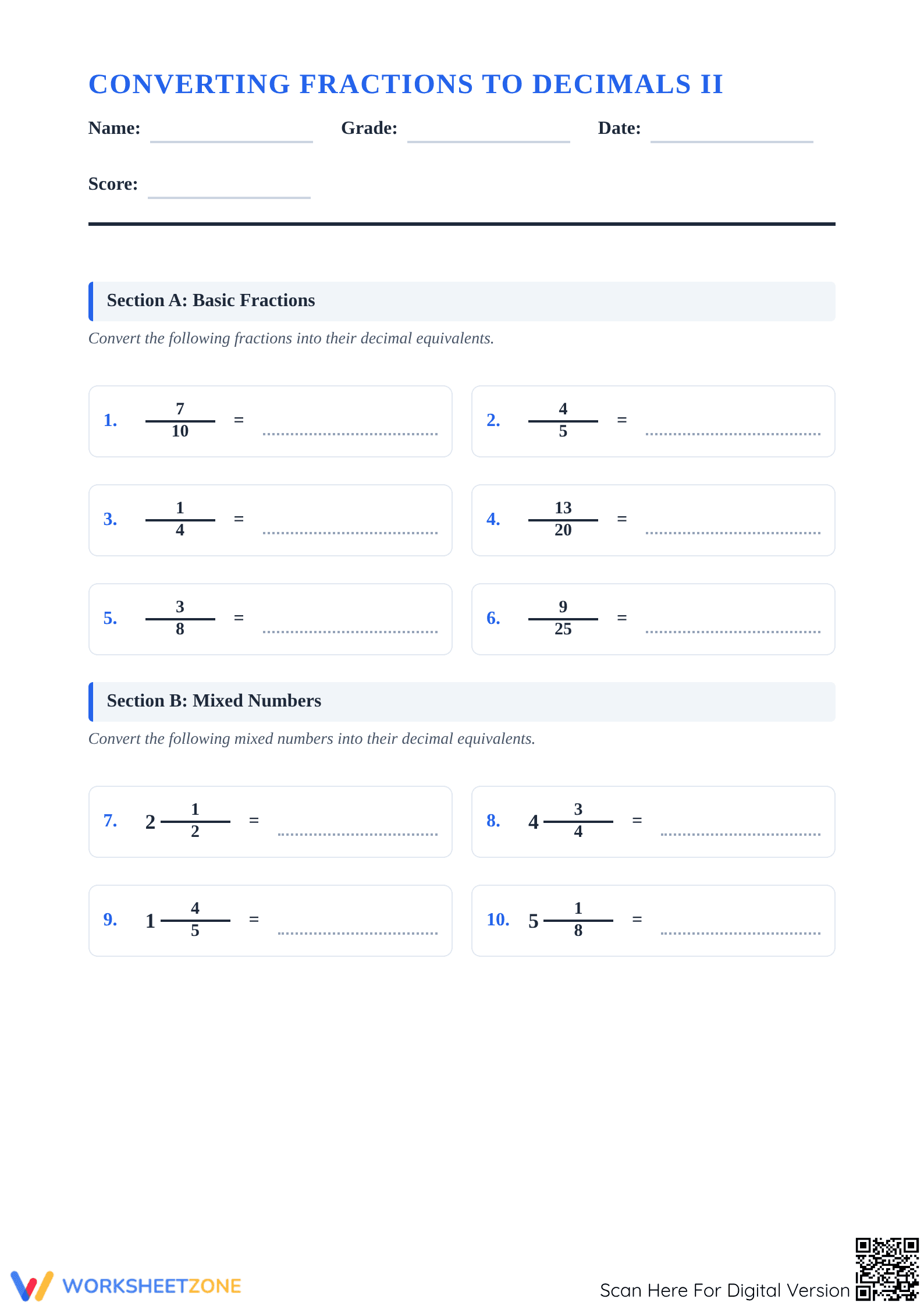
This comprehensive Grade 7 math worksheet provides targeted practice in converting various fractions and mixed numbers into their decimal equivalents. By working through basic fractions, mixed numbers, and complex ratios, students build the procedural fluency needed to master rational number operations and real-world mathematical applications. It ensures students can navigate between different numeric representations with confidence.
At a Glance
- Grade: 7 · Subject: Math
- Standard:
7.NS.A.2.d— Convert rational numbers to decimals using long division and identify repeating patterns- Skill Focus: Fraction to decimal conversion
- Format: 3 pages · 24 problems · Answer key included · PDF
- Best For: Rational number fluency and middle school remediation
- Time: 30–45 minutes
What's Inside
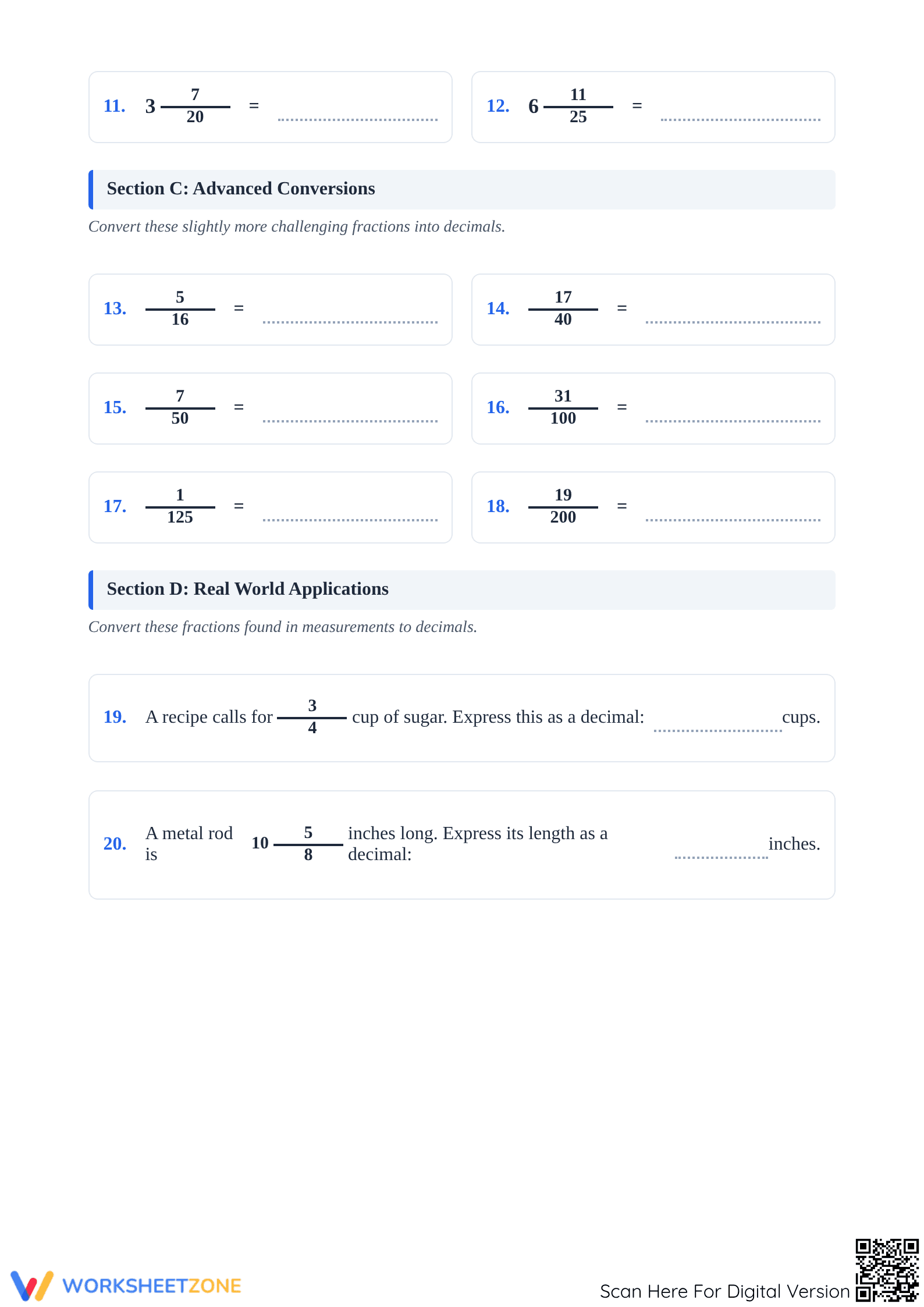
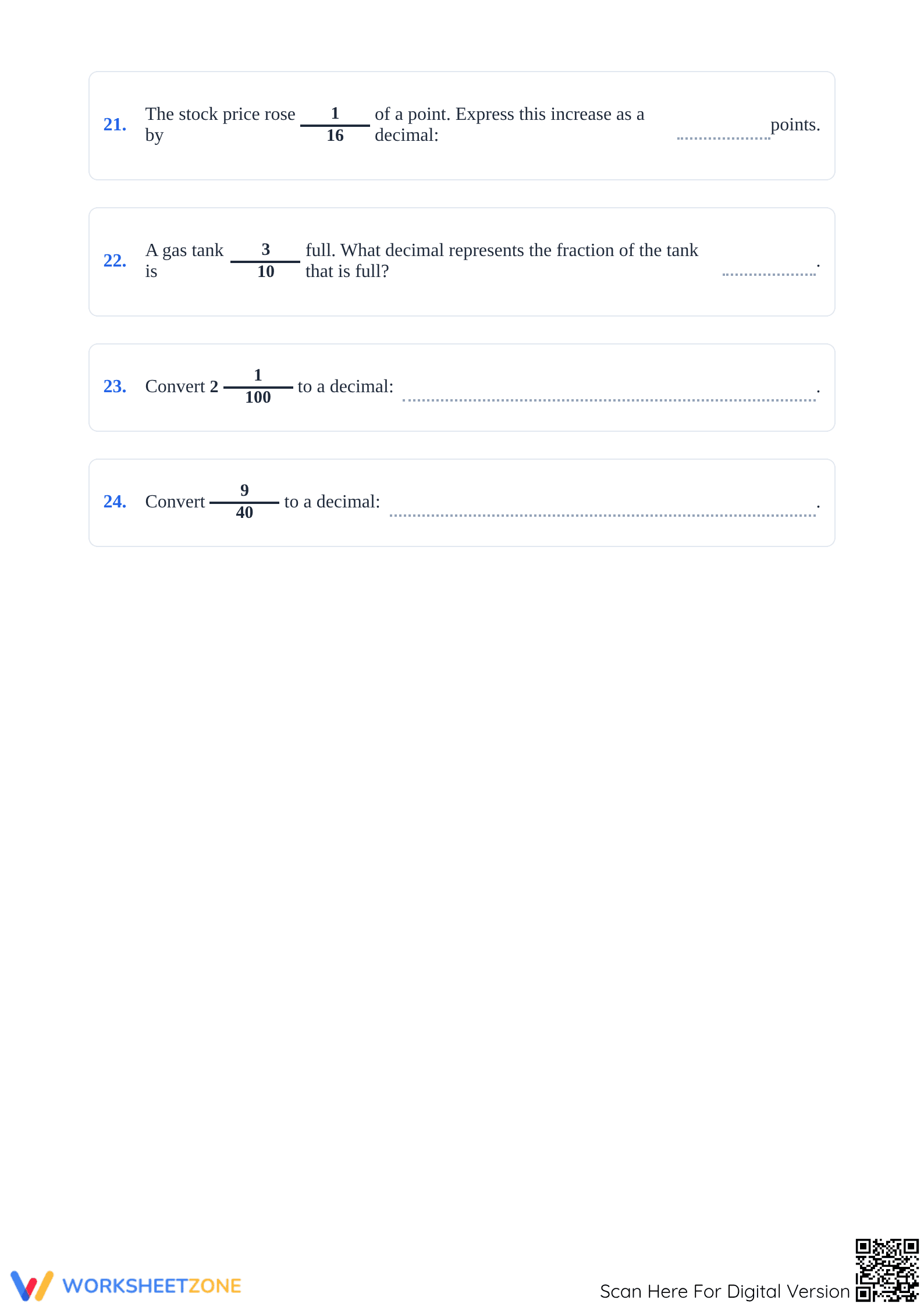
This packet contains 24 carefully sequenced problems spanning three pages, designed to move students from foundational concepts to complex applications. The worksheet features four distinct sections: Basic Fractions, Mixed Numbers, Advanced Conversions, and Real-World Applications. A comprehensive answer key is included to facilitate immediate feedback and student self-correction, making it a complete resource for classroom or home use.
Skill Progression
- Guided practice: Sections A and B introduce 12 problems focused on basic denominators and mixed numbers, allowing students to stabilize their conversion technique.
- Supported practice: Section C presents 6 advanced conversions with more complex denominators (e.g., 16, 40, 125) to challenge precision.
- Independent practice: Section D provides 6 real-world word problems requiring students to apply conversion skills to measurements and finance.
This gradual-release model ensures a smooth transition from basic calculation to conceptual application through a structured I Do, We Do, You Do workflow.
Standards Alignment
This resource is primary aligned to CCSS.MATH.CONTENT.7.NS.A.2.d: "Convert a rational number to a decimal using long division; know that the decimal form of a rational number terminates in 0s or eventually repeats." Both standard codes can be copied directly into lesson plans, IEP goals, or district curriculum mapping tools.
How to Use It
Use this worksheet as a primary practice tool after a direct instruction lesson on long division and rational numbers. It serves perfectly for independent station work or as a structured homework assignment. Teachers can use the final section as a formative assessment to observe how well students translate situational language into mathematical operations. Completion typically takes 30 to 45 minutes.
Who It's For
This worksheet is designed for Grade 7 students, but also provides excellent remediation for Grade 8 and high school students who need to strengthen their number sense. It pairs naturally with instructional passages on terminating and repeating decimals or anchor charts demonstrating the relationship between division and fraction bars.
Research by Fisher & Frey (2014) emphasizes that procedural fluency in middle school mathematics is significantly enhanced through the gradual release of responsibility. This worksheet embodies that principle by transitioning students from isolated skill drills to integrated word problems, allowing for the consolidation of numeric conversion techniques. Developing the ability to fluidly switch between fractions and decimals is a critical milestone in Grade 7, as identified by the CCSS standards. The inclusion of 24 structured tasks across multiple levels of complexity provides the heavy lifting required for neural pathway development in mathematical reasoning. By grounding the practice in standard 7.NS.A.2.d, this tool ensures that students are not just memorizing steps but are building the conceptual bridge between division and rational representation. This approach is validated by recent pedagogical analyses which suggest that varied practice remains the most effective method for long-term retention of decimal conversion skills.


