




























Views
Downloads

Essential Fractions to Decimals Worksheet | Grade 7 Math

Paste this activity's link or code into your existing LMS (Google Classroom, Canvas, Teams, Schoology, Moodle, etc.).
Students can open and work on the activity right away, with no student login required.
You'll still be able to track student progress and results from your teacher account.
Mastering Fraction to Decimal Conversion
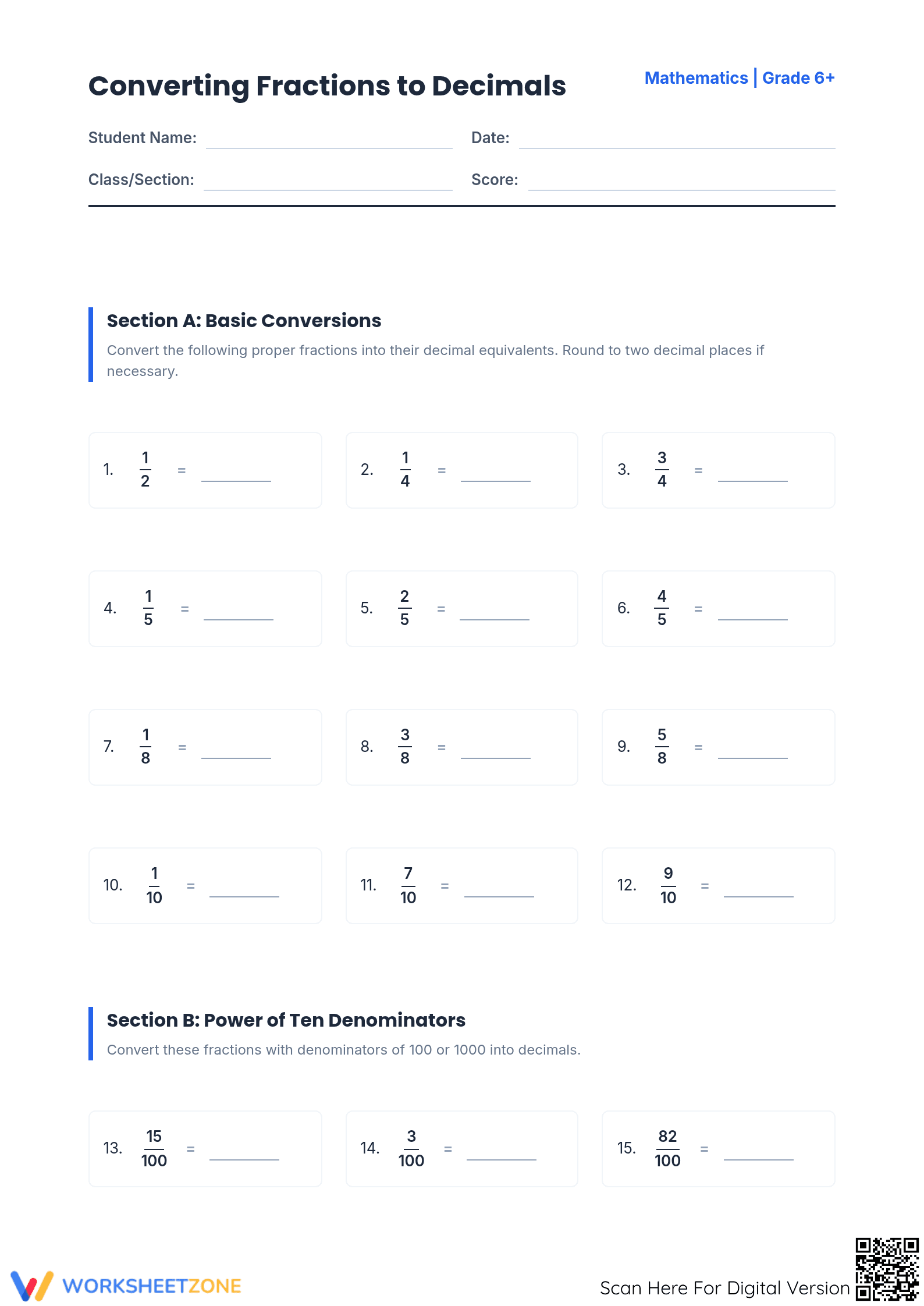
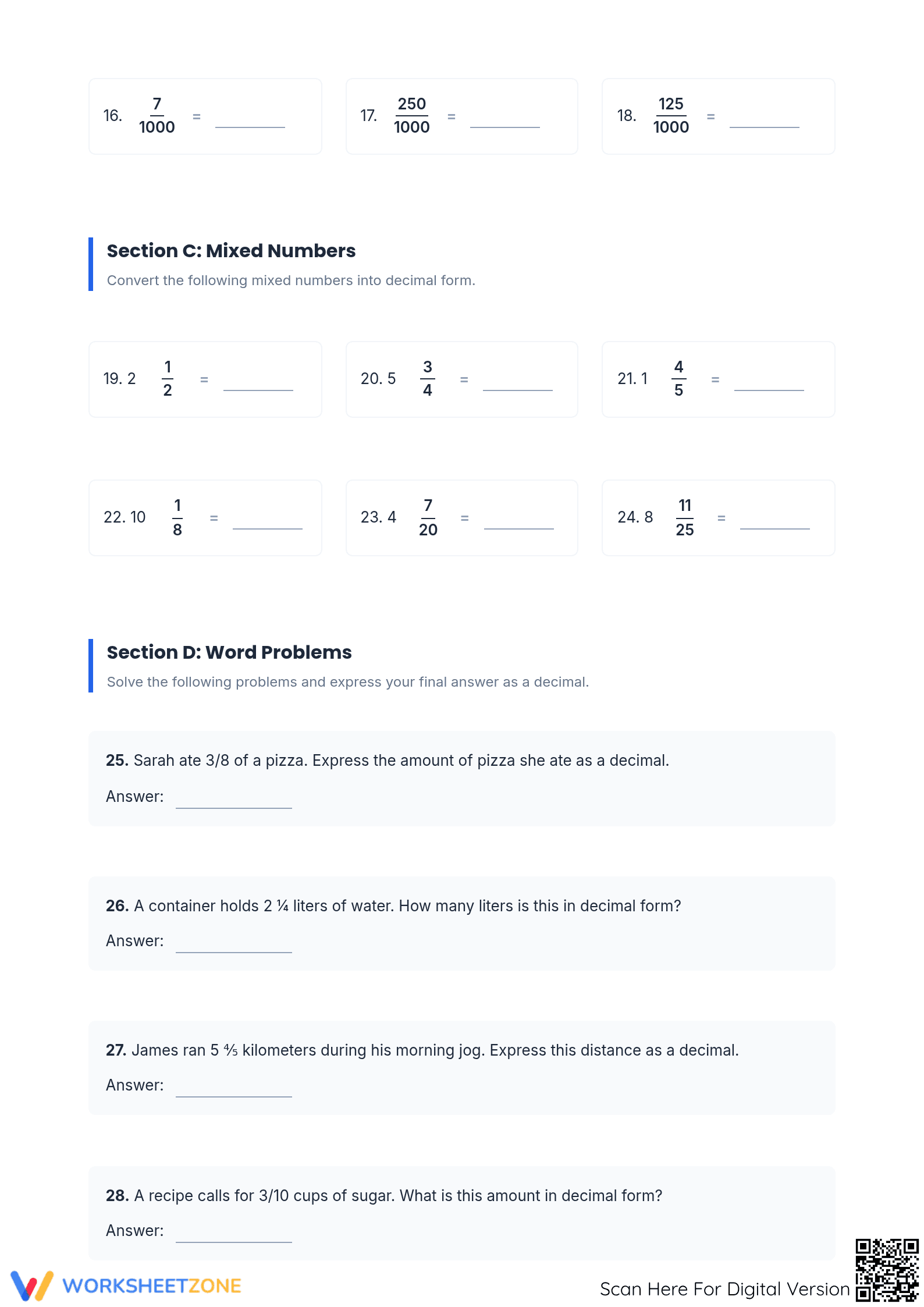
This worksheet provides focused practice for students learning to convert fractions into decimals. Through a clear set of 40 problems, learners will reinforce their understanding of rational numbers and build procedural fluency. It is designed for middle school math classes and serves as an excellent tool for independent practice, homework, or review.
At a Glance
- Grade: 7 · Subject: Math
- Standard:
CCSS.MATH.CONTENT.7.NS.A.2.D— Convert a rational number to a decimal using long division.- Skill Focus: Converting Fractions to Decimals
- Format: 3 pages · 40 problems · Answer key included · PDF
- Best For: Independent practice or homework
- Time: 20–30 minutes
What's Inside
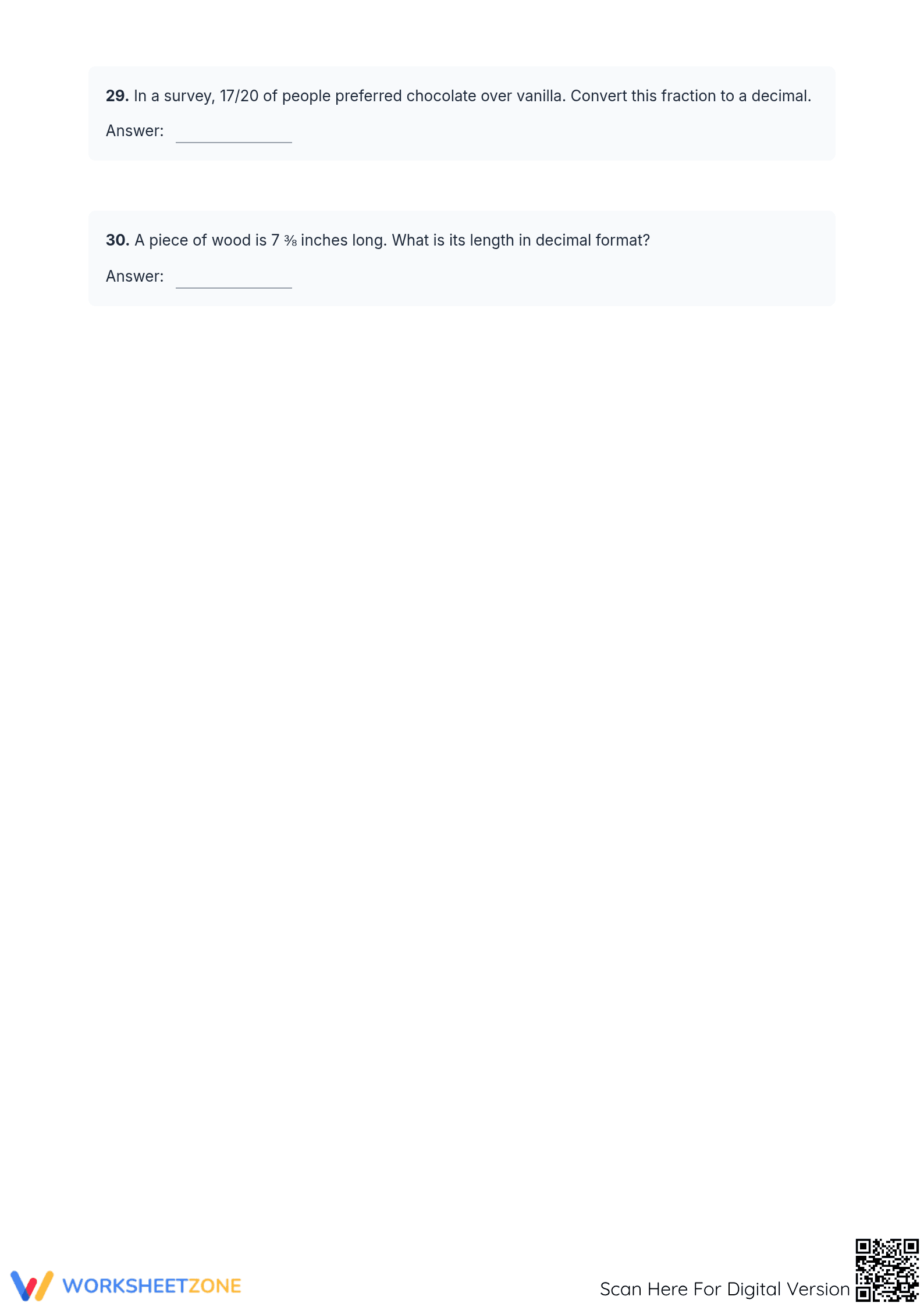
This resource contains a two-page worksheet with 40 fraction-to-decimal conversion problems. The layout is clean and organized, providing ample space for students to show their work. A complete, one-page answer key is included for easy grading or student self-checking, making the review process efficient for teachers and learners alike.
A Foundation for Fluency
The worksheet follows a gradual-release model to build student confidence and skill.
- Guided practice: The first set of problems involves common fractions with denominators like 10, 100, and 2, which are often more familiar to students.
- Supported practice: The tasks progress to include a wider variety of denominators, requiring students to apply long division more consistently.
- Independent practice: By the final problems, students should be able to independently tackle any fraction-to-decimal conversion, demonstrating mastery of the procedure.
This structure ensures a steady progression from foundational understanding to independent application.
Standards Alignment
This worksheet is directly aligned with Common Core standard CCSS.MATH.CONTENT.7.NS.A.2.D, which requires students to "Convert a rational number to a decimal using long division; know that the decimal form of a rational number terminates in 0s or eventually repeats." It also supports foundational skills from Grade 6, such as understanding rational numbers on a number line. Both standard codes can be copied directly into lesson plans, IEP goals, or district curriculum mapping tools.
How to Use It
This versatile worksheet is ideal for independent practice after a direct instruction lesson on converting fractions to decimals. It gives students the repetition needed to internalize the long division process. Alternatively, use it as a formative assessment tool; by observing which problems students struggle with, teachers can identify common errors, such as misplaced decimals or repeating pattern recognition. Most students will complete the worksheet in 20 to 30 minutes.
Who It's For
This resource is designed for 7th-grade math students but is also suitable for 6th graders needing a challenge or 8th graders requiring review of rational number operations. It pairs well with a lesson on number systems or an anchor chart showing the steps of long division. The straightforward design makes it accessible for a wide range of learners.
Mastering the conversion of fractions to decimals is a critical gateway skill for success in middle school mathematics, particularly for algebra readiness. This worksheet addresses standard `CCSS.MATH.CONTENT.7.NS.A.2.D` by providing the focused, procedural practice necessary for fluency. Research consistently shows that procedural fluency and conceptual understanding are intertwined; one supports the other. According to Fisher & Frey (2014), students require multiple opportunities to practice a new skill in varied contexts to achieve automaticity. This resource offers 40 such opportunities, allowing students to move beyond the mechanics and begin seeing the underlying mathematical relationships between different forms of rational numbers. It serves as a practical tool for building the number sense that underpins higher-level mathematics, ensuring students are prepared for more complex algebraic concepts.


