


























Views
Downloads


6.EE.A.2 Worksheet: Algebraic Expressions — Grade 6 Aligned
Paste this activity's link or code into your existing LMS (Google Classroom, Canvas, Teams, Schoology, Moodle, etc.).
Students can open and work on the activity right away, with no student login required.
You'll still be able to track student progress and results from your teacher account.
Translate complex mathematical relationships into clear verbal descriptions and back again with this comprehensive algebraic expressions worksheet. Designed for fifth and sixth-grade students, this resource focuses on the linguistic foundations of algebra, ensuring learners can interpret variables, operations, and constants within real-world contexts. It bridges the gap between abstract symbols and everyday language.
At a Glance
- Grade: 5-6 · Subject: Math
- Standard:
6.EE.A.2— Write expressions that record operations with numbers and with letters standing for numbers- Skill Focus: Algebraic translation and interpretation
- Format: 3 pages · 15 problems · Answer key included · PDF
- Best For: Initial algebra instruction and formative assessment
- Time: 30–45 minutes
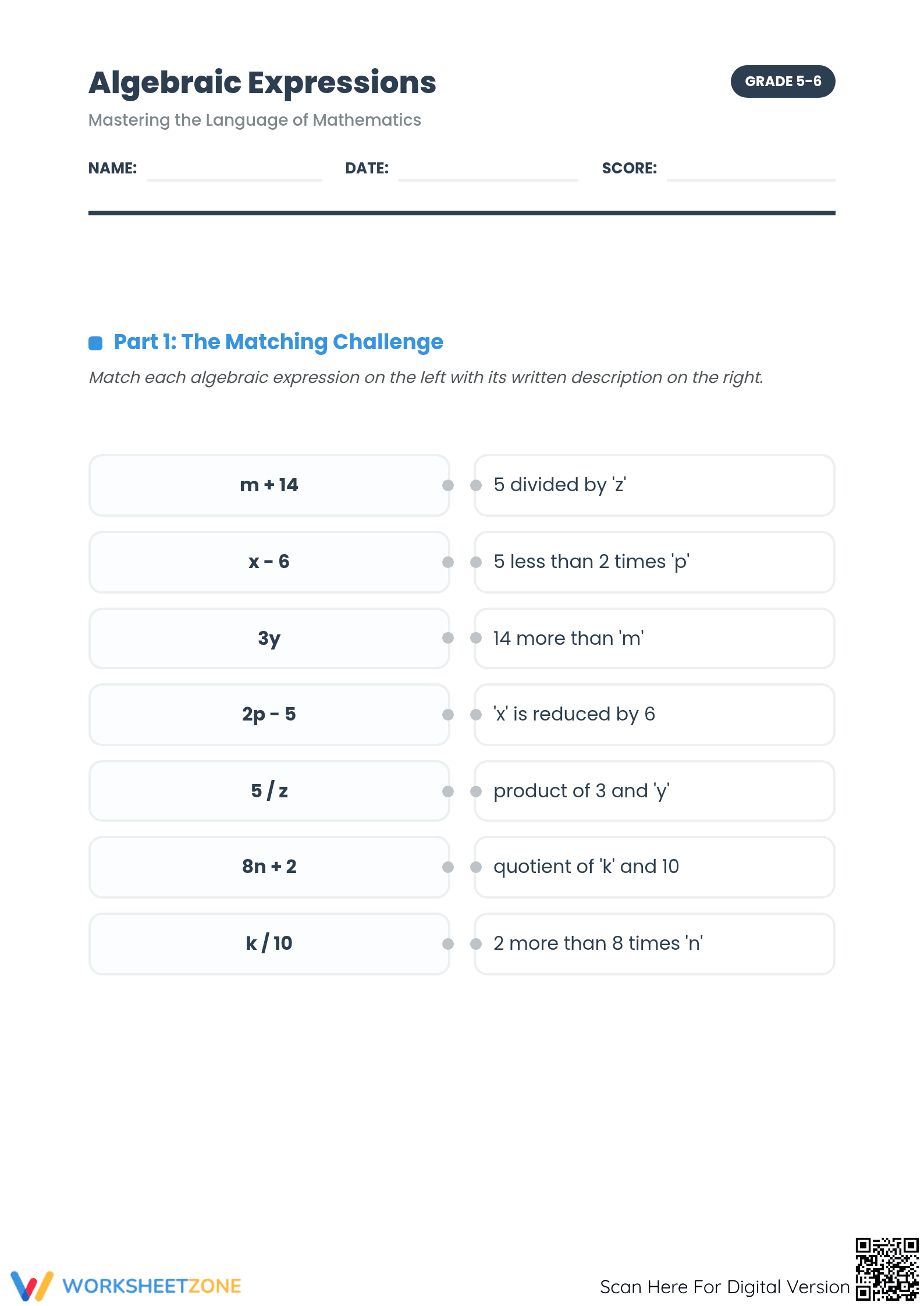
This three-page packet contains fifteen structured exercises divided into three distinct sections. Part 1 features a matching challenge where students link expressions like "2p - 5" to phrases such as "5 less than 2 times p." Part 2 requires students to write their own expressions from word phrases, while Part 3 reverses the process, asking students to generate original word descriptions for given mathematical expressions.
The tasks map directly to the sub-skills of mathematical modeling. The matching section provides high scaffolding to identify correct operation keywords such as "product," "quotient," and "reduced by." As students move to Parts 2 and 3, the scaffolding is removed, requiring independent generation of syntax. This progression allows teachers to identify students at the "Approaching" tier who can recognize expressions but struggle to compose them, versus those at the "Mastery" tier. Scores can be recorded as evidence for 6.EE.A.2 proficiency benchmarks.
This resource is primarily aligned to 6.EE.A.2, which focuses on reading and writing expressions in which letters stand for numbers. It specifically addresses the sub-standard of recording operations with numbers and variables. Both standard codes can be copied directly into lesson plans, IEP goals, or district curriculum mapping tools to ensure instructional coherence across middle school mathematics vertical alignment.
Use this worksheet as a primary practice tool following a direct instruction session on algebraic vocabulary. Alternatively, utilize the matching section as a warm-up "bell-ringer" to activate prior knowledge before a lesson on solving equations. During the independent writing phase, circulate to observe if students correctly interpret "less than" as a subtraction operation with reversed order. Expect a total completion time of 35 minutes for most Grade 6 learners.
This resource is ideal for Grade 5 and 6 students beginning their algebra journey. It is particularly effective for English Language Learners (ELLs) who need explicit practice with mathematical Tier 3 vocabulary. Pair this worksheet with a vocabulary anchor chart or a short instructional passage about the history of algebraic notation to provide a rich, cross-disciplinary learning experience for your classroom.
Mathematical literacy is a critical prerequisite for success in higher-order STEM fields, yet the transition from arithmetic to algebra often poses a significant linguistic barrier for many middle school students. According to research by Fisher & Frey (2014) on the gradual release of responsibility, structured translation tasks like those found in this 6.EE.A.2 worksheet are essential for moving students from dependent recognition to independent production. By focusing on the 6.EE.A.2 standard, this resource ensures that students internalize the plain-English meaning of operations before they are asked to solve complex equations. This approach aligns with evidence-based practices for algebraic readiness, providing a scaffolded pathway that reduces cognitive load during the interpretation phase. Educators can rely on this validated instructional sequence to build a robust foundation for variable-based thinking, which is a key predictor of performance in subsequent high school mathematics coursework and college-level quantitative reasoning.


