


























Views
Downloads



Printable Ratio to Fraction & Percent Guide | Grade 6
Paste this activity's link or code into your existing LMS (Google Classroom, Canvas, Teams, Schoology, Moodle, etc.).
Students can open and work on the activity right away, with no student login required.
You'll still be able to track student progress and results from your teacher account.
This comprehensive 32-problem worksheet empowers students to master the vital transition between part-to-part ratios and their equivalent fraction, decimal, and percent representations. By calculating total parts first, learners build a conceptual bridge that ensures mathematical accuracy and deepens their understanding of proportional relationships in real-world contexts.
At a Glance
- Grade: 6 · Subject: Math
- Standard:
CCSS.MATH.CONTENT.6.RP.A.3— Calculate equivalent fractions, decimals, and percents from part-to-part ratio comparisons- Skill Focus: Part-to-part ratio conversion
- Format: 3 pages · 32 problems · Answer key included · PDF
- Best For: Independent practice and skills fluency
- Time: 25–40 minutes
The resource contains three structured pages featuring a clear, tabular format. Students are presented with part-to-part ratios and must determine the total parts to derive the fraction, decimal, and percent for the first component. A complete multi-page answer key is included to facilitate rapid grading and immediate student feedback during the instructional cycle.
Practice moves from simple 1:1 ratios to more complex multi-digit comparisons.
- Guided practice: The first 10 problems use familiar small-number ratios to establish the calculation workflow and build student confidence.
- Supported practice: Problems 11 through 25 introduce prime numbers and larger sums to test computational stamina and precision.
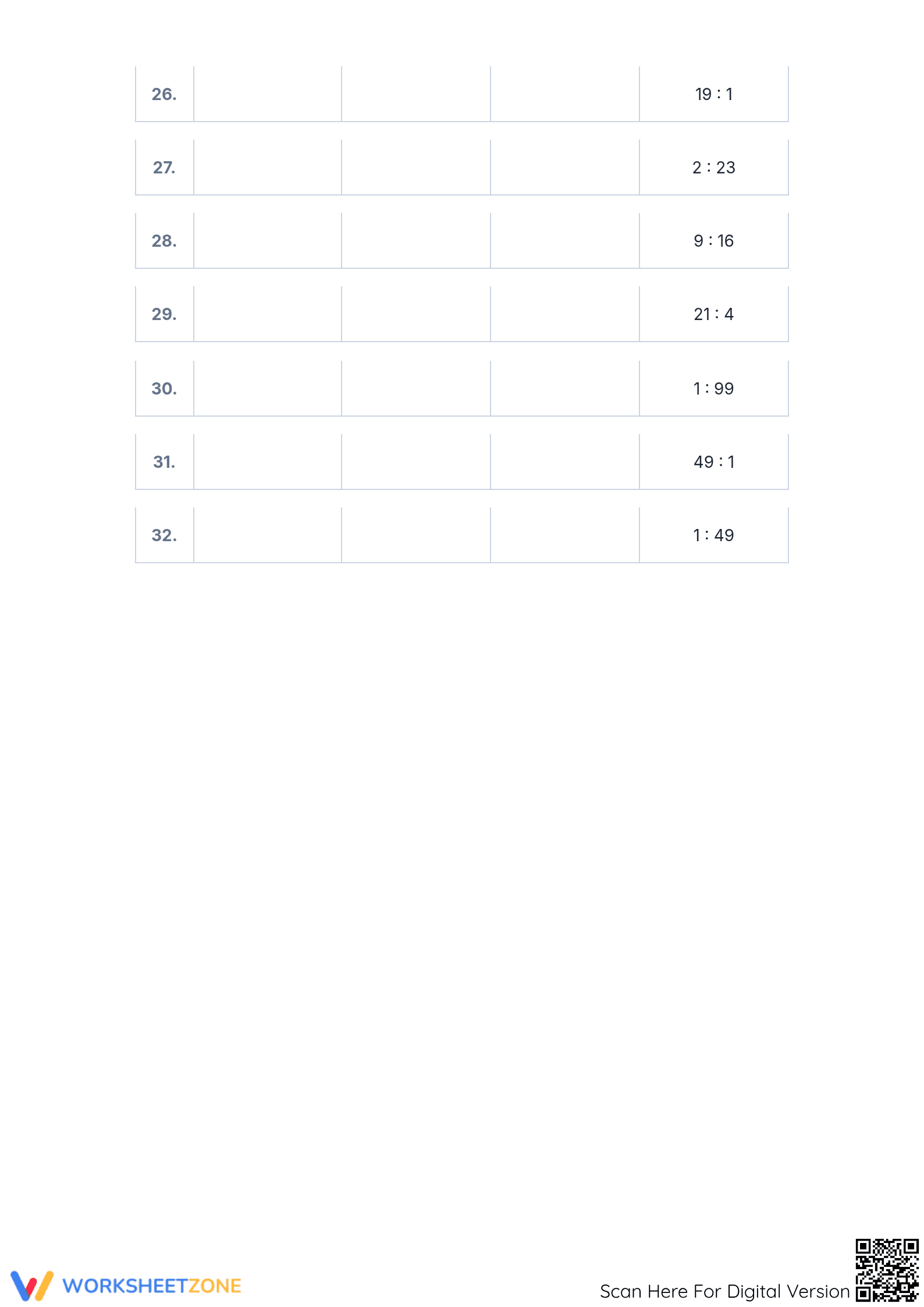
- Independent practice: The final 7 problems feature high-value ratios that require precise decimal-to-percent movements for mastery.
This gradual-release structure ensures students build procedural fluency before tackling more challenging calculations without additional support.
Aligned to `CCSS.MATH.CONTENT.6.RP.A.3`, which requires students to use ratio reasoning to solve mathematical problems. Specifically, it targets the ability to find a percent of a quantity as a rate per 100 and represent ratios in multiple numeric forms. Both standard codes can be copied directly into lesson plans, IEP goals, or district curriculum mapping tools.
Use this worksheet as a "during instruction" activity after introducing the concept of part-to-whole relationships. Teachers should observe students during the first five problems to ensure they are adding both parts of the ratio to find the correct denominator. Expected completion time ranges from 25 to 40 minutes depending on prior fluency levels.
This resource is ideal for Grade 6 and 7 students developing fluency in rational number forms. It serves as an excellent remediation tool for high school students struggling with statistics or a challenge for advanced Grade 5 learners. Pair it with a visual tape diagram lesson or a fraction-decimal-percent anchor chart for maximum instructional impact.
According to a ScienceDirect TpT Analysis, structured repetitive practice in ratio conversion significantly improves long-term retention of rational number concepts compared to isolated discovery tasks. This worksheet addresses `CCSS.6.RP.A.3` by requiring students to repeatedly transform part-to-part ratios into part-to-whole fractions, then further into decimal and percent forms. This multi-step process reinforces the cognitive link between different mathematical notations, a prerequisite for success in 7th-grade proportional reasoning and high school algebra. Fisher & Frey (2014) emphasize that such scaffolded, focused practice is essential for moving students toward independent mastery. By providing 32 distinct opportunities to apply the same logical sequence, the resource ensures that the procedural steps become automated, allowing students to focus on higher-order problem-solving in future units. This data-driven approach to skill acquisition is a hallmark of high-quality educational materials designed for modern classrooms.


