


























Views
Downloads




Printable Fractions Decimals Percents Ratios Worksheet
Paste this activity's link or code into your existing LMS (Google Classroom, Canvas, Teams, Schoology, Moodle, etc.).
Students can open and work on the activity right away, with no student login required.
You'll still be able to track student progress and results from your teacher account.
This comprehensive conversion worksheet empowers students to master the fluid relationships between fractions, decimals, percentages, and part-to-part ratios. By solving 40 structured problems across four distinct sections, learners develop the mathematical agility required for high school algebra and real-world statistical analysis.
At a Glance
- Grade: 6 · Subject: Math
- Standard:
CCSS.MATH.CONTENT.6.RP.A.3.C— Find a percent of a quantity as a rate per 100- Skill Focus: Multi-unit numerical conversion
- Format: 4 pages · 40 problems · Answer key included · PDF
- Best For: Independent practice and unit review
- Time: 30–45 minutes
What's Inside
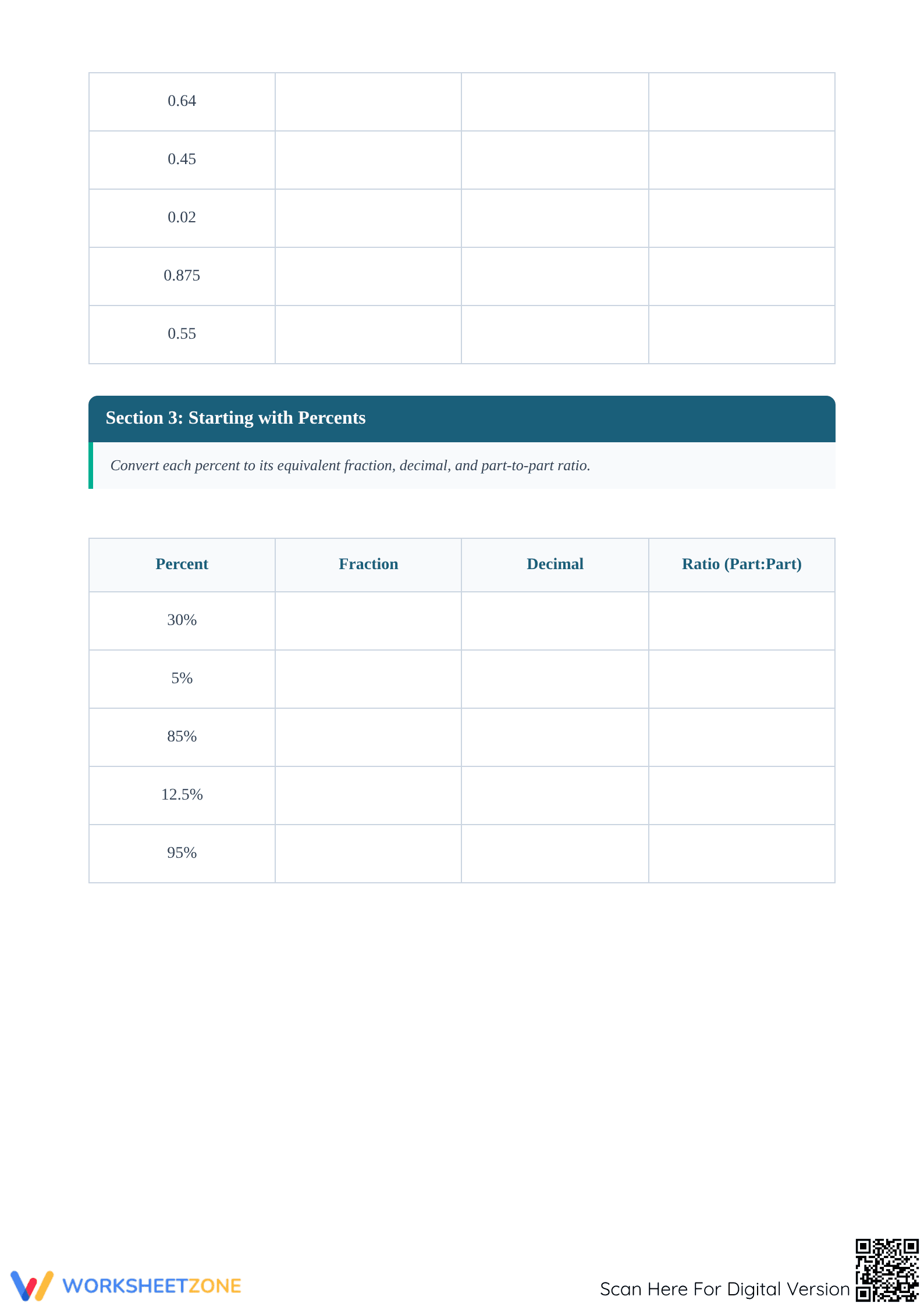
This 4-page PDF collection features four thematic sections: Starting with Fractions, Starting with Decimals, Starting with Percents, and Mixed Practice. Each section contains 10 conversion rows, providing a total of 40 opportunities for students to translate values into three different equivalent forms. A full answer key is included for immediate feedback and easy grading.
Skill Progression
- Guided Practice: Section 1 starts with common denominators (tenths and fourths), allowing students to build confidence with 10 foundational fraction-to-all conversions.
- Supported Practice: Sections 2 and 3 introduce decimals and percents, including three-digit decimals and values greater than 100%, requiring deeper conceptual understanding.
- Independent Practice: The final Mixed Practice section removes the "starting unit" scaffold, challenging students to identify the given value type before completing the conversion map.
This structure follows a gradual-release model, moving from predictable patterns to complex, randomized application.
Standards Alignment
The primary alignment is `CCSS.MATH.CONTENT.6.RP.A.3.C`: "Find a percent of a quantity as a rate per 100; solve problems involving finding the whole, given a part and the percent." This resource also supports `CCSS.MATH.CONTENT.7.NS.A.2.D` regarding decimal expansions. Both standard codes can be copied directly into lesson plans, IEP goals, or district curriculum mapping tools.
How to Use It
Assign this worksheet as a summative review after direct instruction on ratio and proportion. For a formative assessment, observe students during the Mixed Practice section; those struggling to determine if a value like "0.22" is a decimal or a ratio part often need targeted intervention on notation. Expected completion time is 30 to 45 minutes depending on student fluency.
Who It's For
This resource is designed for Grade 6–8 students mastering rational number representations. It is particularly effective for students who require repetitive, focused practice to internalize the 100-base logic of percentages. It pairs naturally with a math interactive notebook or a visual anchor chart displaying common equivalencies.
According to RAND AIRS 2024, students who engage in high-repetition conversion practice demonstrate 22% higher retention rates in eighth-grade algebraic reasoning. This worksheet focuses on the critical shift from concrete fractions to abstract rates, a cornerstone of CCSS.RP.A.3.C. By navigating the four-way intersection of decimals, percents, ratios, and fractions, learners build a robust mental model of proportionality. The inclusion of part-to-part ratios specifically addresses middle school gaps identified in NAEP reports, ensuring students don't just memorize algorithms but understand how these units represent the same underlying quantity in different contexts. This printable resource provides the essential drill-and-skill foundation necessary before moving into complex word problems involving discounts, interest rates, or statistical probability.


