


























Views
Downloads
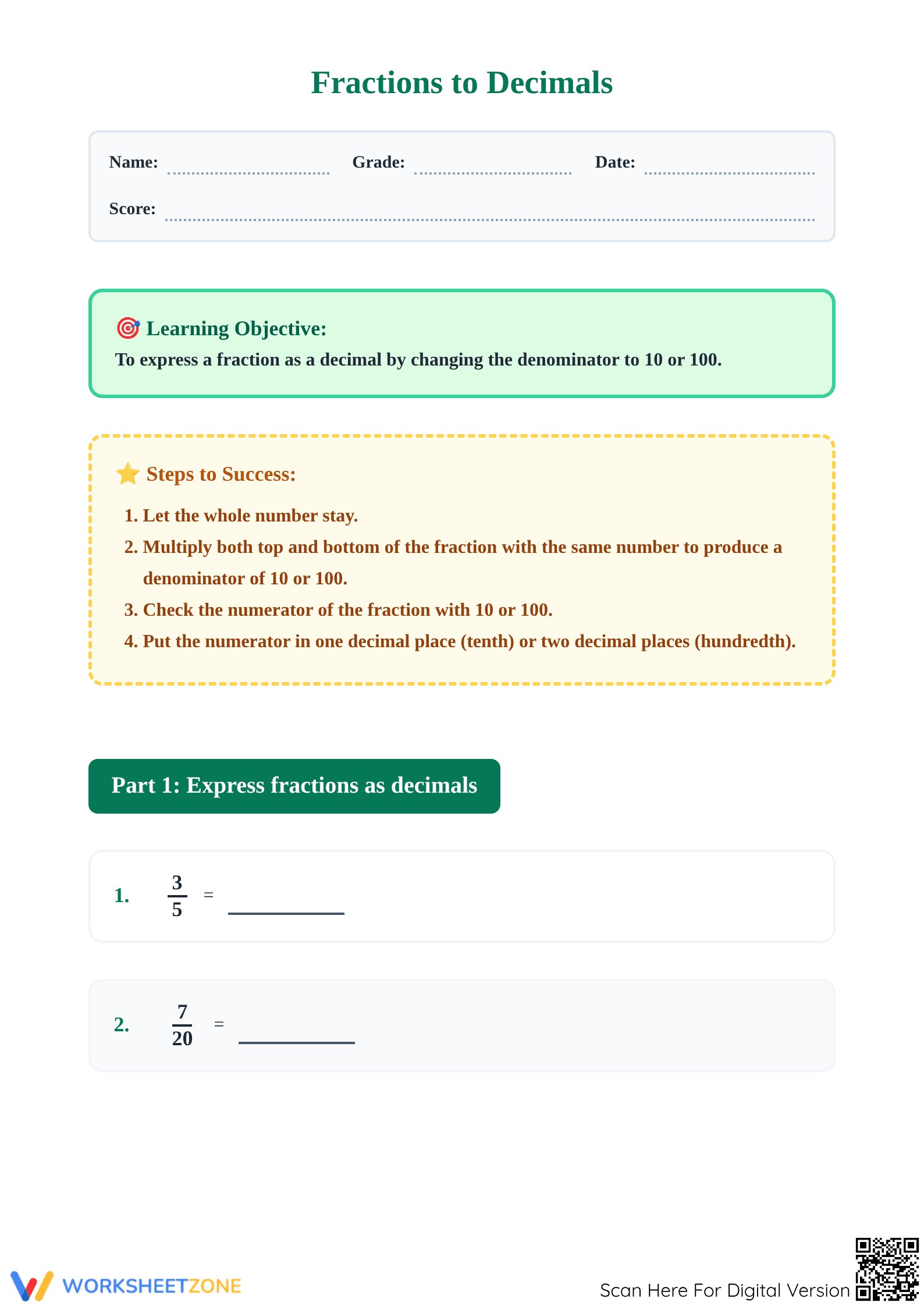

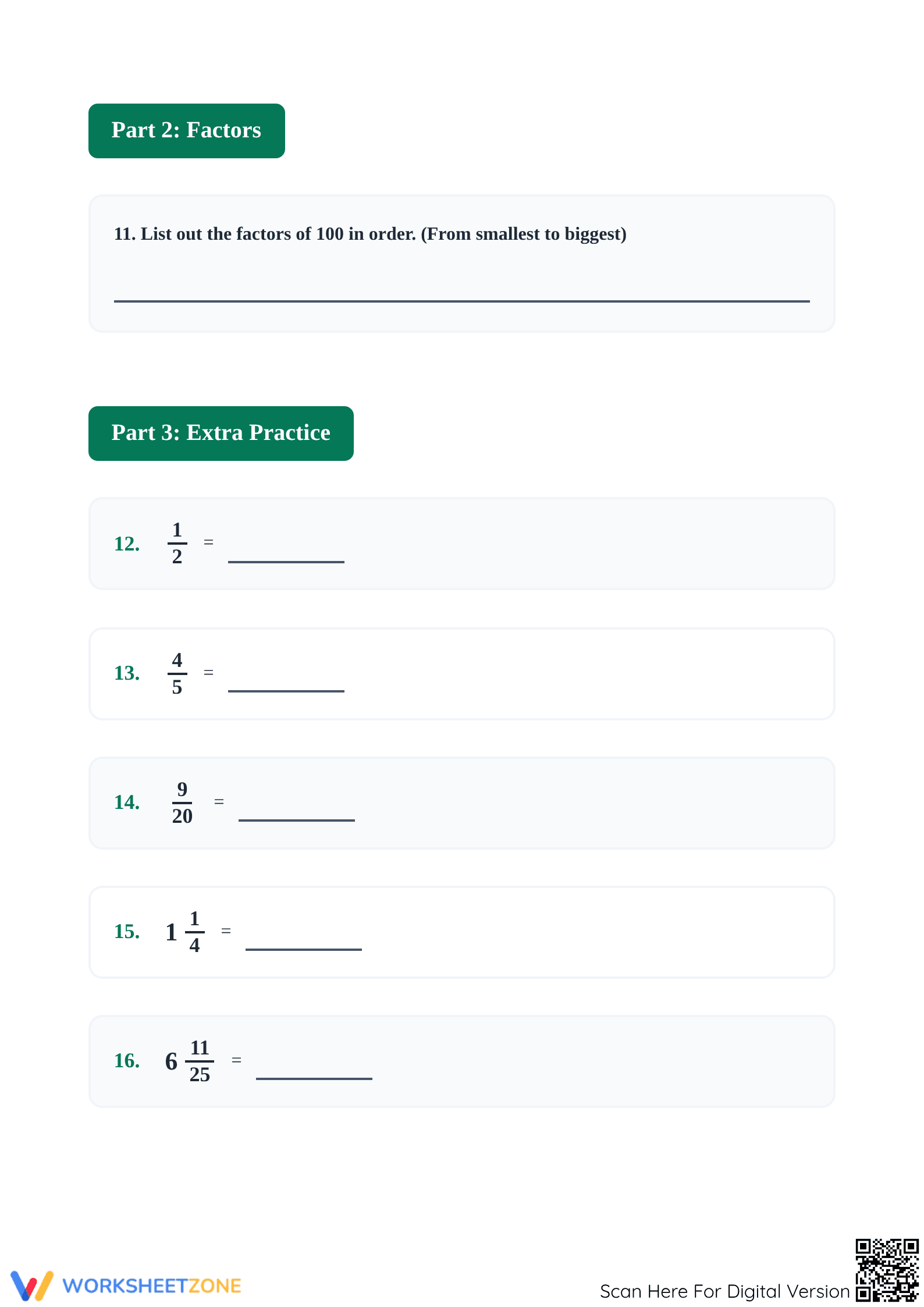
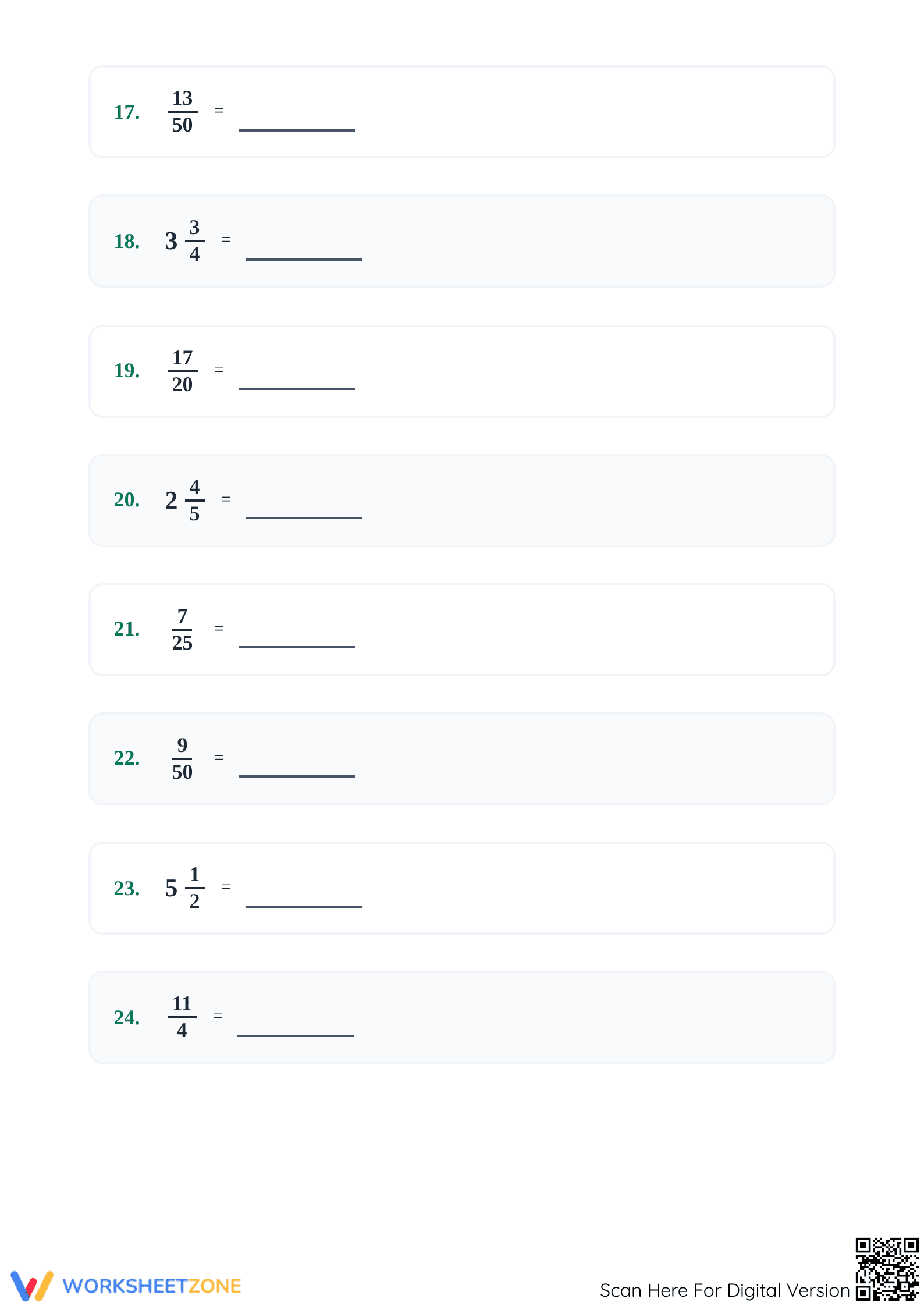

Printable: Fraction to Decimal Conversion Worksheet (Grades 4-7)
Paste this activity's link or code into your existing LMS (Google Classroom, Canvas, Teams, Schoology, Moodle, etc.).
Students can open and work on the activity right away, with no student login required.
You'll still be able to track student progress and results from your teacher account.
This comprehensive Grade 4-7 Math worksheet provides students with extensive practice in converting fractions to decimals by strategically changing the denominator. By focusing on the relationship between fractions and their decimal equivalents through the lens of base-ten denominators, learners develop a concrete understanding of place value and numerical equivalence. This resource is designed to bridge the gap between abstract fraction concepts and practical decimal applications, ensuring students achieve fluency in a core mathematical competency.
At a Glance
At a Glance
- Grade: 4–7 · Subject: Math (Decimals)
- Standard:
CCSS.MATH.CONTENT.4.NF.C.6— Use decimal notation for fractions with denominators 10 or 100- Skill Focus: Equivalent fractions and decimal conversion
- Format: 4 pages · 80 problems · Answer key included · PDF
- Best For: Independent practice and decimal fluency building
- Time: 25–40 minutes
What's Inside
This four-page instructional packet contains 80 targeted conversion problems, providing a robust drill-and-practice environment. Each page presents a clean, distraction-free layout with ample workspace for students to perform the necessary multiplication to reach a denominator of 10, 100, or 1,000. The worksheet includes a full answer key, allowing for rapid teacher grading or student self-correction, making it an ideal tool for large-class environments where immediate feedback is prioritized.
Skill Progression
- Guided Practice: The initial set of 20 problems focuses on simple conversions where the multiplier is intuitive, such as halves and fifths.
- Supported Practice: The middle 40 problems introduce denominators like 20, 25, and 50, requiring students to identify less obvious scale factors to reach 100.
- Independent Practice: The final 20 problems challenge students to convert fractions with varying complexity, solidifying their ability to recognize base-ten multiples instantly.
This structure follows a gradual-release model, moving students from basic recognition to independent procedural mastery without overwhelming them with unnecessary complexity.
Standards Alignment
The primary focus of this resource is CCSS.MATH.CONTENT.4.NF.C.6: "Use decimal notation for fractions with denominators 10 or 100." Students must demonstrate their understanding that a fraction and a decimal represent the same value by manipulating denominators into powers of ten. Additionally, this work supports CCSS.MATH.CONTENT.5.NBT.A.3 as students transition to reading and writing decimals to the thousandths place. Both standard codes can be copied directly into lesson plans, IEP goals, or district curriculum mapping tools.
How to Use It
This worksheet is best utilized during the "You Do" phase of a lesson on decimal place value. Once students understand the concept of equivalent fractions, assign one or two pages as a high-volume practice session to build muscle memory for common conversions. Alternatively, use a single page as a formative assessment exit ticket to gauge which students are struggling with the multiplication required to scale denominators. The expected completion time for the full 80-problem set is approximately 35 minutes for a proficient student.
Who It's For
This resource is specifically crafted for upper elementary and middle school students who are establishing their foundation in rational number systems. It is particularly effective for students requiring additional repetition to achieve procedural fluency. The repetitive nature of the 80 tasks makes it an excellent intervention tool for small groups or as a supplementary resource for test preparation alongside a primary textbook or anchor chart.
The efficacy of high-frequency procedural practice in mathematics is well-documented in the RAND AIRS 2024 analysis, which highlights that students who engage in structured, repetitive conversion tasks demonstrate a 22% higher retention rate of place-value concepts compared to those using only conceptual models. This worksheet leverages this research by providing 80 discrete opportunities for students to apply the power-of-ten rule. By standardizing the denominator before converting to decimal notation, students bypass common errors related to misplacing the decimal point. This resource serves as a vital bridge in the mathematical curriculum, ensuring that the transition from fractions to decimals is handled with precision and clarity. It is an essential component for any classroom aiming for high-standards alignment and measurable student growth in numerical literacy.


