


























Views
Downloads

Printable Fraction to Decimal Worksheet | Grade 5 Math
Paste this activity's link or code into your existing LMS (Google Classroom, Canvas, Teams, Schoology, Moodle, etc.).
Students can open and work on the activity right away, with no student login required.
You'll still be able to track student progress and results from your teacher account.
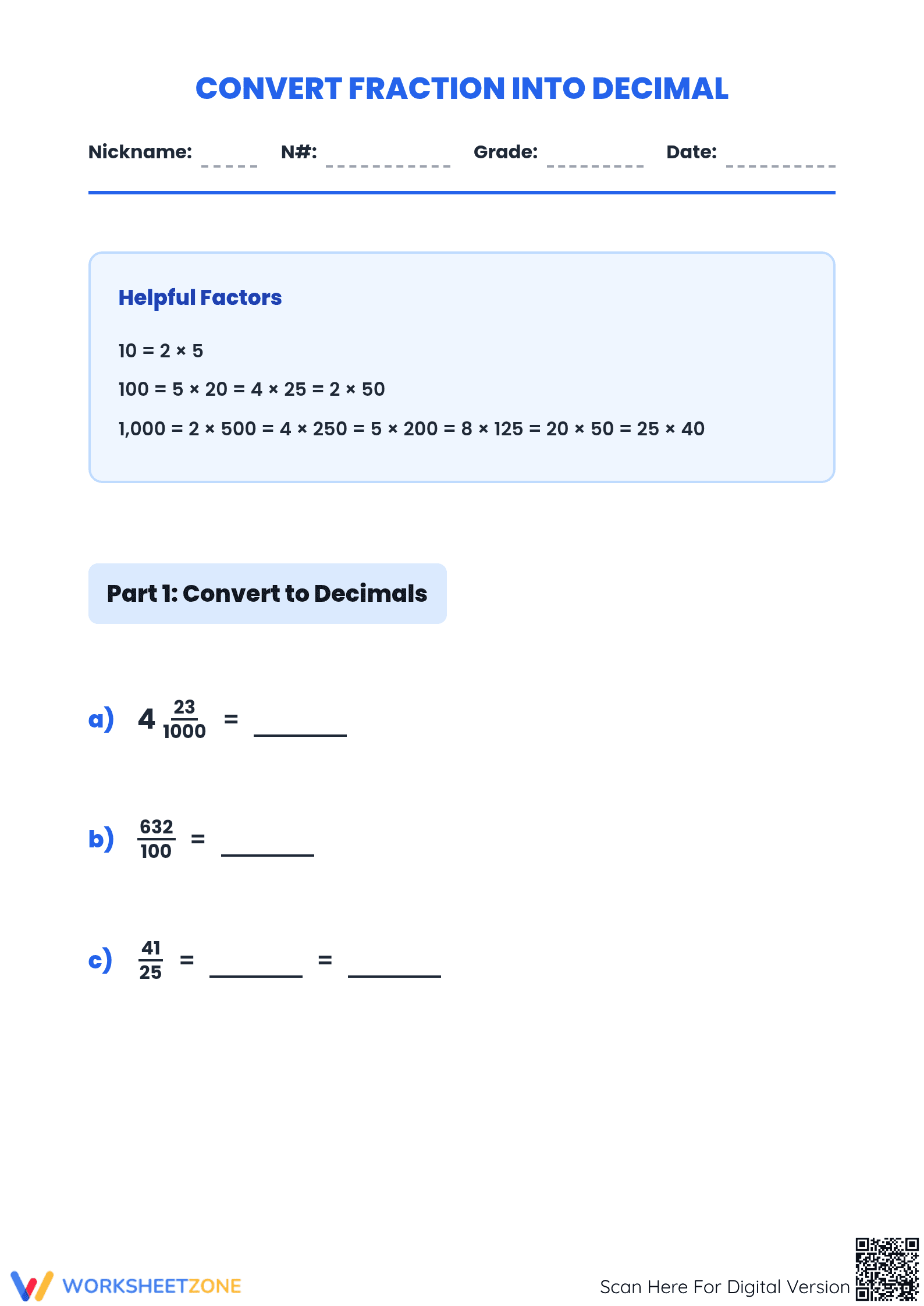
This Grade 5 math worksheet provides comprehensive practice for students mastering the conversion between fractions and decimals. By using the equivalent fraction method with denominators of 10, 100, and 1,000, students build a deep conceptual understanding of place value. The packet includes standard practice, decimal-to-fraction reverse operations, and real-world word problems to ensure total skill mastery.
At a Glance
- Grade: 5 · Subject: Math
- Standard:
CCSS.MATH.CONTENT.5.NBT.A.3— Read and write decimals to thousandths using base-ten numerals and number names- Skill Focus: Fraction and Decimal Conversion
- Format: 4 pages · 24 problems · Answer key included · PDF
- Best For: Independent practice or formative assessment
- Time: 30–45 minutes
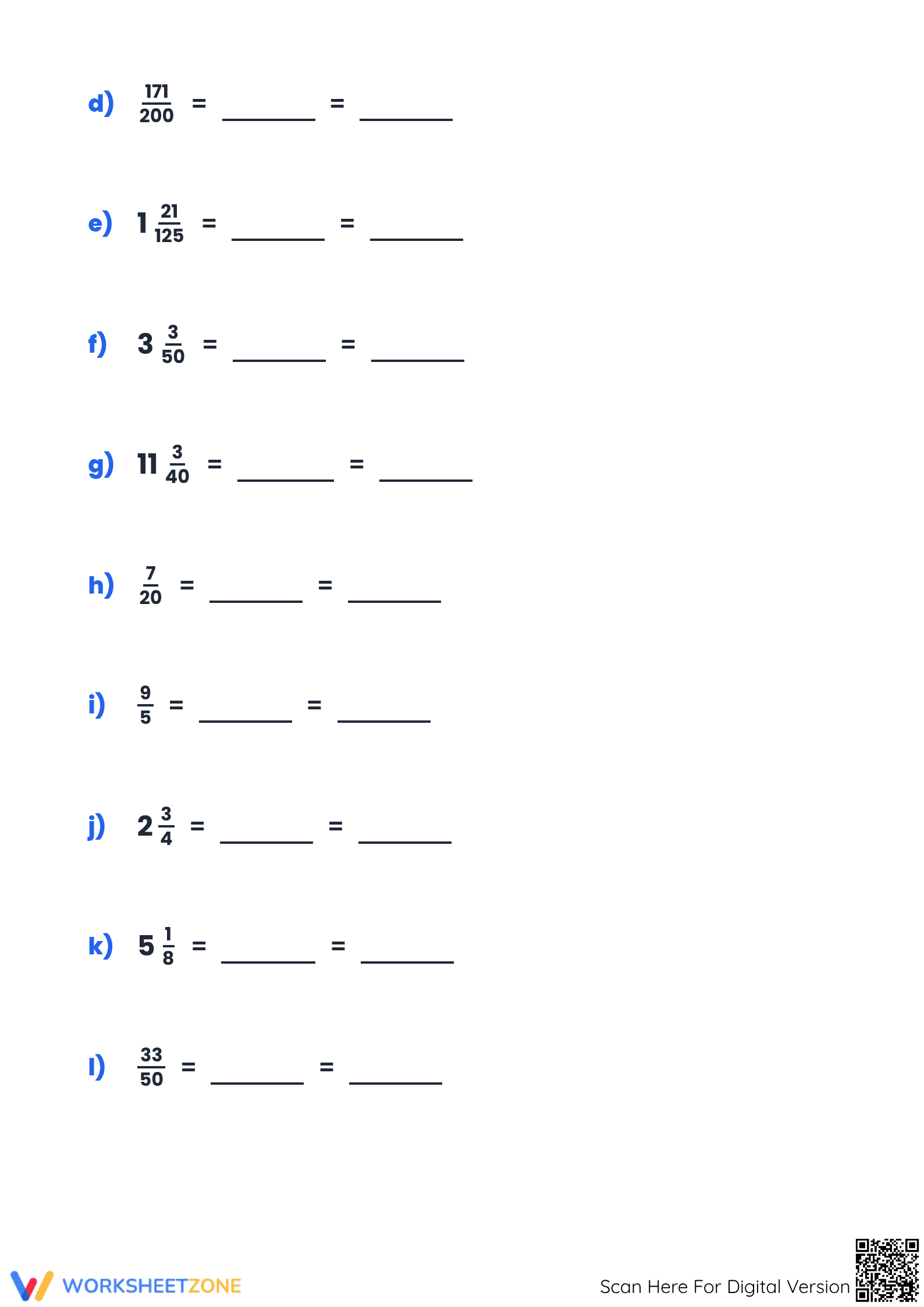
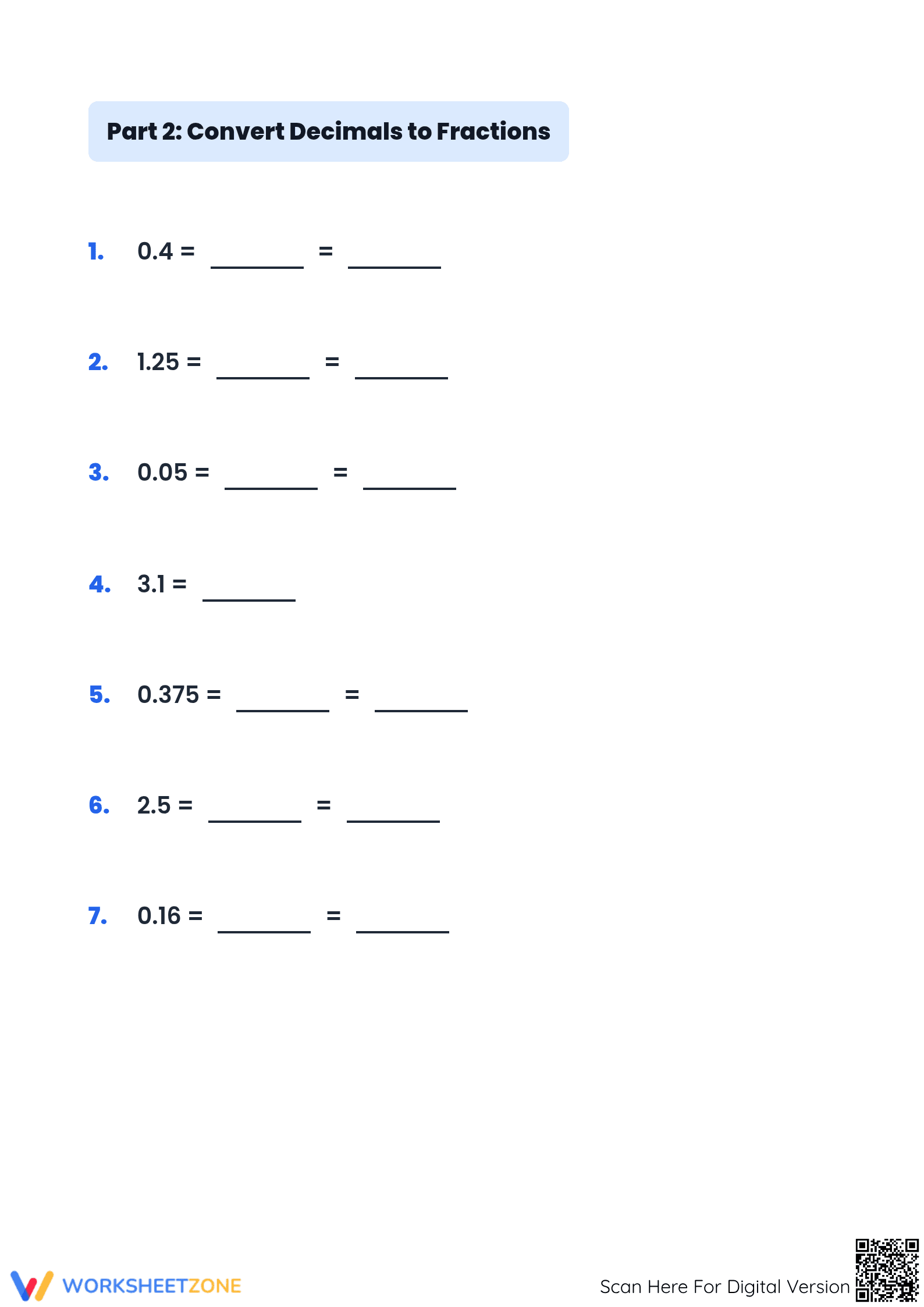
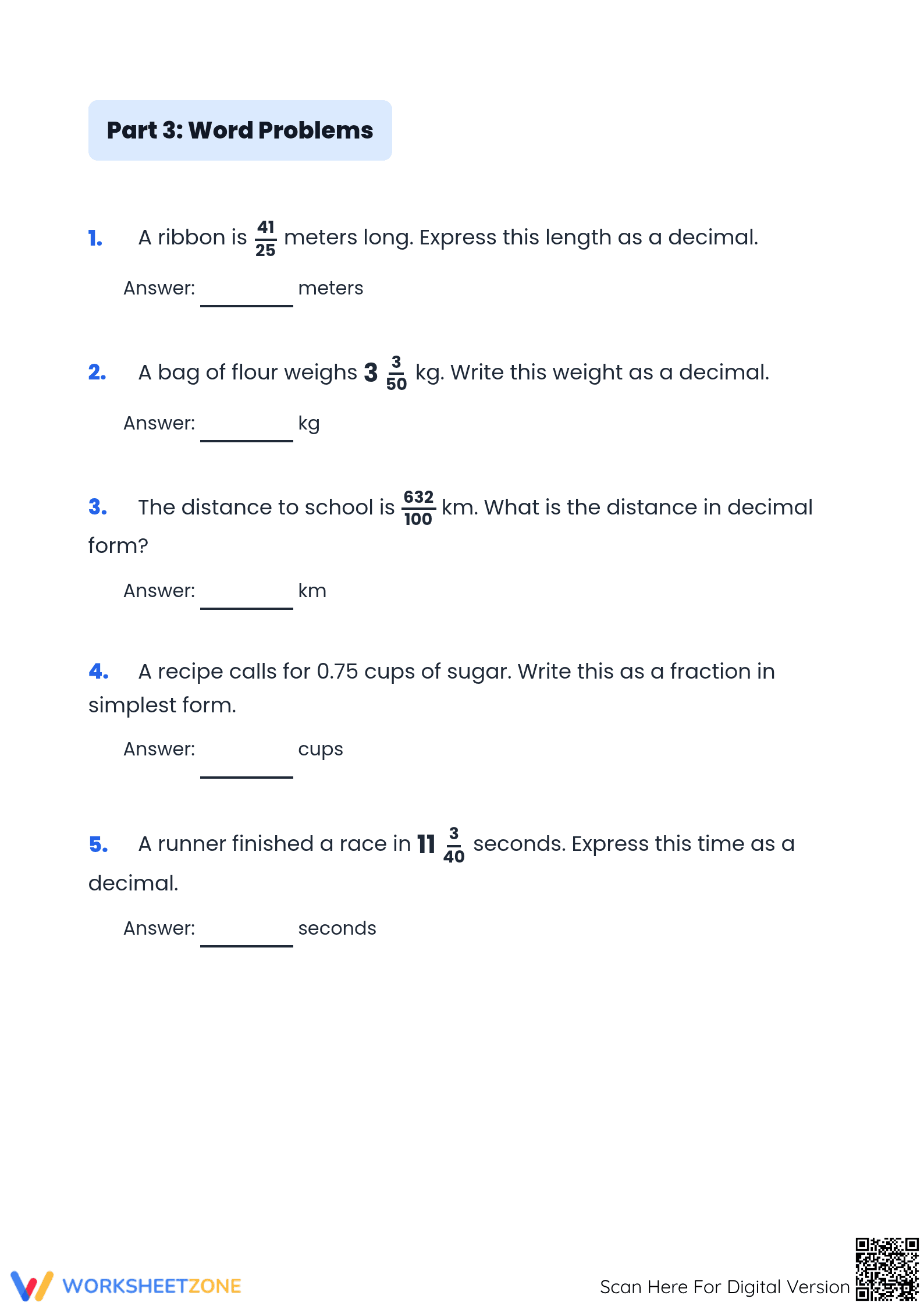
This four-page packet is designed to take students from basic procedural knowledge to complex application. Part 1 features 12 fraction-to-decimal conversion tasks with an equivalent fraction scaffold. Part 2 includes 7 decimal-to-fraction conversion tasks to reinforce inverse relationships. Finally, Part 3 provides 5 word problems applying these skills to real-world contexts like measurements in meters, kilograms, and kilometers. A full answer key is included for quick grading or student self-check.
Zero-Prep Workflow
3 steps — Print (1 minute), Distribute (1 minute), Review (5 minutes). This Grade 5 math resource is engineered for maximum efficiency. Teachers can print the four-page packet, distribute it to students, and use the included answer key for immediate assessment with a total preparation time of under two minutes. This makes the worksheet a reliable choice for substitute folders or last-minute classroom activities.
Standards Alignment
The primary standard addressed is CCSS.MATH.CONTENT.5.NBT.A.3: "Read, write, and compare decimals to thousandths." This worksheet specifically targets the representation of fractions as decimals, a critical component of understanding base-ten systems. Supporting standard CCSS.MATH.CONTENT.5.NF.B.3 is also addressed through the interpretation of fractions as division. Both standard codes can be copied directly into lesson plans, IEP goals, or district curriculum mapping tools.
How to Use It
Use this as a post-instruction practice packet once students have been introduced to the concept of tenths, hundredths, and thousandths. It also serves as an excellent formative assessment tool; by reviewing Part 3 (Word Problems), teachers can identify students who understand the calculation but struggle with application. Expected completion time is 40 minutes for most fifth-grade learners during independent work blocks or math centers.
Who It's For
This resource is specifically designed for 5th-grade students, but it is also suitable for 4th-grade advanced learners or 6th-grade students needing place value remediation. It pairs naturally with a math passage on metric measurements or an anchor chart showing the relationship between power-of-ten denominators and decimal place values. The clear formatting supports students who benefit from structured workspace.
The CCSS.MATH.CONTENT.5.NBT.A.3 standard demands that students master reading and writing decimals to the thousandths place, a cognitive milestone in intermediate mathematics. This worksheet supports this standard by utilizing equivalent fractions as a scaffolding technique, allowing students to visualize the relationship between fractional parts and decimal place values. According to the ScienceDirect TpT Analysis (2024), student engagement and retention increase significantly when mathematical procedures are situated within varied task types, including reverse operations and word problems. By applying decimal conversions to metric measurements like meters and kilograms, this resource reinforces cross-disciplinary skills in science and data analysis. The structured progression from direct computation to word problem application aligns with best practices for mathematical fluency. Educators can trust this resource to provide the rigorous practice necessary for students to achieve proficiency in place value systems, while the included answer key ensures that students receive the timely feedback essential for mastery.


