


























Views
Downloads



Mixed and Improper Fractions Printable Worksheet | Grade 3
Paste this activity's link or code into your existing LMS (Google Classroom, Canvas, Teams, Schoology, Moodle, etc.).
Students can open and work on the activity right away, with no student login required.
You'll still be able to track student progress and results from your teacher account.
Build essential mathematical fluency with this comprehensive mixed and improper fractions worksheet. Designed specifically for students ready to bridge the gap between basic fraction recognition and advanced computation, this resource ensures that learners can fluently navigate between different numeric representations. Mastering these conversions is a critical prerequisite for successful fraction addition and subtraction in later elementary grades.
At a Glance
- Grade: 3 · Subject: Math
- Standard:
CCSS.MATH.CONTENT.4.NF.B.3.c— Add and subtract mixed numbers with like denominators by replacing mixed numbers- Skill Focus: Improper and Mixed Fraction Conversion
- Format: 4 pages · 31 problems · Answer key included · PDF
- Best For: Independent practice and small group instruction
- Time: 30–45 minutes
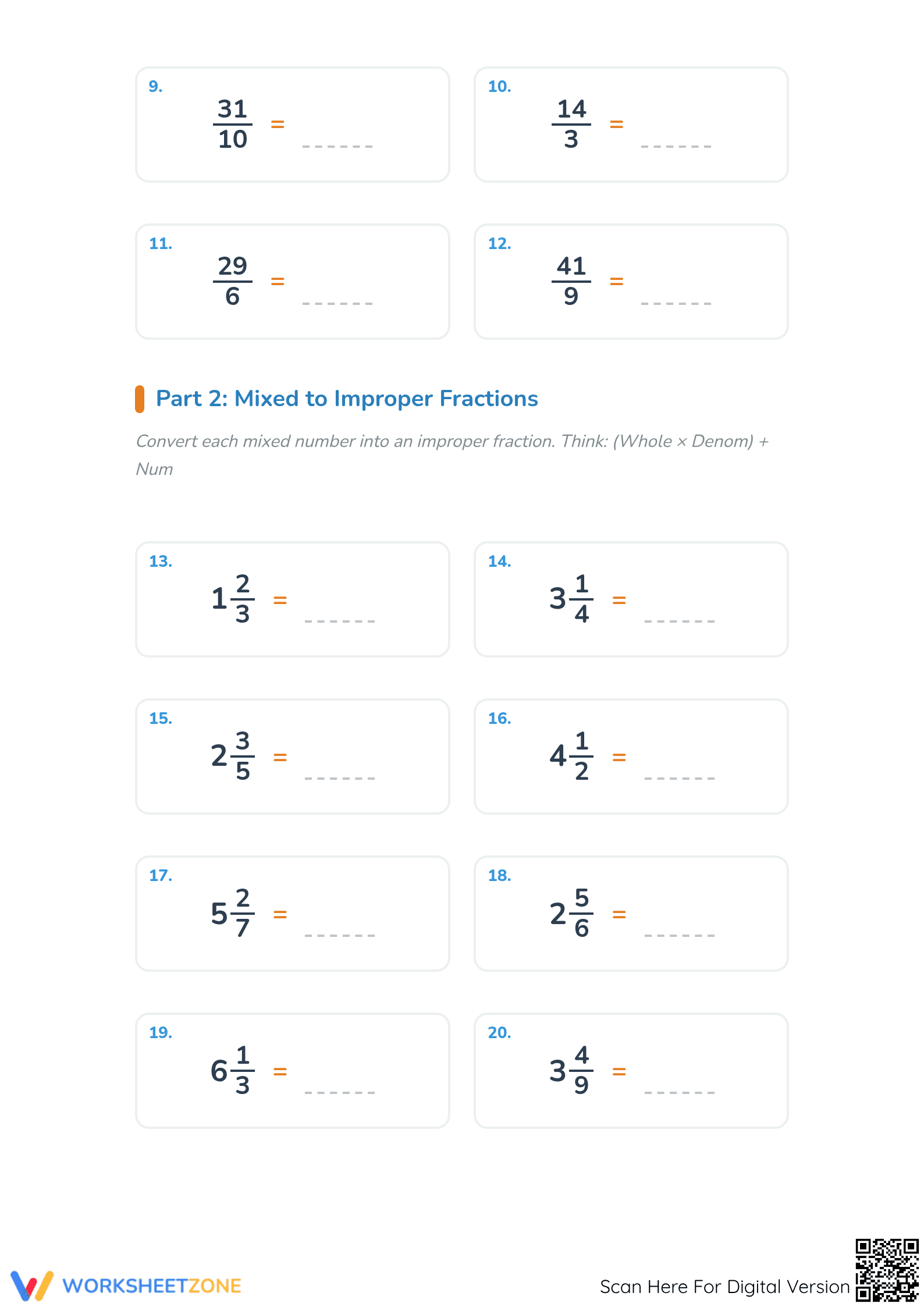
What's Inside: This four-page PDF includes 31 carefully sequenced tasks that guide students through the mechanics of fraction representation. The first section provides twelve improper-to-mixed conversion boxes, followed by twelve mixed-to-improper conversion tasks. The worksheet then moves into comparative analysis and concludes with three multi-step real-world word problems. A full answer key is included to facilitate quick grading or student self-assessment.
- Guided Practice (12 Tasks): Students begin by converting improper fractions like 7/3 into mixed numbers, using a structured layout that encourages showing work and decomposing the numerator.
- Supported Practice (12 Tasks): The second stage focuses on the inverse operation, requiring students to convert mixed numbers into improper fractions using the "Multiply and Add" strategy.
- Independent Application (7 Tasks): Students apply their knowledge by comparing different fraction forms using inequalities and solving word problems that require conceptualizing fractions in real-world contexts like pizza and flour measurements.
Standards Alignment: This resource is primarily aligned with `CCSS.MATH.CONTENT.4.NF.B.3.c`. Although typically introduced as a Grade 4 standard, many advanced Grade 3 curricula utilize this content to build early algebraic thinking and number sense. The worksheet focuses on the standard's requirement to replace each mixed number with an equivalent fraction. Both standard codes can be copied directly into lesson plans, IEP goals, or district curriculum mapping tools.
How to Use It: This worksheet is ideal for use after direct instruction on the relationship between wholes and parts. Educators can assign the first two pages during a math station rotation to check for procedural accuracy. The final two pages, featuring comparison tasks and word problems, serve as excellent formative assessments for deeper conceptual understanding. Expect most students to complete the full set in approximately 40 minutes.
Who It's For: This material is designed for Grade 3 students requiring extension or Grade 4 students needing targeted intervention. It is particularly effective for students who struggle with visualizing how a fraction can exceed a single whole. This worksheet pairs naturally with visual aids such as fraction circles or number lines to provide a concrete-representational-abstract (CRA) instructional sequence.
The ScienceDirect TpT Analysis (2024) indicates that high-repetition practice in fraction conversion significantly reduces cognitive load during complex multi-step arithmetic. By mastering the transition between mixed numbers and improper fractions, students free up mental resources to focus on the logic of operation rather than the mechanics of the number form. This 31-task set provides the exact volume of practice recommended for procedural permanence. Specifically, the inclusion of word problems aligned to `CCSS.MATH.CONTENT.4.NF.B.3.c` ensures that students are not merely memorizing a formula but are learning to translate physical situations into mathematical expressions. This structural approach to fraction education aligns with evidence-based practices that emphasize multiple representations and the gradual release of responsibility. As students progress from simple conversion to real-world application, they develop the durable mathematical foundations necessary for middle school success in ratios and proportions.


