


























Views
Downloads




Essential Mixed Numbers Worksheet | Grade 3 Math Printable
Paste this activity's link or code into your existing LMS (Google Classroom, Canvas, Teams, Schoology, Moodle, etc.).
Students can open and work on the activity right away, with no student login required.
You'll still be able to track student progress and results from your teacher account.
This Grade 3 Math worksheet provides structured practice for converting between mixed numbers and improper fractions. Students develop fluency through visual models, algorithmic steps, and word problems. By mastering these conversions, learners build the conceptual foundation needed for advanced fractional operations and real-world problem-solving. Each section transitions from scaffolds to independent application.
At a Glance
- Grade: Grade 3 · Subject: Math
- Standard:
CCSS.MATH.CONTENT.4.NF.B.3.C— Replace mixed numbers with equivalent fractions and improper fractions to solve problems.- Skill Focus: Improper and Mixed Fraction Conversion
- Format: 5 pages · 36 problems · Answer key included · PDF
- Best For: Small group instruction or independent practice
- Time: 45–60 minutes
What's Inside
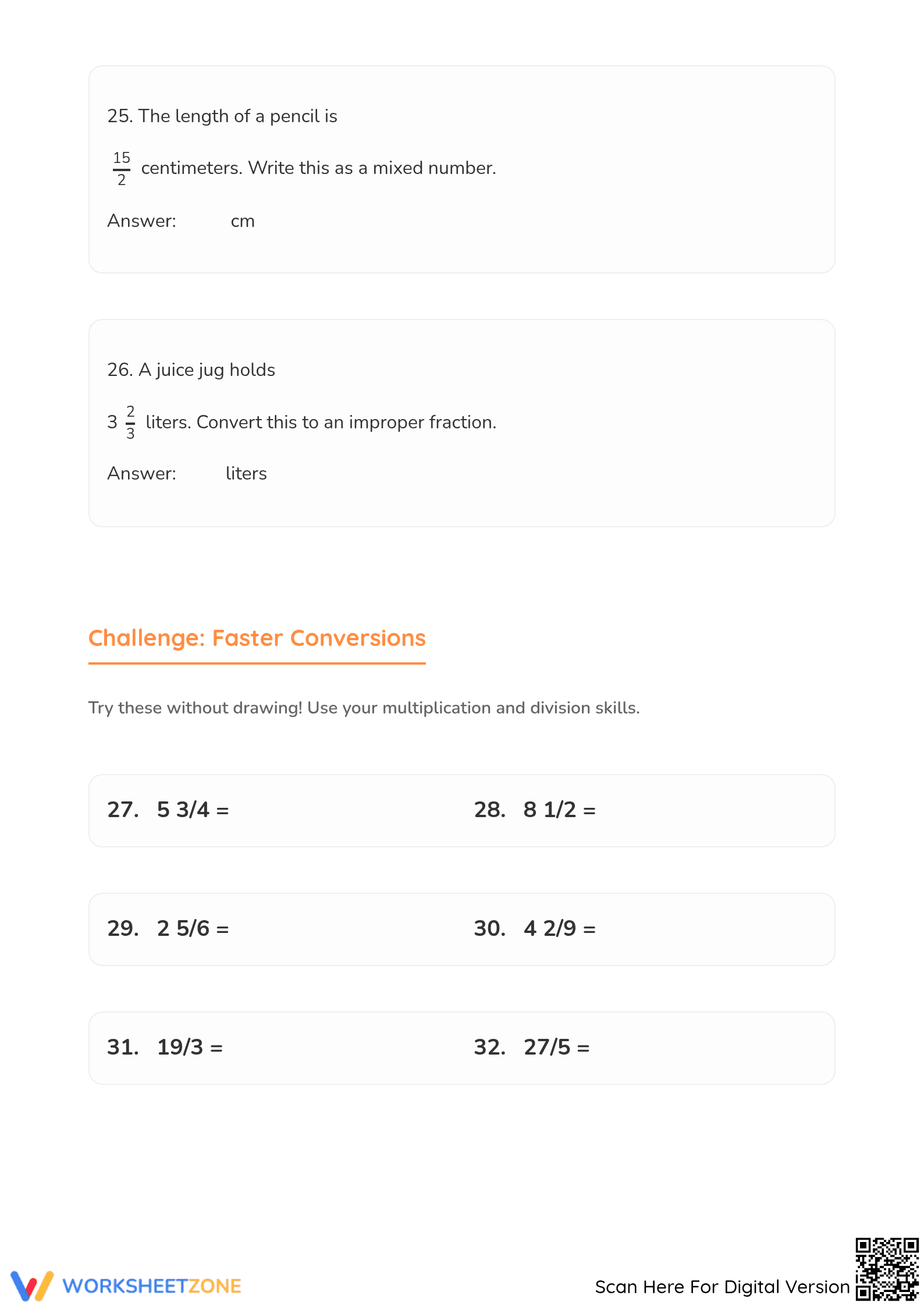
The packet features four distinct sections spread across five high-quality pages. It begins with visual models to anchor conceptual understanding, followed by 20 algorithmic practice problems with helpful step-by-step reminders. The set also includes four rigorous word problems and a ten-item "Fast Conversion" challenge section. A complete answer key is provided to facilitate rapid grading and student self-correction.
Zero-Prep Workflow
Teachers can implement this zero-prep resource in under two minutes. First, print the five-page PDF (60 seconds). Second, distribute the packets to students during your core math block (30 seconds). Third, review the visual models in Part 1 as a whole class before releasing students to work independently (30 seconds). This streamlined workflow is ideal for emergency sub plans or busy classroom schedules.
Standards Alignment
Primary alignment is with `CCSS.MATH.CONTENT.4.NF.B.3.C`, which requires students to add and subtract mixed numbers by replacing them with equivalent fractions. Although this is typically a 4th-grade standard, this Grade 3 resource serves as an excellent extension for advanced learners or a core component of mastery-based curricula. Both standard codes can be copied directly into lesson plans, IEP goals, or district curriculum mapping tools.
How to Use It
Use this worksheet during the "You Do" phase of a gradual release lesson on fraction equivalence. It provides the volume of practice needed to move from conceptual drawing to mental calculation. For formative assessment, observe students during Part 3; if they struggle with the division step, provide a multiplication chart to support their division facts. Expected completion time is approximately 50 minutes.
Who It's For
This resource is designed for Grade 3 students ready for advanced fraction concepts and Grade 4 students requiring remediation. It is particularly effective for English Language Learners due to the heavy reliance on visual models in the introductory section. Pair this worksheet with a physical set of fraction tiles or circles to provide a concrete manipulative experience before transitioning to paper.
The ability to transition between mixed numbers and improper fractions is a pivotal milestone in elementary math development. According to a RAND AIRS 2024 analysis of instructional materials, students who master these conversions through a combination of visual modeling and procedural practice demonstrate higher success rates when performing complex operations. This worksheet aligns with `CCSS.MATH.CONTENT.4.NF.B.3.C` by providing a dual-pathway approach: the initial sections use geometric circles and rectangles to build mental imagery, while the algorithmic parts reinforce standard calculation methods. Mastery of this skill ensures students view fractions as single numerical values rather than isolated sets of numbers, a conceptual shift that NAEP research identifies as critical for long-term algebraic readiness. The addition of real-world word problems further validates the student's ability to apply abstract concepts to authentic contexts like measurements and sharing.


