




























Views
Downloads


Future Intentions Worksheet | Grade 5-8 Printable

Paste this activity's link or code into your existing LMS (Google Classroom, Canvas, Teams, Schoology, Moodle, etc.).
Students can open and work on the activity right away, with no student login required.
You'll still be able to track student progress and results from your teacher account.
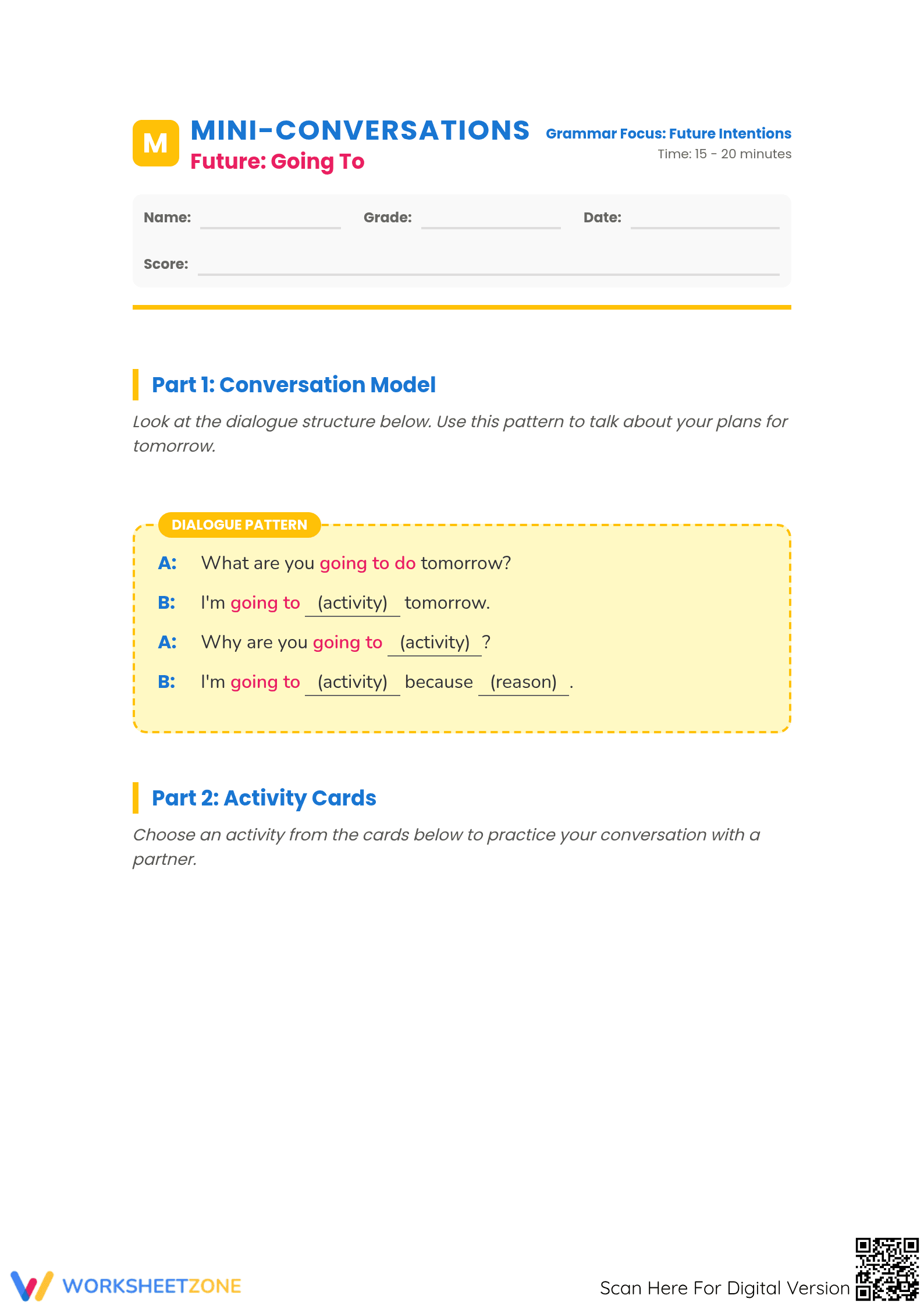
This comprehensive Grade 5-8 worksheet focuses on the grammatical structure of "going to" to express future intentions. Students will move from guided conversation modeling to independent writing and interactive partner practice. By using the provided dialogue patterns, learners develop the confidence to speak and write about their upcoming plans with clarity and precision.
At a Glance
- Grade: 5-8 · Subject: English Language Arts
- Standard:
CCSS.ELA-LITERACY.L.5.1— Demonstrate command of grammar when speaking about future plans using 'going to'- Skill Focus: Future Intentions with "Going To"
- Format: 3 pages · 26 tasks · Teacher notes included · PDF
- Best For: Interactive partner speaking and grammar practice
- Time: 15–20 minutes
What's Inside
This 3-page resource includes a structured conversation model that scaffolds the "going to" pattern for students. It features 20 individual activity cards ranging from daily chores to travel plans, providing diverse prompts for oral practice. The final page offers a writing practice section for consolidating learning and a detailed teacher guide for running a successful mingle activity.
Zero-Prep Workflow
- Print: Print the three pages and cut the 20 activity cards, which takes approximately 60 seconds.
- Distribute: Give one card to each student and model the dialogue on the board in under 2 minutes.
- Review: Set a timer for 15 minutes of partner exchange and review the written responses as a formative check.
This streamlined approach ensures that teachers can implement a high-engagement speaking activity without extensive planning or preparation time.
Standards Alignment
The primary standard for this resource is `CCSS.ELA-LITERACY.L.5.1`, which requires students to demonstrate a command of the conventions of standard English grammar and usage when writing or speaking. Specifically, it supports the mastery of verb tenses and intentions. This standard code can be copied directly into lesson plans, IEP goals, or district curriculum mapping tools.
How to Use It
Use this as a mingle activity during the practice phase of a grammar lesson. Give each student one card and have them find different partners to practice the dialogue model. Teachers should circulate and observe, noting if students correctly use the "going to + verb" structure and provide logical reasons for their plans. This serves as an excellent warm-up or transition activity.
Who It's For
This worksheet is ideal for Grade 5-8 students who are refining their use of future tenses. It is particularly effective for English Language Learners (ELL) at the A1-A2 level who benefit from sentence frames and visual cues. Pair this resource with a short reading passage about weekend plans or an anchor chart on future verb forms for maximum impact.
Effective grammar instruction requires a balance between explicit modeling and interactive application to ensure long-term retention of language structures. According to the RAND AIRS 2024 report on literacy instruction, providing students with structured sentence frames and opportunities for peer-to-peer verbal exchange significantly improves their ability to internalize complex grammatical rules like future intentions. This worksheet targets the CCSS.ELA-LITERACY.L.5.1 standard by guiding students through a three-stage progression: understanding the dialogue pattern, applying it to 20 diverse real-world contexts, and formalizing their learning through creative writing. The inclusion of activity cards encourages a communicative approach to language learning, which NAEP research suggests is essential for developing communicative competence in middle-grade learners. By focusing on the plain-English skill of expressing what they are going to do, students bridge the gap between abstract grammar rules and meaningful, functional communication in English Language Arts.


