


























Views
Downloads




Grade 8 Context Clues Worksheet | Essential Practice
Paste this activity's link or code into your existing LMS (Google Classroom, Canvas, Teams, Schoology, Moodle, etc.).
Students can open and work on the activity right away, with no student login required.
You'll still be able to track student progress and results from your teacher account.
This Grade 8 context clues worksheet provides a rigorous framework for students to decipher complex vocabulary using textual evidence. By analyzing 12 distinct sentences, learners develop the critical ability to infer meanings of sophisticated terms like scrupulously and ascertain. This resource ensures students move beyond guessing to evidence-based linguistic analysis and vocabulary mastery.
At a Glance
- Grade: 8 · Subject: English Language Arts
- Standard:
CCSS.ELA-LITERACY.L.8.4.A— Use context clues to determine the meaning of unknown words- Skill Focus: Contextual Inference & Evidence Citation
- Format: 5 pages · 12 problems · Answer key included · PDF
- Best For: Independent practice and vocabulary assessment
- Time: 25–35 minutes
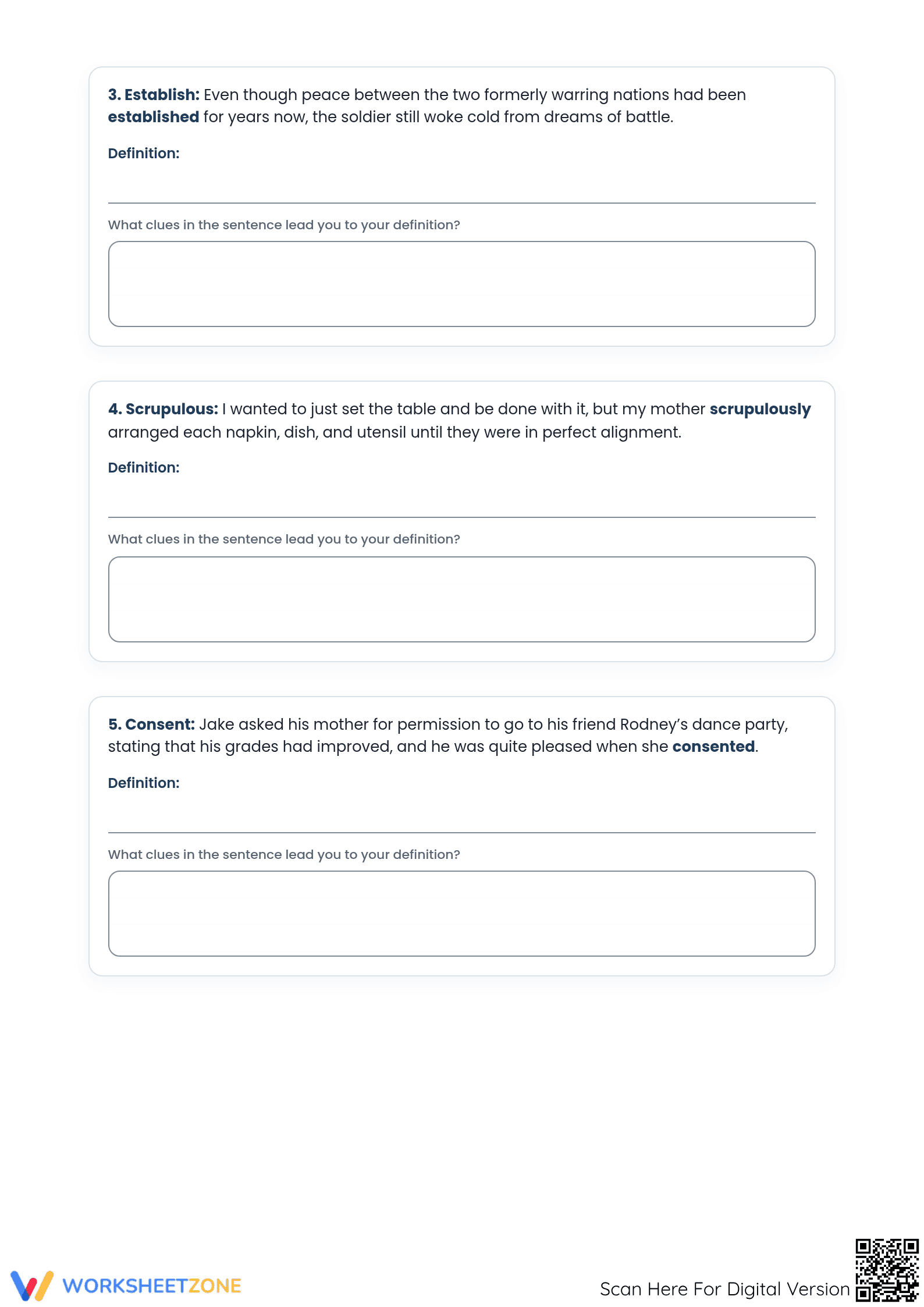
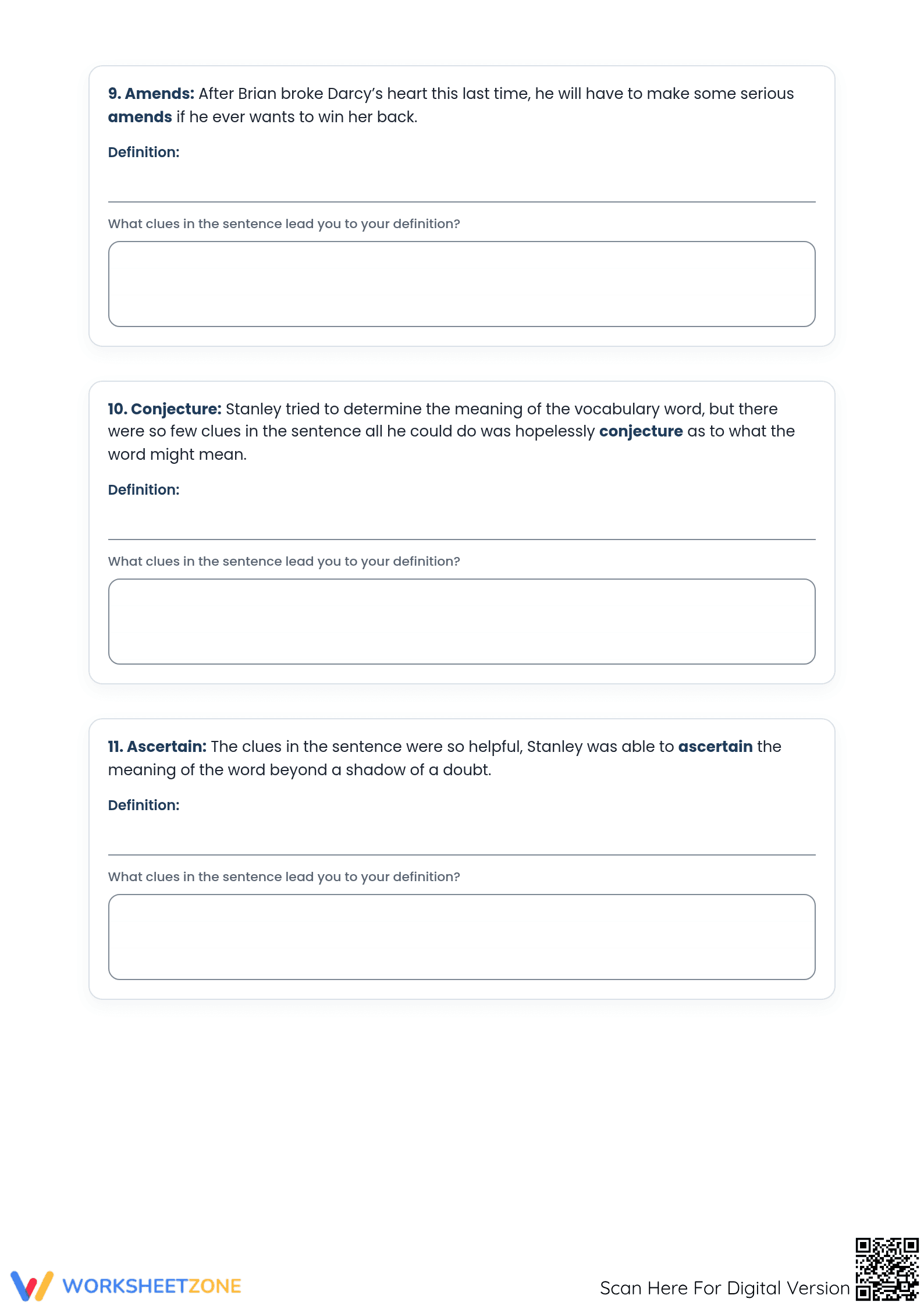
What's Inside: The packet contains 12 high-interest sentences spread across 5 pages. Each item features a bolded vocabulary word within a complex sentence structure. Students are provided with two specific response areas for every task: a line for the formal definition and a dedicated workspace to explain the specific clues or ideas that guided their thinking, ensuring they can justify their logic.
Skill Progression
- Guided Practice: The first 4 items use direct synonyms and clear contrast clues to help students identify the basic mechanics of contextual inference.
- Supported Practice: Items 5 through 8 introduce more abstract concepts where the context is embedded in the overall tone of the sentence rather than a single keyword.
- Independent Practice: The final 4 tasks require students to synthesize multiple clues across complex clauses to arrive at a precise definition.
This structure follows a gradual-release model, moving from simple identification to complex justification of linguistic choices.
Standards Alignment: This resource is specifically aligned to CCSS.ELA-LITERACY.L.8.4.A: "Use context (e.g., the overall meaning of a sentence or paragraph; a word's position or function in a sentence) as a clue to the meaning of a word or phrase." It also supports L.8.6 by expanding the acquisition of academic and domain-specific words. Both standard codes can be copied directly into lesson plans, IEP goals, or district curriculum mapping tools.
How to Use It: Use this as a mid-unit formative assessment to gauge how well students can justify their vocabulary choices. It works exceptionally well as a bell-ringer activity or a focused homework assignment. Teachers should observe the evidence boxes to identify students who struggle with citing specific textual evidence versus those who rely solely on prior knowledge. Expected completion time is 30 minutes.
Who It's For: This is designed for Grade 8 students but serves as an excellent challenge for Grade 7 or a review for Grade 9. It is particularly effective for English Language Learners (ELLs) who need structured practice in identifying signal words. Pair this with a root word anchor chart or a short story passage to reinforce the skill in a broader literary context.
Research by Fisher & Frey (2014) emphasizes that vocabulary instruction is most effective when students are required to generate their own definitions based on textual evidence rather than simply memorizing a dictionary entry. This worksheet implements that research-based strategy by forcing a two-step cognitive process: identification and justification. By aligning with CCSS.ELA-LITERACY.L.8.4.A, the resource targets the specific Grade 8 demand for analyzing word position and function within complex syntax. Data from NAEP indicates that students who master contextual inference perform significantly higher on overall reading comprehension assessments. This 12-task set provides the necessary repetition to move this skill from a conscious effort to an automated reading habit. The inclusion of 5 pages of focused practice ensures that students encounter a variety of sentence structures, which is critical for long-term retention and transfer of vocabulary skills across different genres of informational and literary texts.


