


























Views
Downloads



Essential Constant of Proportionality Task | Grade 7
Paste this activity's link or code into your existing LMS (Google Classroom, Canvas, Teams, Schoology, Moodle, etc.).
Students can open and work on the activity right away, with no student login required.
You'll still be able to track student progress and results from your teacher account.
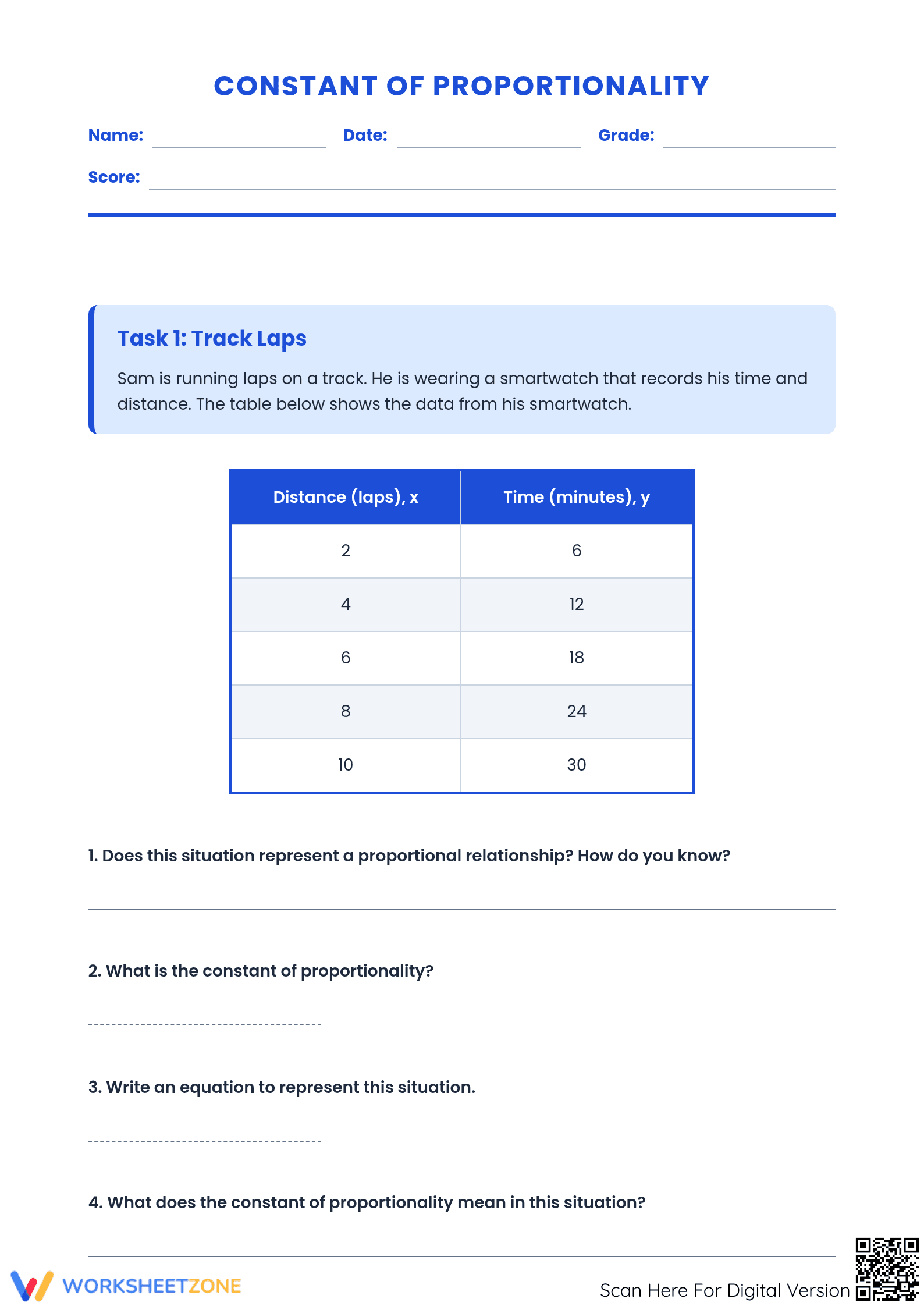
This Grade 7 performance task allows students to demonstrate mastery of proportional relationships through real-world scenarios involving track laps and farmer's market pricing. Students analyze tables to identify constants, write representative equations, and apply their findings to solve multi-step problems. It provides a comprehensive assessment of unit rate understanding and mathematical modeling skills.
At a Glance
- Grade: 7 · Subject: Math
- Standard:
CCSS.MATH.CONTENT.7.RP.A.2— Identify and represent proportional relationships between quantities in tables and equations- Skill Focus: Constant of Proportionality (Unit Rate)
- Format: 3 pages · 12 problems · Answer key included · PDF
- Best For: Summative assessment or guided mastery practice
- Time: 35–45 minutes
Inside this three-page packet, you will find two distinct performance tasks centered on real-world data. Task one focuses on distance-time relationships in running, while task two explores weight-cost ratios at a market. The layout includes structured tables, open-ended "how do you know" justification prompts, and space for equation modeling. A full answer key is provided for efficient grading.
This worksheet is designed to elicit evidence of mathematical mastery across three tiers of understanding. Students begin by identifying if a relationship is proportional (Approaching), then calculate the specific constant of proportionality (Meeting), and finally interpret that constant within a situational context (Exceeding). Each task maps to a sub-skill, facilitating progress tracking for IEP goals or district gradebooks.
Primary alignment is to `CCSS.MATH.CONTENT.7.RP.A.2.B`, which requires students to identify the constant of proportionality in tables and verbal descriptions. It also supports `CCSS.MATH.CONTENT.7.RP.A.2.C` through the requirement to represent these relationships with equations of the form y = kx. Both standard codes can be copied directly into lesson plans, IEP goals, or district curriculum mapping tools.
Use this resource as a summative performance task after completing direct instruction on unit rates and proportional tables. During the instructional sequence, observe students as they attempt Question 4; if they struggle to verbalize the meaning of the constant, use it as a prompt for a small-group strategy session. The expected completion time for most seventh graders is 40 minutes.
This task is ideal for Grade 7 general education students, but the clear table structures make it accessible for students with accommodations. It pairs naturally with a "Constant of Proportionality" anchor chart or a lesson on ratios. Teachers can use the real-world contexts to help students bridge the gap between abstract numbers and tangible quantities.
The development of proportional reasoning is a cornerstone of middle school mathematics, serving as the essential bridge between arithmetic and algebraic functions. According to Fisher & Frey (2014), the use of performance tasks that require students to translate between multiple representations—such as tables, verbal descriptions, and equations—is a high-leverage instructional strategy that promotes long-term retention of `CCSS.MATH.CONTENT.7.RP.A.2`. This worksheet scaffolds the identification of the constant of proportionality (unit rate) by grounding abstract calculations in familiar contexts like running laps and purchasing goods. By requiring students to justify their reasoning in writing, the resource aligns with best practices for mathematical discourse and evidence-based modeling. Research indicates that students who master these foundational proportional concepts in seventh grade demonstrate significantly higher achievement in eighth-grade linear algebra and high school geometry courses. This resource provides the rigorous, standards-aligned practice necessary for such academic success.


