


























Views
Downloads


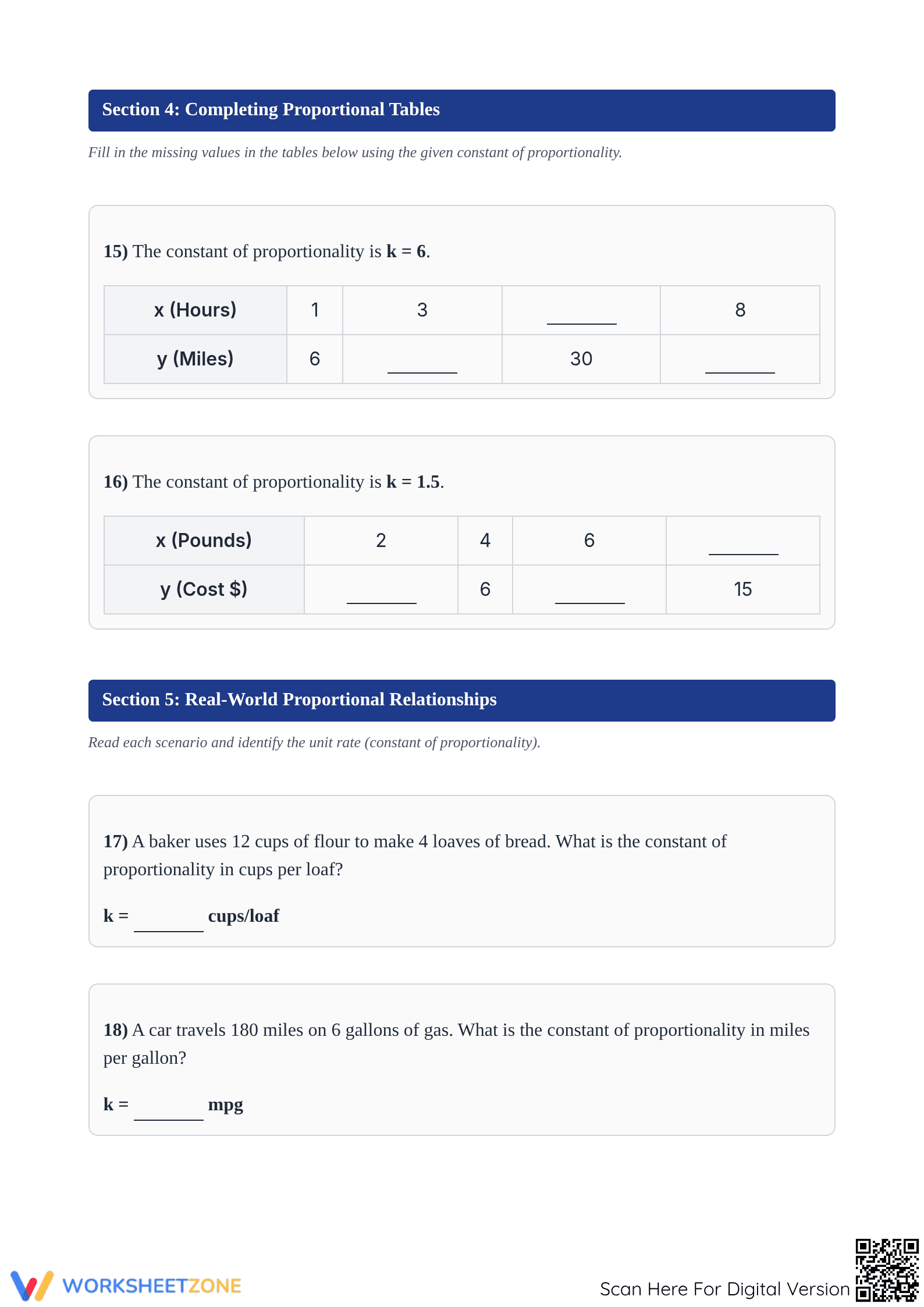


Printable Constant of Proportionality Practice | Grade 7 Math
Paste this activity's link or code into your existing LMS (Google Classroom, Canvas, Teams, Schoology, Moodle, etc.).
Students can open and work on the activity right away, with no student login required.
You'll still be able to track student progress and results from your teacher account.
Mastering the constant of proportionality is a foundational step for middle school mathematicians transitioning into complex algebraic thinking. This comprehensive practice set empowers students to identify unit rates across multiple representations, including tables, equations, graphs, and real-world scenarios. By bridging these mathematical models, students develop a fluid understanding of proportional relationships and rate-based reasoning.
At a Glance
- Grade: 7 · Subject: Math
- Standard:
7.RP.A.2.b— Identify the constant of proportionality in tables, graphs, equations, and verbal descriptions- Skill Focus: Unit Rate and Proportional Reasoning
- Format: 5 pages · 25 problems · Answer key included · PDF
- Best For: Homework, formative assessment, or independent practice
- Time: 45–60 minutes
This extensive five-page PDF includes 25 unique problems organized into six logical sections for scaffolded learning. Students progress from identifying 'k' in simple tables and equations to interpreting linear graphs and solving multi-step real-world word problems. The resource features clear headings, spacious layouts for calculations, and a full answer key to facilitate immediate student feedback or streamlined teacher grading.
Skill Progression
- Guided Practice: The first section provides direct prompts to determine 'k' using the ratio y/x in four distinct tables, establishing the core mathematical relationship between two variables.
- Supported Practice: Students transition to identifying constants within various equation formats and plotting points on coordinate planes, reinforcing the concept of 'k' as the unit rate.
- Independent Practice: The final sections challenge learners to solve word problems involving miles per gallon and unit costs, culminating in a challenge section that tests algebraic manipulation.
This gradual-release approach ensures students move from procedural fluency to conceptual application using the proven "I Do, We Do, You Do" instructional framework for math mastery.
Standards Alignment
The primary focus is 7.RP.A.2.b, which requires students to identify the constant of proportionality (unit rate) in tables, graphs, equations, diagrams, and verbal descriptions of proportional relationships. This worksheet also supports 7.RP.A.2.c by requiring students to represent proportional relationships by equations. Both standard codes can be copied directly into lesson plans, IEP goals, or district curriculum mapping tools.
How to Use It
Distribute this worksheet as a summative homework assignment following a direct instruction lesson on proportional relationships to solidify understanding. Alternatively, use specific sections as timed "exit tickets" to observe if students can accurately calculate the unit rate from a graph versus an equation. Expected completion time ranges from 45 to 60 minutes depending on the student's prior exposure to linear rates.
Who It's For
This resource is designed for Grade 7 math students but serves as an excellent remedial tool for Grade 8 and 9 learners struggling with linear functions. It pairs naturally with a classroom anchor chart displaying the equation y=kx or a short video tutorial on interpreting coordinate plane intercepts and slope as a rate of change.
Effective mathematical instruction requires exposing students to "multiple representations" (Fisher & Frey, 2014) to build deep conceptual understanding. Research indicates that when students can fluidly move between tables, graphs, and equations, they are significantly more likely to succeed in later algebra-heavy coursework. This worksheet specifically addresses the cognitive demands of standard 7.RP.A.2.b by requiring 25 distinct applications of the unit rate concept. By using the y/x ratio across various contexts, learners internalize the constant of proportionality as a fixed rate of change. According to Fisher & Frey (2014), this type of scaffolded practice reduces the cognitive load during the initial acquisition of abstract algebraic concepts. The inclusion of real-world scenarios, such as calculating miles per gallon or typing speed, provides the necessary context for students to attach meaning to numerical values, ensuring the skill transfers from the classroom to daily life applications.


