


























Views
Downloads
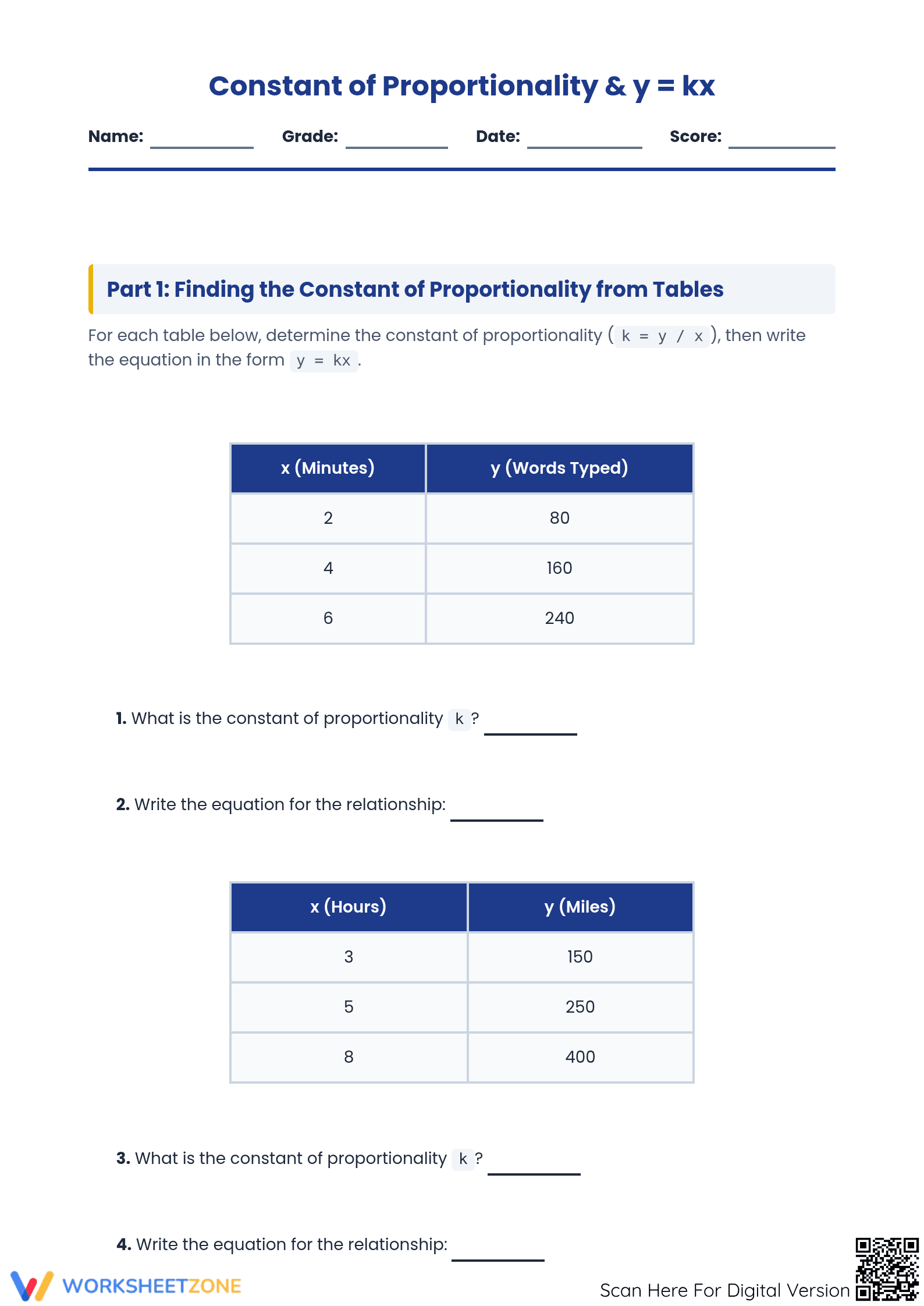
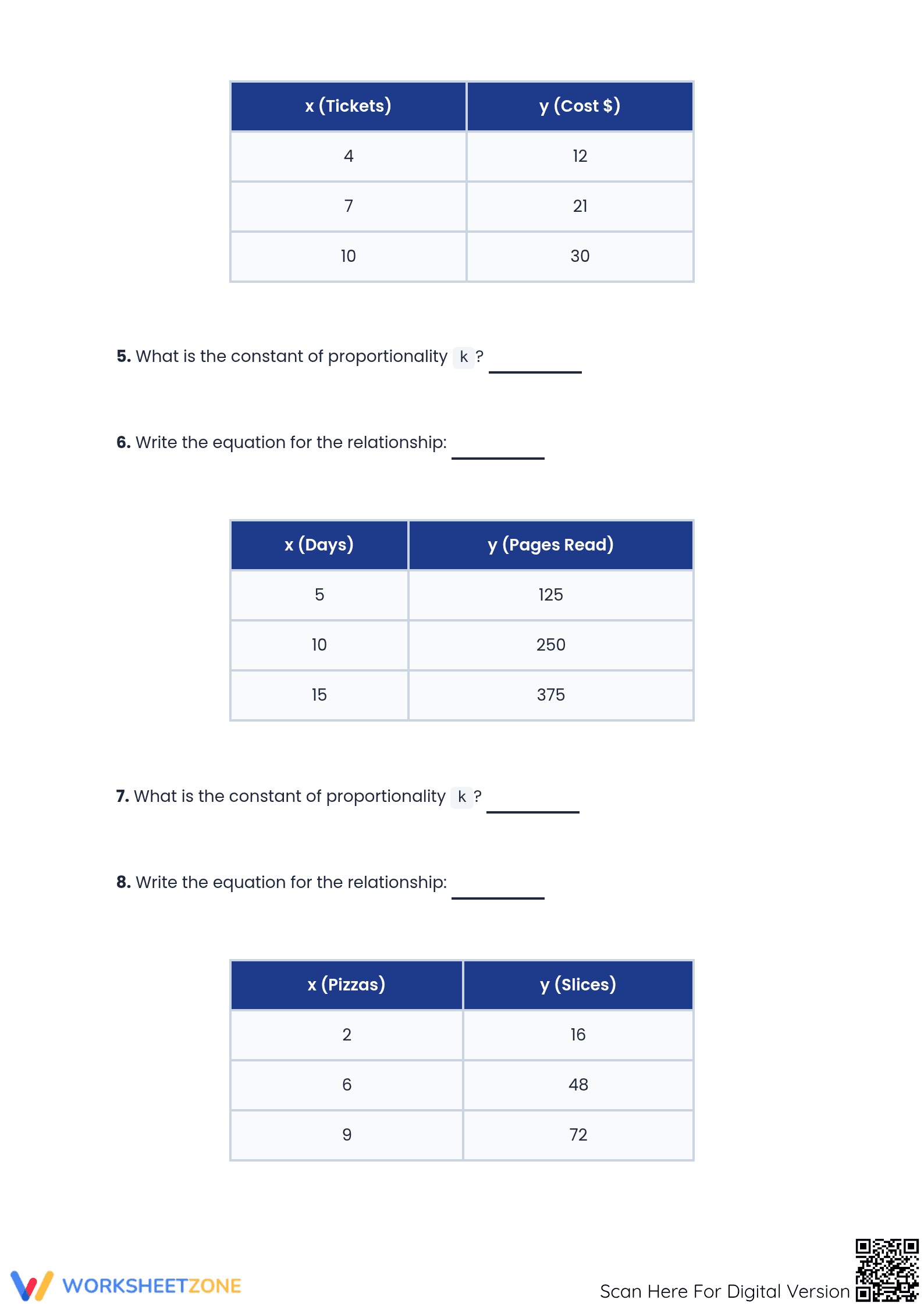
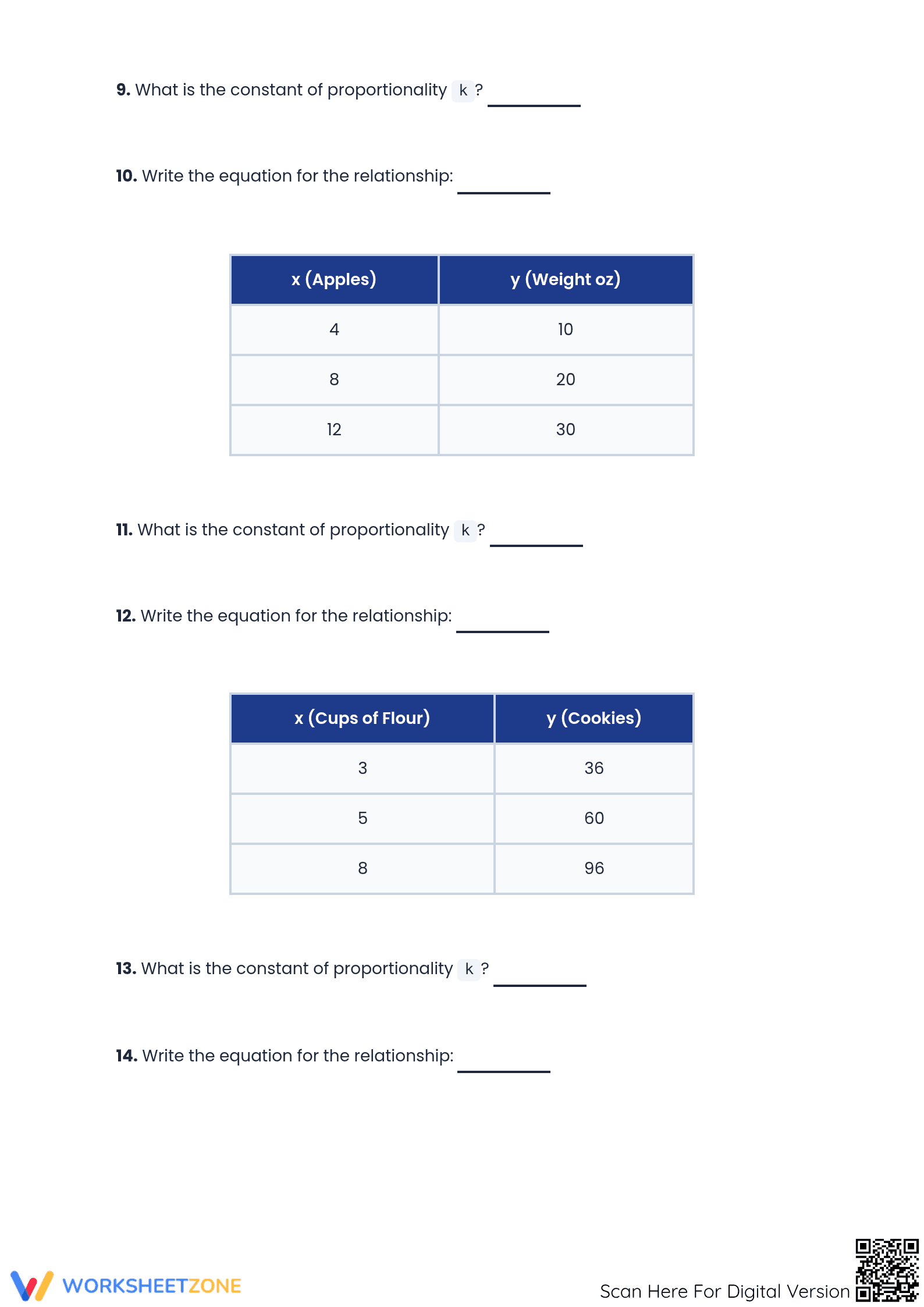
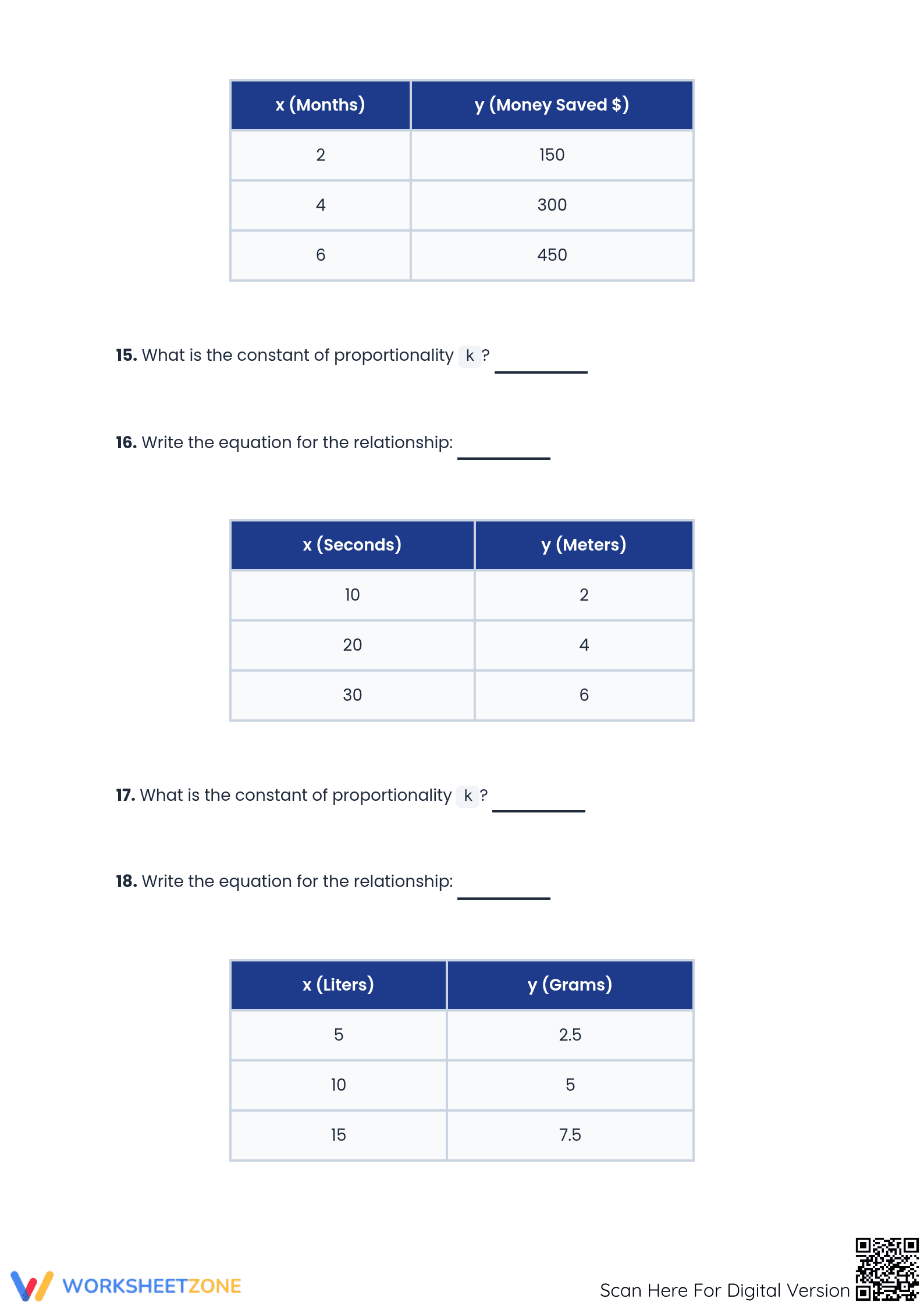

Printable Constant of Proportionality Worksheet | Grade 7
Paste this activity's link or code into your existing LMS (Google Classroom, Canvas, Teams, Schoology, Moodle, etc.).
Students can open and work on the activity right away, with no student login required.
You'll still be able to track student progress and results from your teacher account.
This Grade 7 math worksheet provides students with 23 structured problems to master identifying the unit rate and writing linear equations. By analyzing real-world contexts across tables and graphs, learners develop the procedural fluency needed to represent proportional relationships in the standard y=kx form. A full answer key is included.
At a Glance
- Grade: 7 · Subject: Math
- Standard:
7.RP.A.2— Identify the constant of proportionality and represent proportional relationships by equations- Skill Focus: Calculating k and writing y=kx
- Format: 5 pages · 23 problems · Answer key included · PDF
- Best For: Middle school pre-algebra and ratio mastery
- Time: 45–60 minutes
What's Inside
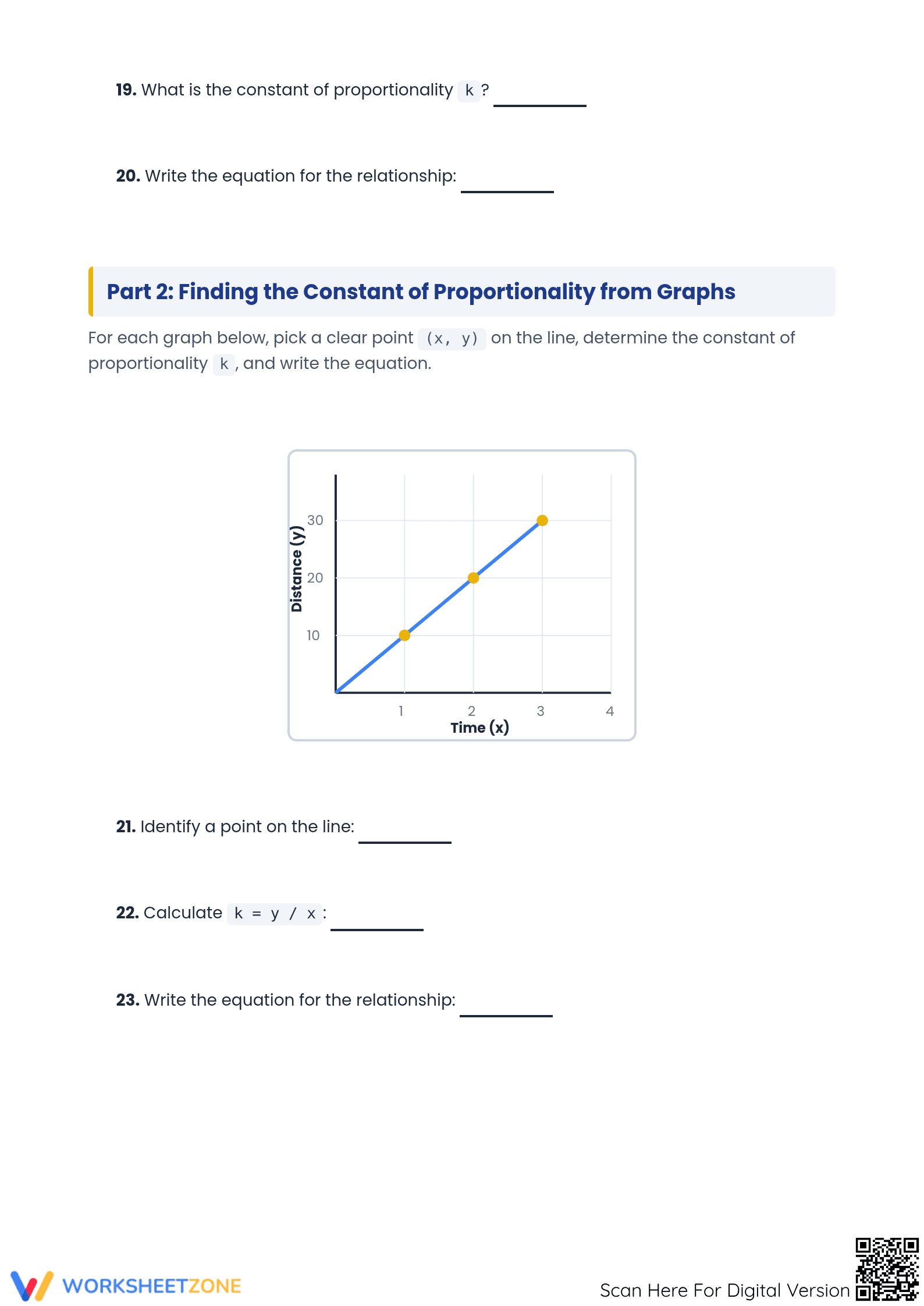
Across five pages, this packet contains ten data tables and a detailed coordinate graph. Students calculate the constant of proportionality for scenarios like typing speed and travel distance. The layout provides spaces for identifying variable k and formulating equations, while the final section introduces graphical analysis to solidify algebraic connections between lines and ratios.
Skill Progression
- Guided Practice: Students begin with 4 introductory tables using integer values to calculate the constant of proportionality (k) and write basic y=kx equations.
- Supported Practice: The next 6 tables introduce more varied real-world contexts and non-integer results, requiring learners to apply division strategies to multiple data points.
- Independent Practice: The final page transitions to graphical analysis, where students must identify specific coordinates on a line to derive the proportionality constant independently.
This instructional sequence follows a gradual-release model, moving from structured tabular data to abstract visual representations to ensure mastery of the multiplicative relationship between variables.
Standards Alignment
The primary focus is `7.RP.A.2`, which involves recognizing and representing proportional relationships between quantities. This alignment ensures students can move accurately between multiple representations of a ratio. The standard code can be copied directly into lesson plans, IEP goals, or district curriculum mapping tools to track progress toward math benchmarks.
How to Use It
Assign this as a collaborative station activity or a robust homework assignment to reinforce direct instruction. During the lesson, observe students as they divide y by x; this serves as a formative assessment moment to clarify the difference between independent and dependent variables. Completion typically takes one full class period.
Who It's For
This is designed for 7th-grade students or advanced 6th-grade learners. It is effective for students needing practice with division or those transitioning to abstract equations. Pairing this with a coordinate plane anchor chart provides necessary support for diverse learners in general education or inclusive classroom settings.
Linear proportional relationships form the bedrock of middle school algebraic reasoning. This resource targets CCSS.MATH.CONTENT.7.RP.A.2, requiring students to identify the constant of proportionality and represent relationships with the equation y=kx. By transitioning from structured tables to visual graphs, the worksheet builds the conceptual bridge between arithmetic ratios and algebraic functions. According to EdReports 2024, high-quality math instructional materials must prioritize rigor and balance, ensuring students spend significant time practicing the procedural fluency required to manipulate these equations. The 23 unique problems provided here offer the repetition necessary for mastery without sacrificing the cognitive demand of interpreting real-world contexts like speed, cost, and unit weight. This focused practice ensures that learners can confidently move toward more complex transformations and non-proportional linear functions. Educators can use these tasks to verify that students have internalized the unit rate as a multiplicative constant within a mathematical system.


