


























Views
Downloads

Essential Cc, Ee, and Hh Phonics Worksheet | Kindergarten
Paste this activity's link or code into your existing LMS (Google Classroom, Canvas, Teams, Schoology, Moodle, etc.).
Students can open and work on the activity right away, with no student login required.
You'll still be able to track student progress and results from your teacher account.
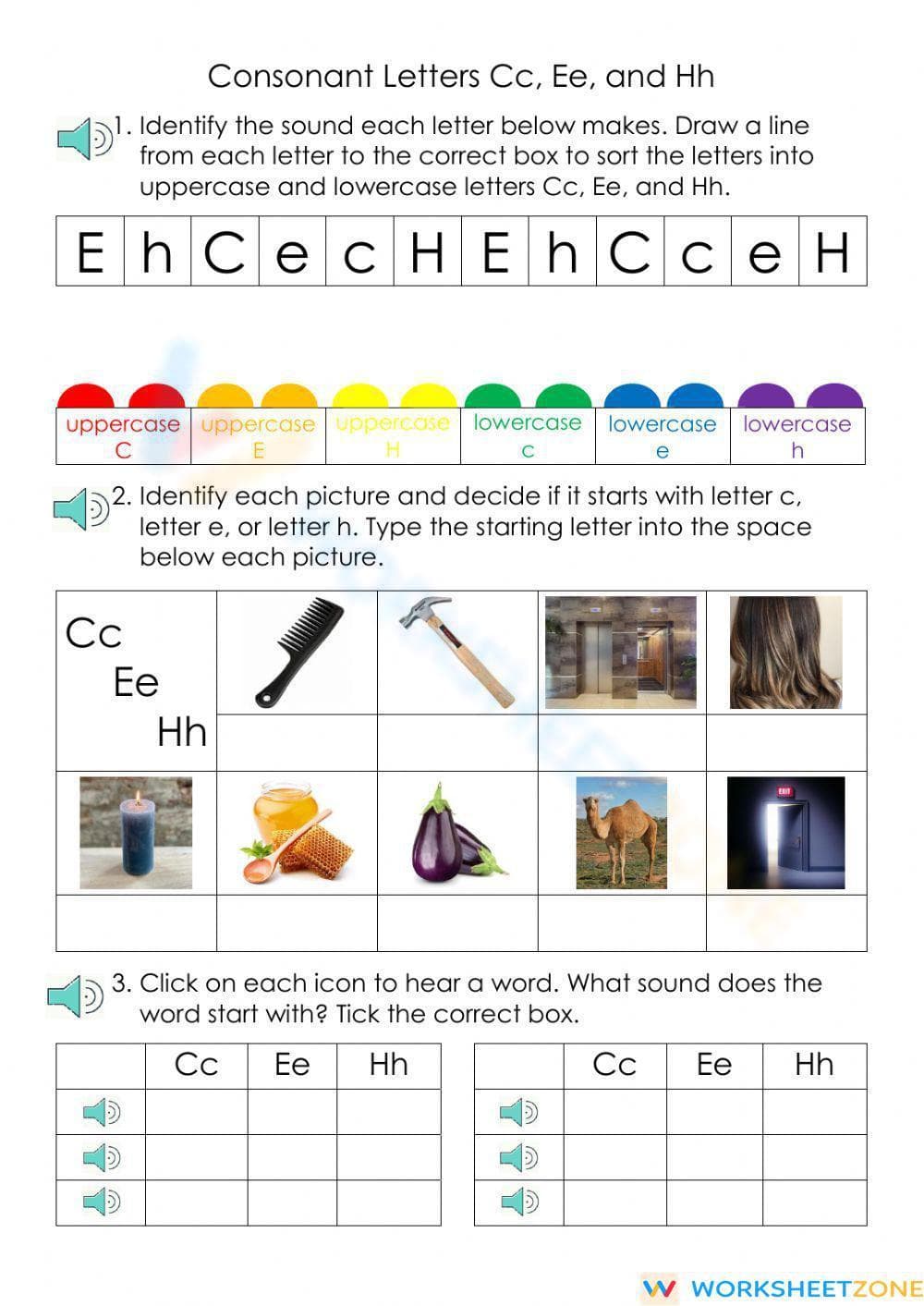
This Kindergarten phonics worksheet provides essential practice for recognizing and producing sounds for letters Cc, Ee, and Hh. Students engage in tasks like letter sorting and initial sound identification to build foundational literacy. Connecting visual letter forms with auditory sounds develops the phonemic awareness necessary for early reading success.
At a Glance
- Grade: Kindergarten · Subject: English Language Arts
- Standard:
CCSS.ELA-LITERACY.RF.K.1.D— Recognize and name all upper- and lowercase letters of the alphabet- Skill Focus: Letter Recognition and Initial Sounds
- Format: 1 page · 3 tasks · Answer key included · PDF
- Best For: Independent practice and phonics centers
- Time: 10–15 minutes
Inside this single-page resource are three activities for letter mastery. Task one involves sorting uppercase and lowercase letters into color-coded boxes. The second section features ten images where students identify the beginning sound and write the corresponding letter. The final component uses audio cues to match spoken words with their starting letters, providing a multi-sensory learning experience.
Zero-Prep Workflow
The zero-prep workflow is designed for maximum efficiency in the classroom. Step one: Print the PDF or open the interactive version in under 30 seconds. Step two: Distribute copies to your students, taking less than a minute. Step three: Review student work using the included answer key during a brief transition. This resource is perfect for emergency sub plans or quick phonics reinforcement during busy mornings.
Standards Alignment
This worksheet is aligned to CCSS.ELA-LITERACY.RF.K.1.D, which requires students to recognize and name upper- and lowercase letters of the alphabet. It also supports CCSS.ELA-LITERACY.RF.K.3.A by focusing on one-to-one letter-sound correspondences for consonants and short vowel sounds. Both standard codes can be copied directly into lesson plans, IEP goals, or district curriculum mapping tools.
How to Use It
Use this worksheet during small-group rotations as a formative assessment tool. Observe how students differentiate between uppercase and lowercase letters to check for visual discrimination skills. It also works exceptionally well as a quick exit ticket after a direct instruction lesson on letter sounds. Expect most Kindergarten students to complete the entire page within a 12-minute window.
Who It's For
This resource is specifically tailored for Kindergarten students, but works well for Grade 1 remediation. The clear visual icons and simple layout make it accessible for English Language Learners. Pair this worksheet with a shared reading of a text featuring these specific letters to reinforce skills in context and bridge the gap between isolation and application.
Phonemic awareness is a critical predictor of later reading achievement, as highlighted by the NAEP assessments. This worksheet addresses foundational skills by requiring students to isolate and identify initial sounds in spoken and written words. According to research by Fisher & Frey (2014), the gradual release of responsibility model—moving from teacher-led sorting to independent initial sound identification—is vital for mastery. By focusing on letters like Cc, Ee, and Hh, this resource helps students build the alphabetic principle necessary for decoding more complex text structures. The standard code CCSS.ELA-LITERACY.RF.K.1.D ensures that students are meeting national benchmarks for letter recognition. This comprehensive approach to phonics instruction supports the development of automaticity in letter-sound correspondence, which is a key component of early literacy frameworks used in modern elementary classrooms across the United States.


