




























0
Views
0
Downloads

0.0
0
Save
0 Likes
Share
Conflict Resolution: Dos and Don'ts
0 Views
0 Downloads

Paste this activity's link or code into your existing LMS (Google Classroom, Canvas, Teams, Schoology, Moodle, etc.).
Students can open and work on the activity right away, with no student login required.
You'll still be able to track student progress and results from your teacher account.
Information
Description
What It Is:
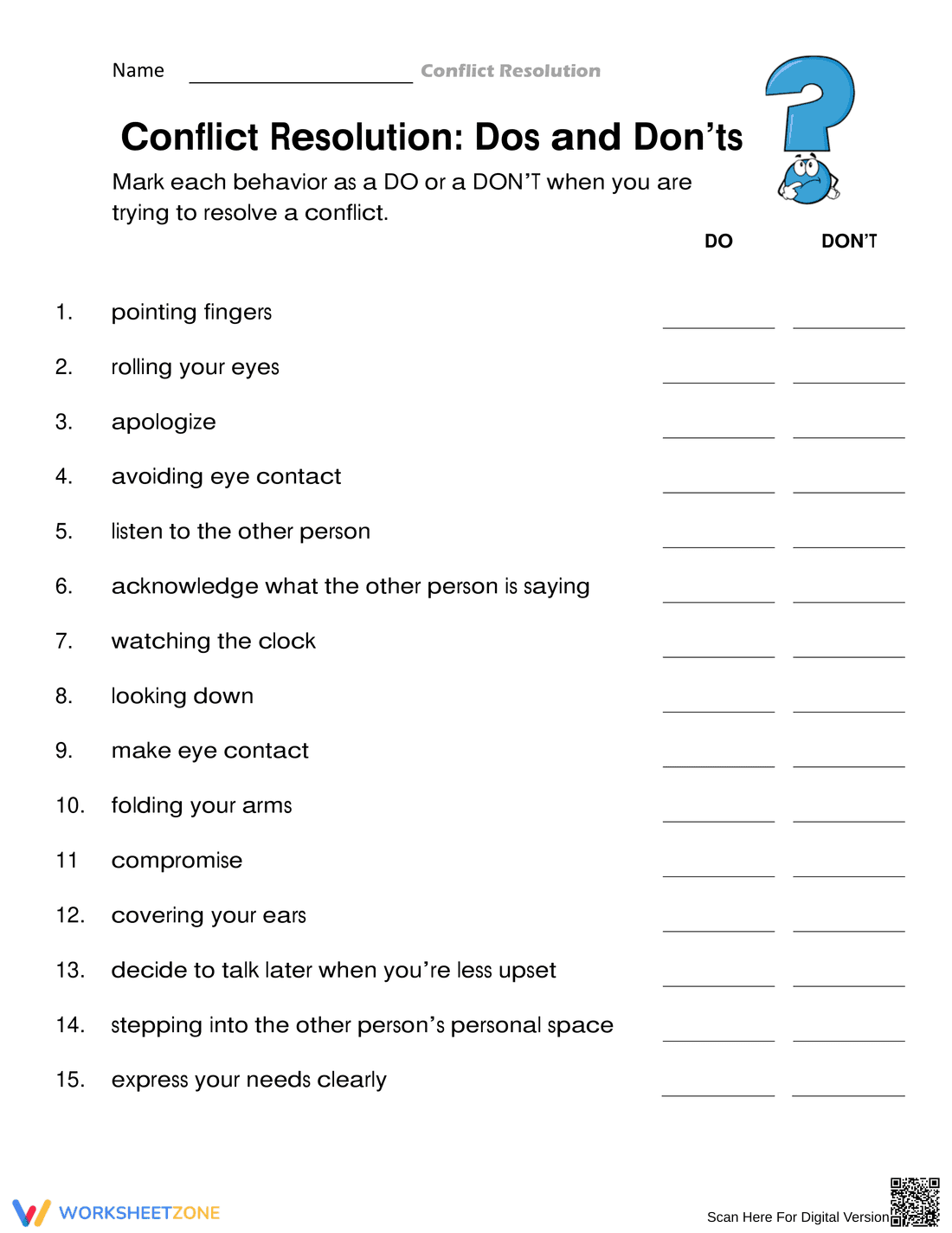
This is a worksheet titled 'Conflict Resolution: Dos and Don'ts'. It presents a list of 15 behaviors, such as 'pointing fingers', 'rolling your eyes', 'apologize', 'avoiding eye contact', 'listen to the other person', 'make eye contact', 'compromise' and 'express your needs clearly'. The student is instructed to mark each behavior as either a 'DO' or a 'DON'T' when trying to resolve a conflict. There are two columns provided for marking their choice.
Grade Level Suitability:
This worksheet is suitable for grades 3-6. The vocabulary is relatively simple, and the concepts of conflict resolution are introduced in a straightforward manner. It could also be helpful for older students who struggle with social skills.
Why Use It:
This worksheet helps students identify positive and negative behaviors in conflict situations. It promotes critical thinking and self-awareness regarding their own actions and the actions of others during disagreements. It encourages students to think about effective communication and problem-solving skills.
How to Use It:
Read each behavior listed on the worksheet carefully. Consider whether the behavior would help or hinder conflict resolution. Mark an 'X' or checkmark in the 'DO' column if the behavior is helpful, and in the 'DON'T' column if the behavior is unhelpful. Discuss the answers as a class or in small groups.
Target Users:
This worksheet is beneficial for elementary and middle school students, special education students, counselors, teachers, and parents who want to teach conflict resolution skills. It can be used in classroom settings, counseling sessions, or at home.
This is a worksheet titled 'Conflict Resolution: Dos and Don'ts'. It presents a list of 15 behaviors, such as 'pointing fingers', 'rolling your eyes', 'apologize', 'avoiding eye contact', 'listen to the other person', 'make eye contact', 'compromise' and 'express your needs clearly'. The student is instructed to mark each behavior as either a 'DO' or a 'DON'T' when trying to resolve a conflict. There are two columns provided for marking their choice.
Grade Level Suitability:
This worksheet is suitable for grades 3-6. The vocabulary is relatively simple, and the concepts of conflict resolution are introduced in a straightforward manner. It could also be helpful for older students who struggle with social skills.
Why Use It:
This worksheet helps students identify positive and negative behaviors in conflict situations. It promotes critical thinking and self-awareness regarding their own actions and the actions of others during disagreements. It encourages students to think about effective communication and problem-solving skills.
How to Use It:
Read each behavior listed on the worksheet carefully. Consider whether the behavior would help or hinder conflict resolution. Mark an 'X' or checkmark in the 'DO' column if the behavior is helpful, and in the 'DON'T' column if the behavior is unhelpful. Discuss the answers as a class or in small groups.
Target Users:
This worksheet is beneficial for elementary and middle school students, special education students, counselors, teachers, and parents who want to teach conflict resolution skills. It can be used in classroom settings, counseling sessions, or at home.


