


























0
Views
0
Downloads

0.0
0
Save
0 Likes
Share
Conflict Resolution and Emotion Management
0 Views
0 Downloads
Paste this activity's link or code into your existing LMS (Google Classroom, Canvas, Teams, Schoology, Moodle, etc.).
Students can open and work on the activity right away, with no student login required.
You'll still be able to track student progress and results from your teacher account.
Information
Description
What It Is:
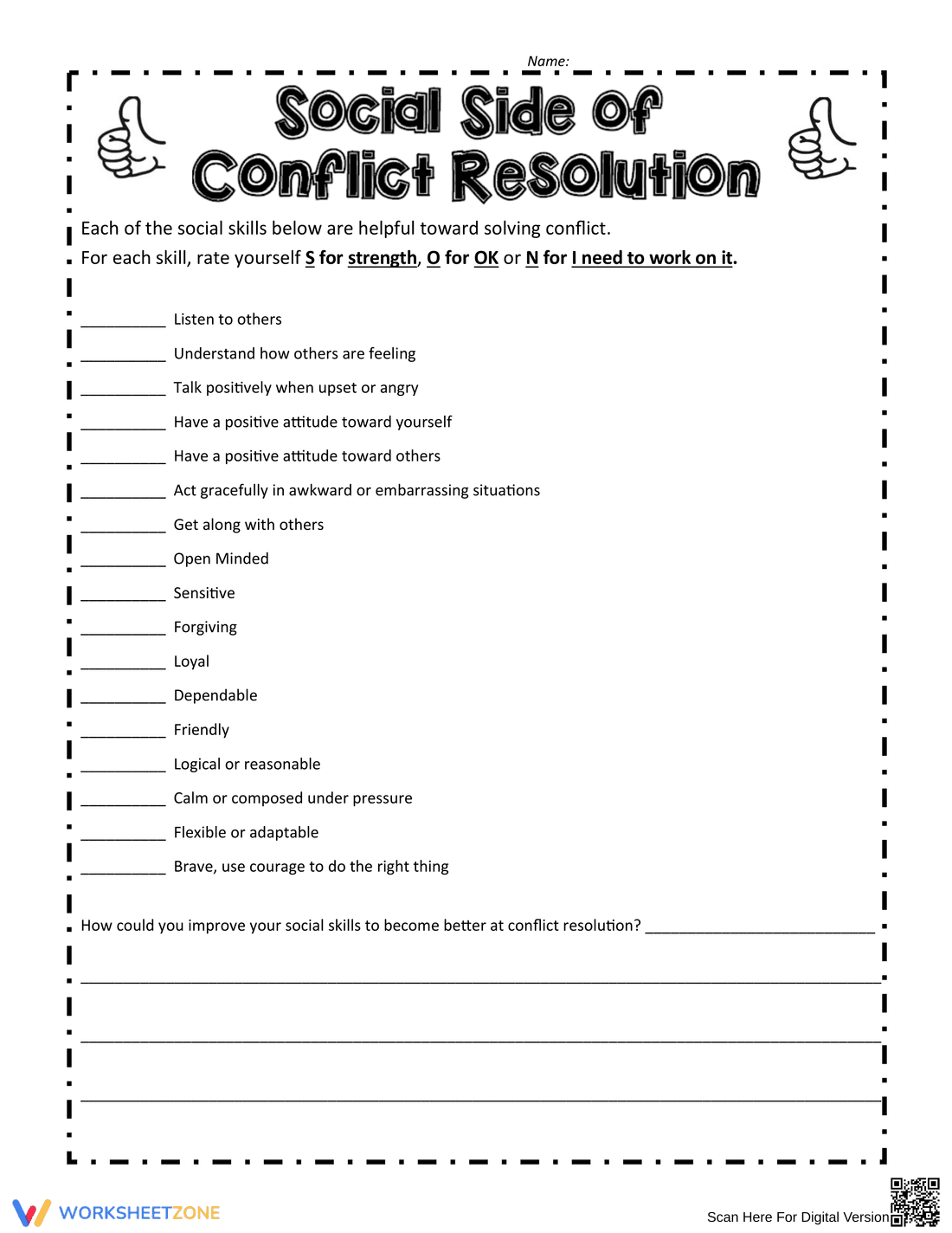
This is a worksheet titled 'Social Side of Conflict Resolution.' It lists various social skills such as 'Listen to others,' 'Understand how others are feeling,' 'Talk positively when upset or angry,' 'Get along with others,' and 'Brave, use courage to do the right thing.' Students are instructed to rate themselves on each skill using 'S' for strength, 'O' for OK, or 'N' for 'I need to work on it.' The worksheet also includes space for students to write about how they can improve their social skills to become better at conflict resolution.
Grade Level Suitability:
This worksheet is suitable for upper elementary (grades 4-5) and middle school (grades 6-8). The vocabulary and concepts are appropriate for these age groups, and the self-reflection activity encourages social-emotional learning skills that are beneficial at these developmental stages.
Why Use It:
This worksheet promotes self-awareness and reflection on social skills crucial for conflict resolution. It helps students identify their strengths and weaknesses in social interactions and encourages them to think about ways to improve their communication and interpersonal skills. It fosters emotional intelligence and provides a framework for discussing and practicing positive social behaviors.
How to Use It:
Begin by explaining the concept of conflict resolution and the importance of social skills. Students should read each skill listed and honestly assess their proficiency, marking 'S,' 'O,' or 'N' accordingly. After rating all the skills, students should use the provided lines to reflect on how they can improve their social skills in conflict situations. Facilitate a class discussion about the different skills and strategies for improvement.
Target Users:
This worksheet is designed for students in grades 4-8 who are learning about conflict resolution, social skills, and self-reflection. It is also beneficial for counselors, teachers, and parents who want to help children develop better communication and interpersonal skills. It can be used in classroom settings, small group activities, or individual counseling sessions.
This is a worksheet titled 'Social Side of Conflict Resolution.' It lists various social skills such as 'Listen to others,' 'Understand how others are feeling,' 'Talk positively when upset or angry,' 'Get along with others,' and 'Brave, use courage to do the right thing.' Students are instructed to rate themselves on each skill using 'S' for strength, 'O' for OK, or 'N' for 'I need to work on it.' The worksheet also includes space for students to write about how they can improve their social skills to become better at conflict resolution.
Grade Level Suitability:
This worksheet is suitable for upper elementary (grades 4-5) and middle school (grades 6-8). The vocabulary and concepts are appropriate for these age groups, and the self-reflection activity encourages social-emotional learning skills that are beneficial at these developmental stages.
Why Use It:
This worksheet promotes self-awareness and reflection on social skills crucial for conflict resolution. It helps students identify their strengths and weaknesses in social interactions and encourages them to think about ways to improve their communication and interpersonal skills. It fosters emotional intelligence and provides a framework for discussing and practicing positive social behaviors.
How to Use It:
Begin by explaining the concept of conflict resolution and the importance of social skills. Students should read each skill listed and honestly assess their proficiency, marking 'S,' 'O,' or 'N' accordingly. After rating all the skills, students should use the provided lines to reflect on how they can improve their social skills in conflict situations. Facilitate a class discussion about the different skills and strategies for improvement.
Target Users:
This worksheet is designed for students in grades 4-8 who are learning about conflict resolution, social skills, and self-reflection. It is also beneficial for counselors, teachers, and parents who want to help children develop better communication and interpersonal skills. It can be used in classroom settings, small group activities, or individual counseling sessions.


