


























Views
Downloads




Complete Tangent-Line Models Worksheet | Grade 12 Calculus
Paste this activity's link or code into your existing LMS (Google Classroom, Canvas, Teams, Schoology, Moodle, etc.).
Students can open and work on the activity right away, with no student login required.
You'll still be able to track student progress and results from your teacher account.
This calculus resource builds student proficiency in constructing linear models using instantaneous rates of change. Grade 12 students derive tangent-line equations to represent local function behavior, moving from guided kinematic scenarios to independent transcendental problems. Through direct practice, learners connect derivative values with concrete real-world contexts and point-slope equations.
At a Glance
- Grade: 12 · Subject: High School Calculus
- Standard: Calculate instantaneous rates of change to construct tangent-line linear equations
- Skill Focus: Find a Tangent-Line Model
- Format: 5 pages · 12 total problems · Full 3-page answer key included · PDF
- Best For: Derivative application review and linear model practice
- Time: 45–60 minutes of active instruction
What's Inside
This 5-page calculus document opens with a reference box containing derivative definitions and tangent-line forms. The worksheet features 12 total problems divided into structured step-by-step tables, independent analytic calculations, and conceptual error analysis. Real-world applications span velocity, height, volume, and economics alongside transcendental functions. A 3-page answer key provides complete worked solutions.
Skill Progression
- Guided practice (Part A, 4 problems): Scaffolds learning through missing-step blanks where students calculate derivatives, evaluate specific coordinates, and write linear equations.
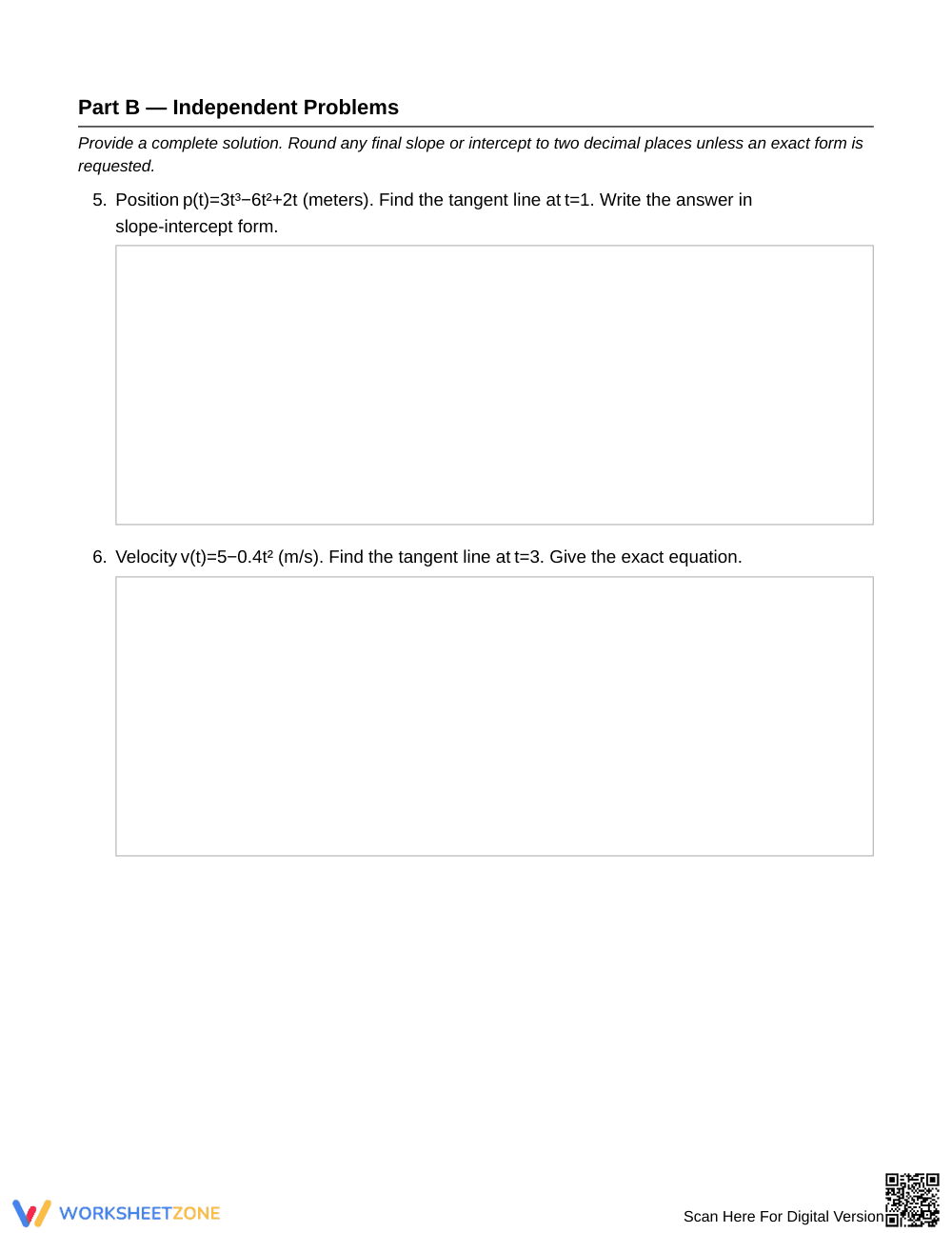
- Supported practice (Part B, 6 problems): Removes step-by-step prompts as students independently differentiate polynomials, radicals, and exponentials.
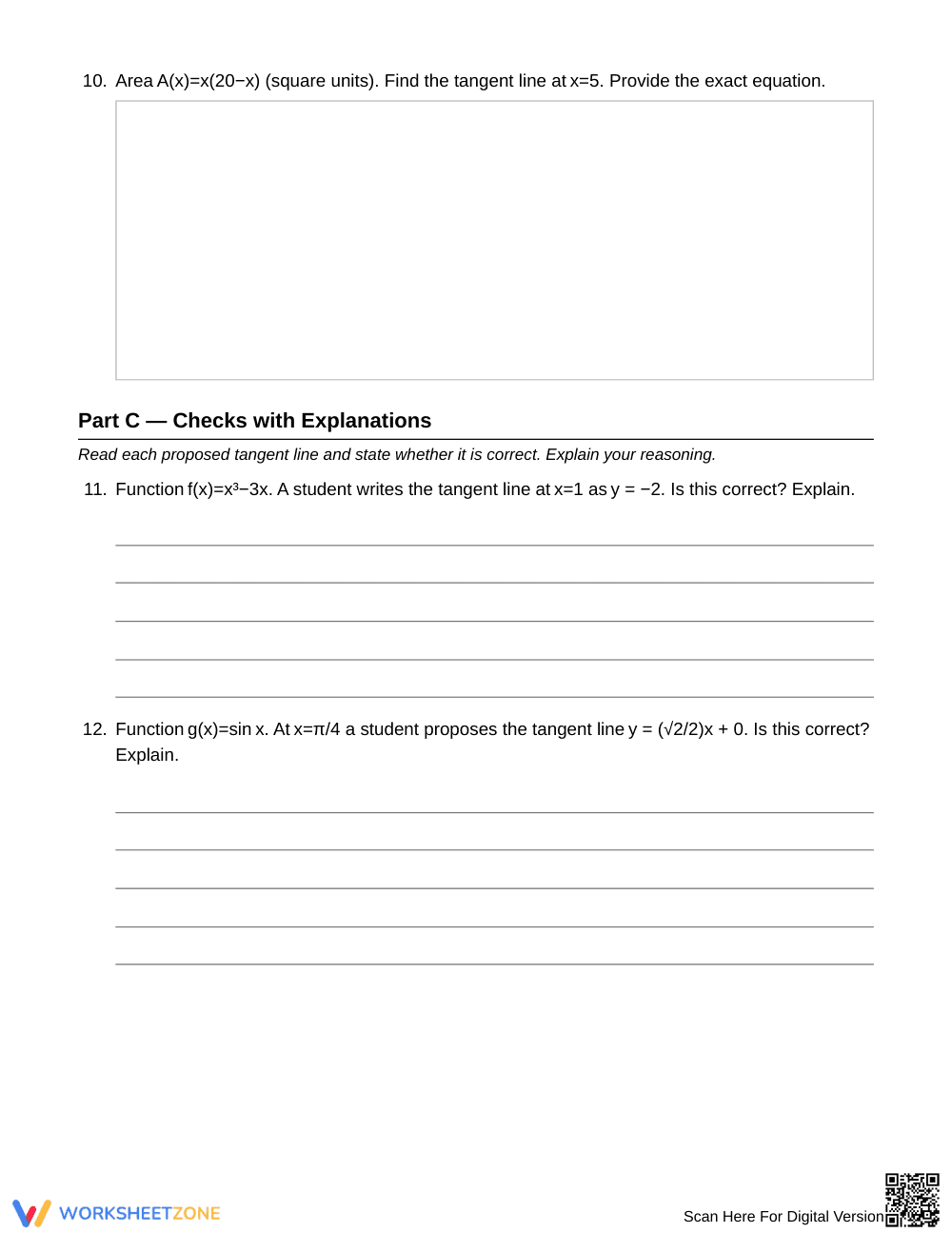
- Independent practice (Part C, 2 problems): Asks learners to diagnose common student misconceptions and defend their evaluations.
This gradual-release sequence moves students smoothly from structured computation to independent modeling and reasoning.
Standards Alignment
This resource aligns with high school calculus standards covering applications of derivatives, focusing on using derivatives to establish local linear tangent-line models for contextual rates of change. Supporting topics include instantaneous velocity and marginal cost analysis. Both standard codes can be copied directly into lesson plans, IEP goals, or district curriculum mapping tools.
How to Use It
Use this worksheet after direct instruction on tangent lines and local linearity. Assign Part A during class as guided practice, then transition students to Parts B and C for independent or paired problem solving. For formative assessment, check whether students substitute points into the derivative rather than the original function when determining tangent slopes. Expected completion time is 45 to 60 minutes.
Who It's For
This printable activity is designed for Grade 12 students in Calculus or AP Calculus. Built-in scaffolding supports students struggling with multi-step procedures, while error-analysis prompts challenge advanced thinkers. Pair this worksheet with a dynamic graphing tool to visually confirm calculated tangent lines against original function curves.
According to Fisher & Frey (2014), structured instructional progressions that guide students from modeled scaffolds to independent problem solving significantly enhance conceptual retention in advanced mathematics. This calculus resource reinforces the core skill of constructing tangent-line models through a systematic 12-task learning sequence. High school calculus students learn to compute instantaneous rates of change, determine linear equations in point-slope and slope-intercept form, and critique mathematical reasoning across physics, economics, and transcendental function contexts. By organizing linear approximation tasks into guided missing-step completions, independent problem solving, and error-analysis justifications, this document supports rigorous mastery aligned with calculus standards for applications of derivatives. Educational leaders and high school mathematics educators can implement this complete five-page resource to bridge computational derivative techniques with higher-order mathematical modeling, ensuring seniors develop analytical precision and procedural fluency across diverse function types.


