




























Views
Downloads




Complete Rhetorical Framing Worksheet | Grade 9 English I

Paste this activity's link or code into your existing LMS (Google Classroom, Canvas, Teams, Schoology, Moodle, etc.).
Students can open and work on the activity right away, with no student login required.
You'll still be able to track student progress and results from your teacher account.
This high school informational text worksheet trains Grade 9 students to evaluate how competing authors manipulate audience perception through strategic emphasis and omission. Working with two paired civic texts regarding the preservation or redevelopment of a historic foundry, learners uncover subtle ideological stances, examine loaded diction, and trace how specific factual inclusions shape argumentative framing.
At a Glance
- Grade: 9 · Subject: English I
- Standard:
RI.9-10.6— Determine author's point of view and analyze rhetorical framing through detail choice- Skill Focus: Trace Framing Through Detail Selection
- Format: 6 pages · 10 problems · Answer key included · PDF
- Best For: High school rhetorical analysis paired text practice
- Time: 45–60 minutes
What's Inside
This 6-page instructional resource contains two complete primary source passages, a foundational concept anchor box, and 10 analytically rigorous items divided into three structured sections. Students encounter a modeled rhetorical exemplar, short-answer evidence links, multi-paragraph comparative analyses, and targeted multiple-choice bias checks, supported by an exhaustive 3-page answer key with exemplar student explanations.
Skill Progression
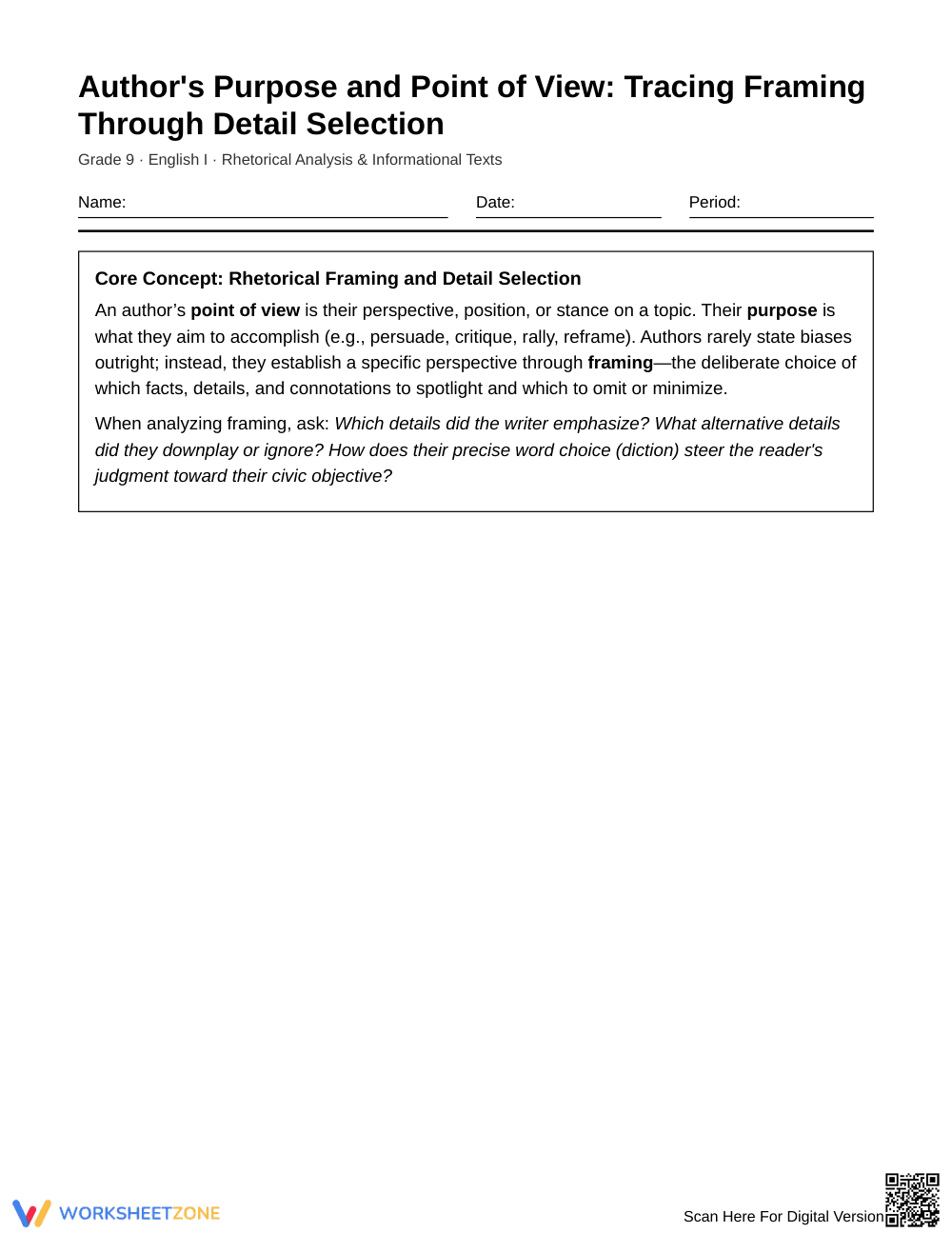
- Guided Practice: A core concept box defines framing and presents a fully annotated teacher model examining how specific architectural descriptions establish emotional resonance.
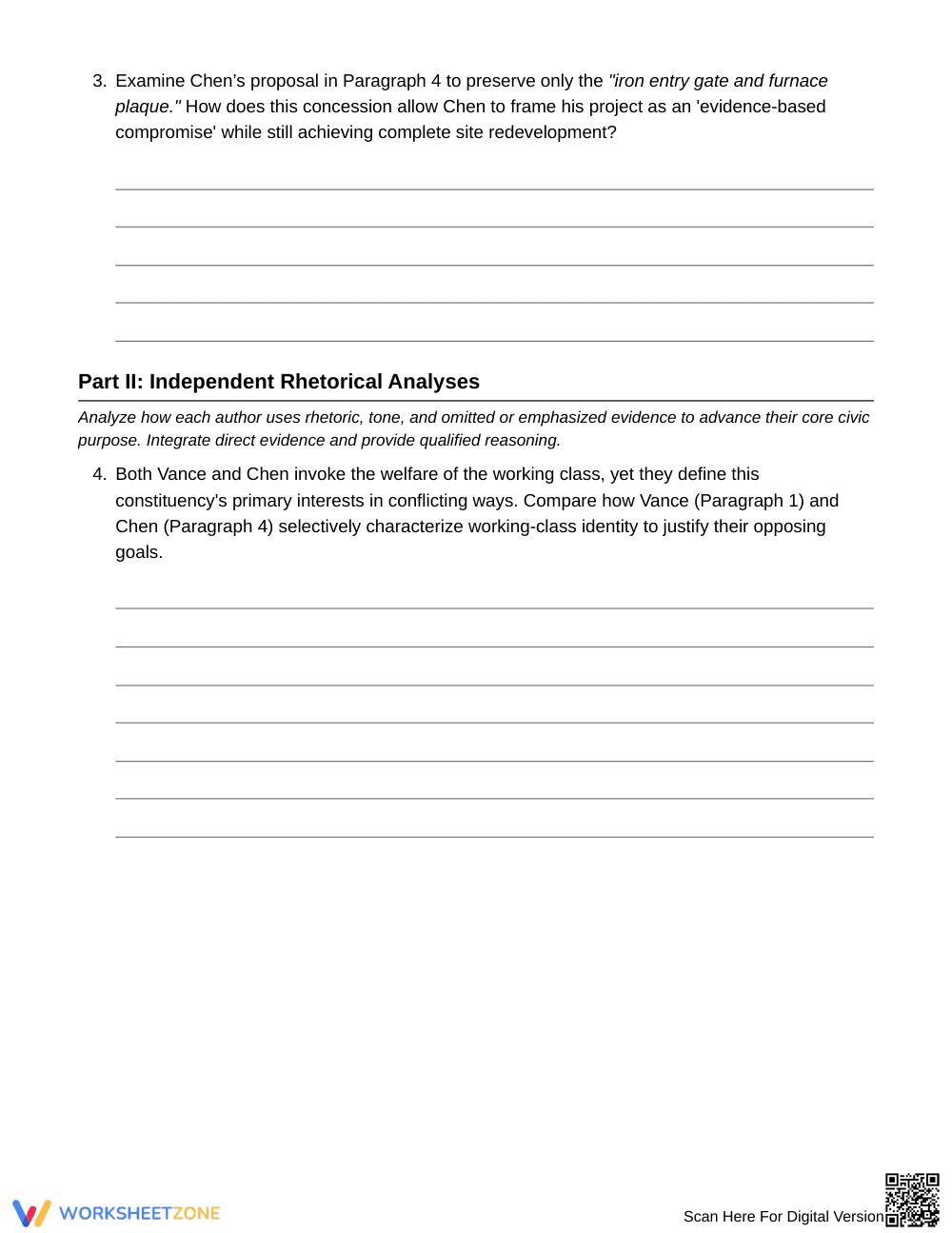
- Supported Practice: Part I delivers 3 scaffolded short-response prompts requiring students to isolate economic diction, counterargument preemption, and strategic rhetorical concessions across both texts.
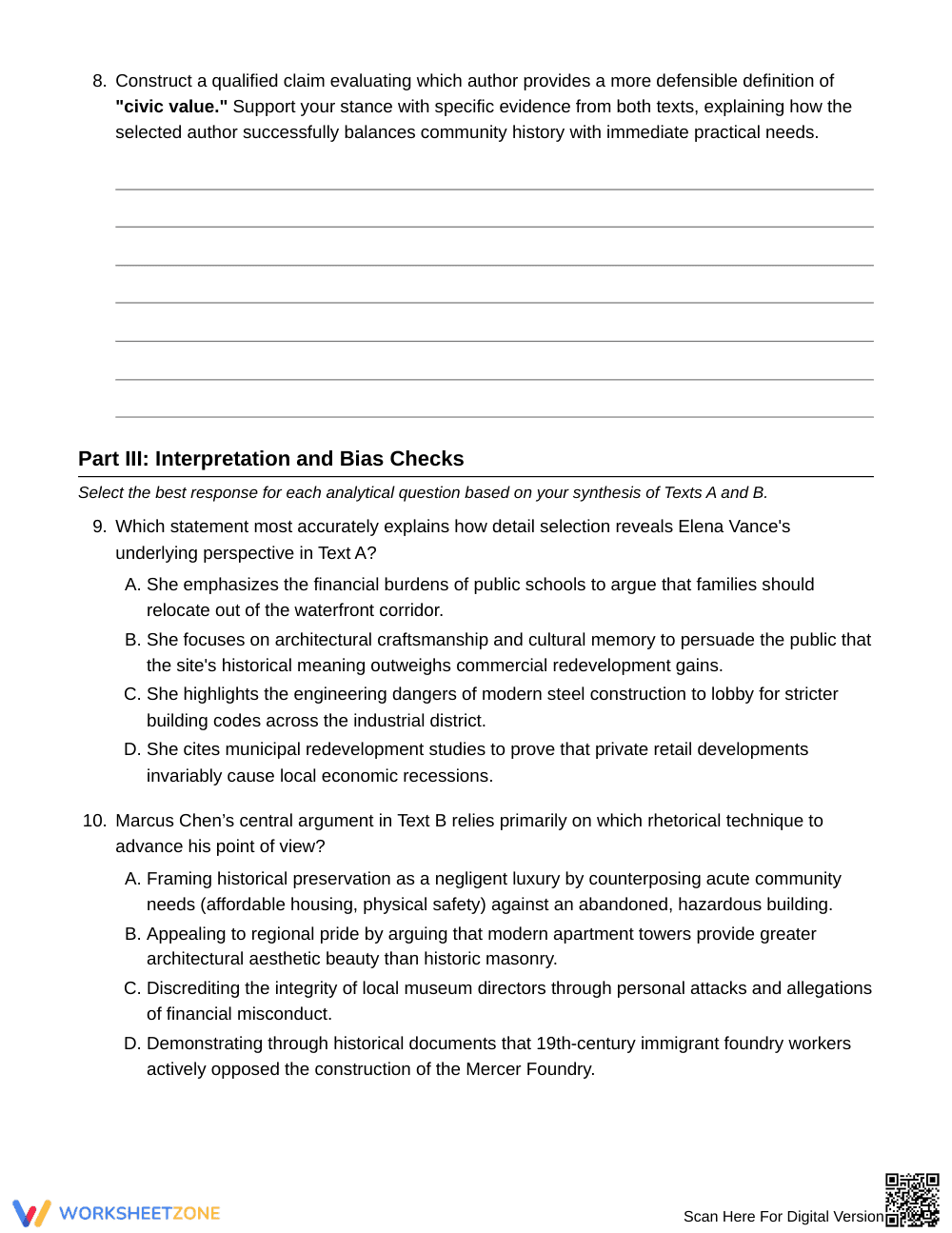
- Independent Practice: Part II and Part III feature 5 extensive constructed-response prompts and 2 multiple-choice synthesis checks that prompt students to contrast tone, identify unstated omissions, and evaluate competing definitions of civic value.
This sequence embodies the gradual release of responsibility model, shifting students methodically from direct conceptual observation toward self-directed rhetorical deconstruction.
Standards Alignment
This worksheet directly targets `RI.9-10.6`: Determine an author's point of view or purpose in a text and analyze how an author uses rhetoric to advance that point of view or purpose. It also reinforces `RI.9-10.8` by requiring learners to delineate and evaluate paired arguments addressing the same municipal issue. Both standard codes can be copied directly into lesson plans, IEP goals, or district curriculum mapping tools.
How to Use It
Deploy this packet during the mid-unit phase of an informational text study after students understand basic rhetorical appeals (ethos, pathos, logos) but need targeted practice tracking subtle bias. Alternatively, utilize it as a high-engagement collaborative jigsaw where student pairs defend opposing texts before completing the comparative analysis. During work time, monitor how accurately students distinguish between what an author explicitly states and what an author strategically leaves unsaid. Expect completion within 45 to 60 minutes.
Who It's For
Designed for Grade 9 English I learners, this lesson provides essential analytical training for general education, Pre-AP, and honors courses. The highlighted textual excerpts support striving readers, while the complex civic themes challenge advanced thinkers. Pair this resource with direct instruction on non-fiction bias indicators or an anchor chart highlighting structural omissions.
According to research in Fisher & Frey (2014), adolescent literacy acquisition accelerates when students analyze how conflicting authors address shared civic dilemmas, as comparative evaluation demands higher-order cognitive processing than isolated passage reading. Mastering standard RI.9-10.6 requires learners to move beyond passive comprehension into active deconstruction of an author's rhetorical craft. By tracing framing through detail selection across balanced municipal arguments, this 10-task worksheet equips ninth-grade readers to detect omitted variables, scrutinize loaded economic vocabulary, and critique institutional perspectives. The embedded instructional framework provides the structural scaffolding necessary for students to evaluate complex informational texts independently across high school English courses.


