


























Views
Downloads



Complete Recurring Object Worksheet | Grade 10 English II
Paste this activity's link or code into your existing LMS (Google Classroom, Canvas, Teams, Schoology, Moodle, etc.).
Students can open and work on the activity right away, with no student login required.
You'll still be able to track student progress and results from your teacher account.
This Grade 10 literary analysis worksheet guides students through tracing how recurring objects gather symbolic meaning and develop situational irony. High school readers examine an original narrative passage, citing strong textual evidence to evaluate shifting character associations and analyze authorial craft.
At a Glance
- Grade: 10 · Subject: English II
- Standard:
RL.9-10.1— Cite strong textual evidence to support textual analysis and inferences- Skill Focus: Trace a Recurring Object’s Associations
- Format: 6 pages · 10 problems · Answer key included · PDF
- Best For: Close reading and motif analysis
- Time: 45–60 minutes
What's Inside
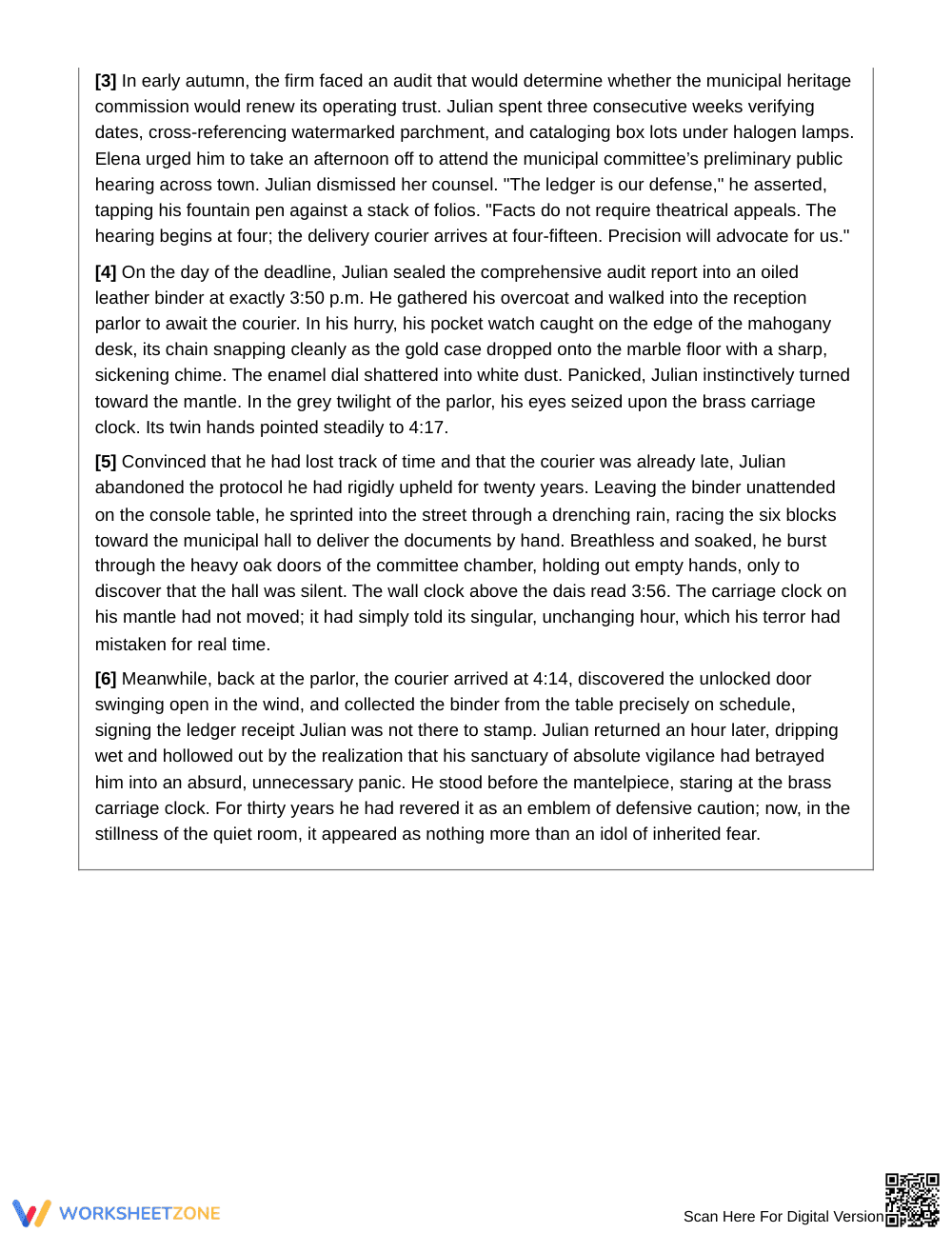
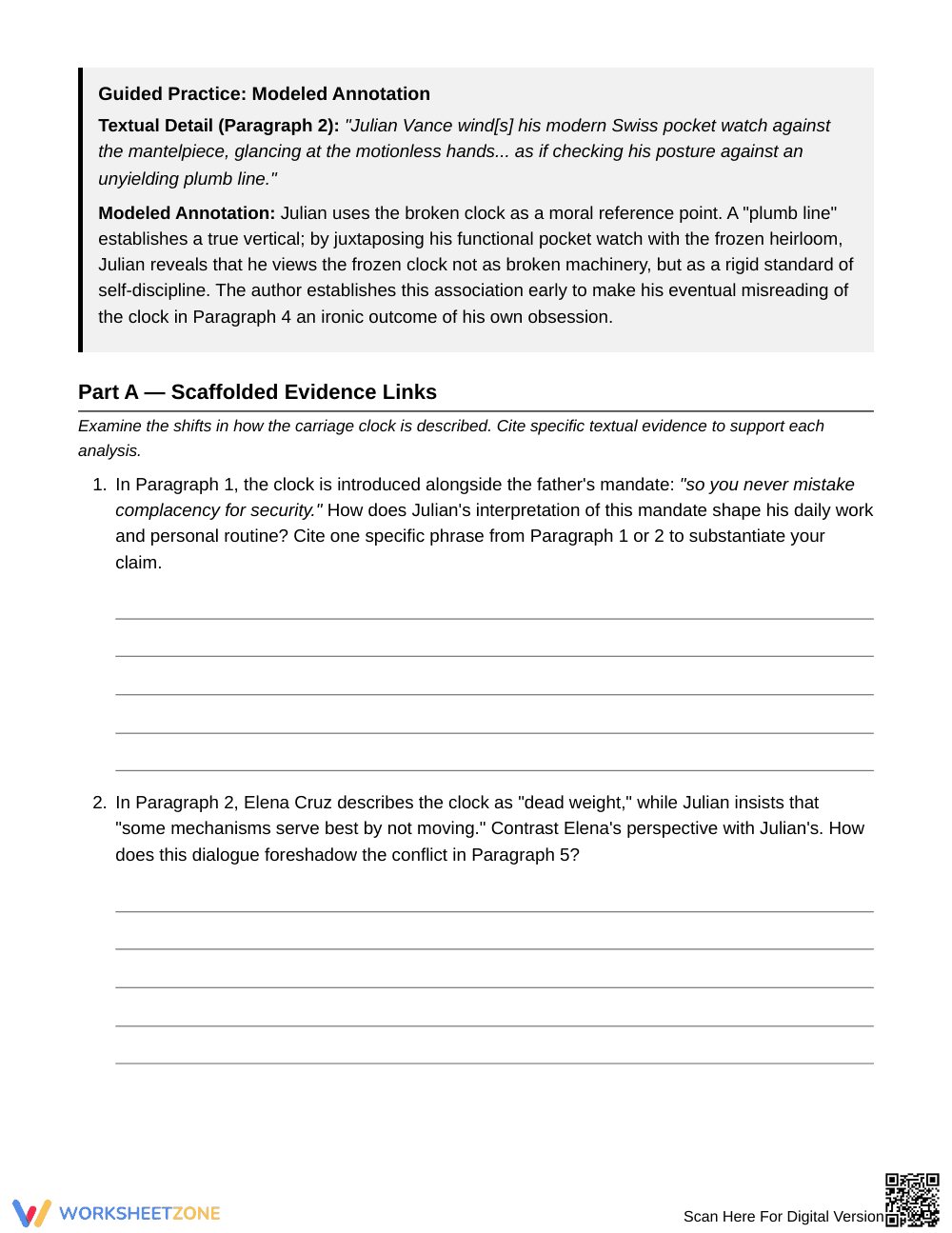
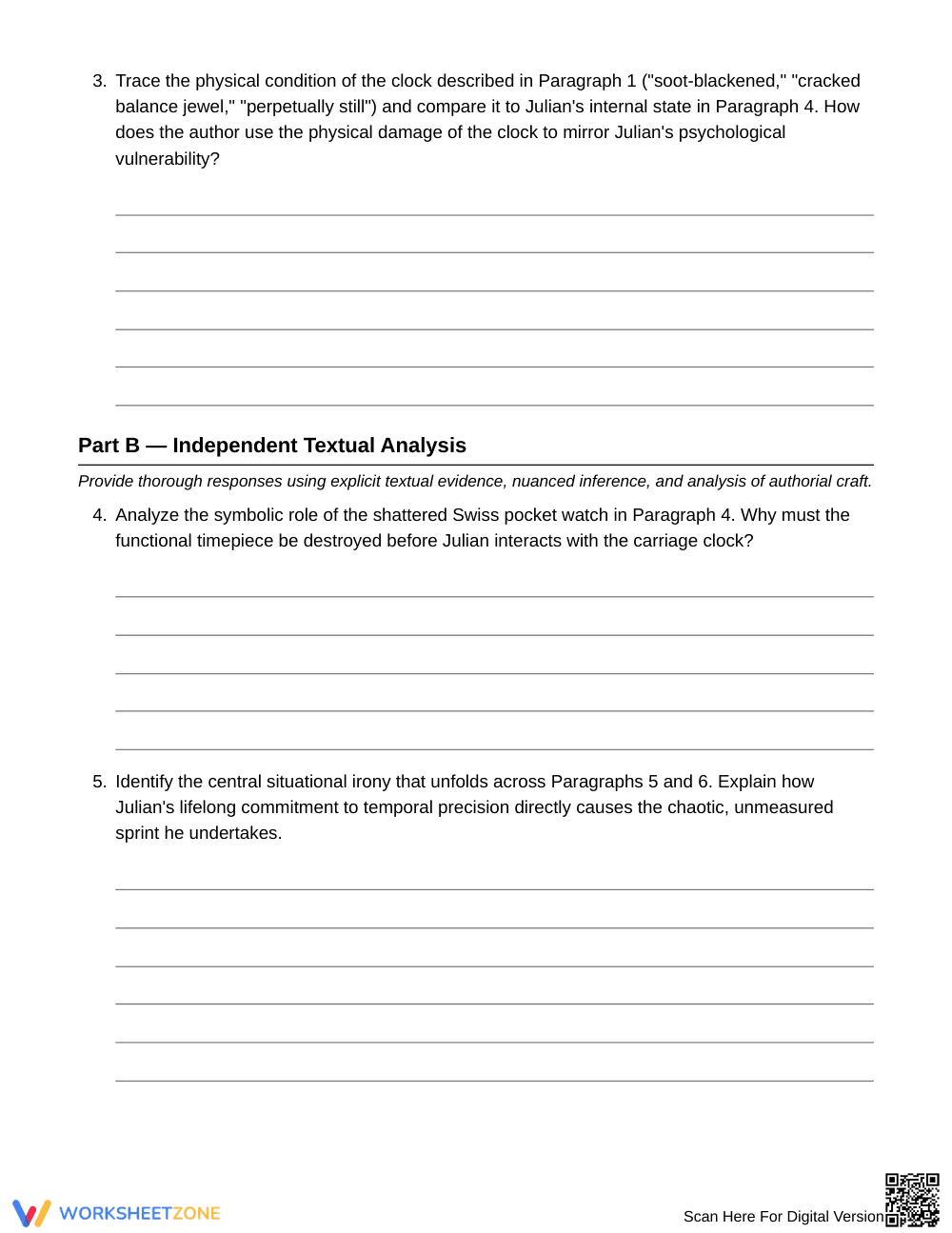
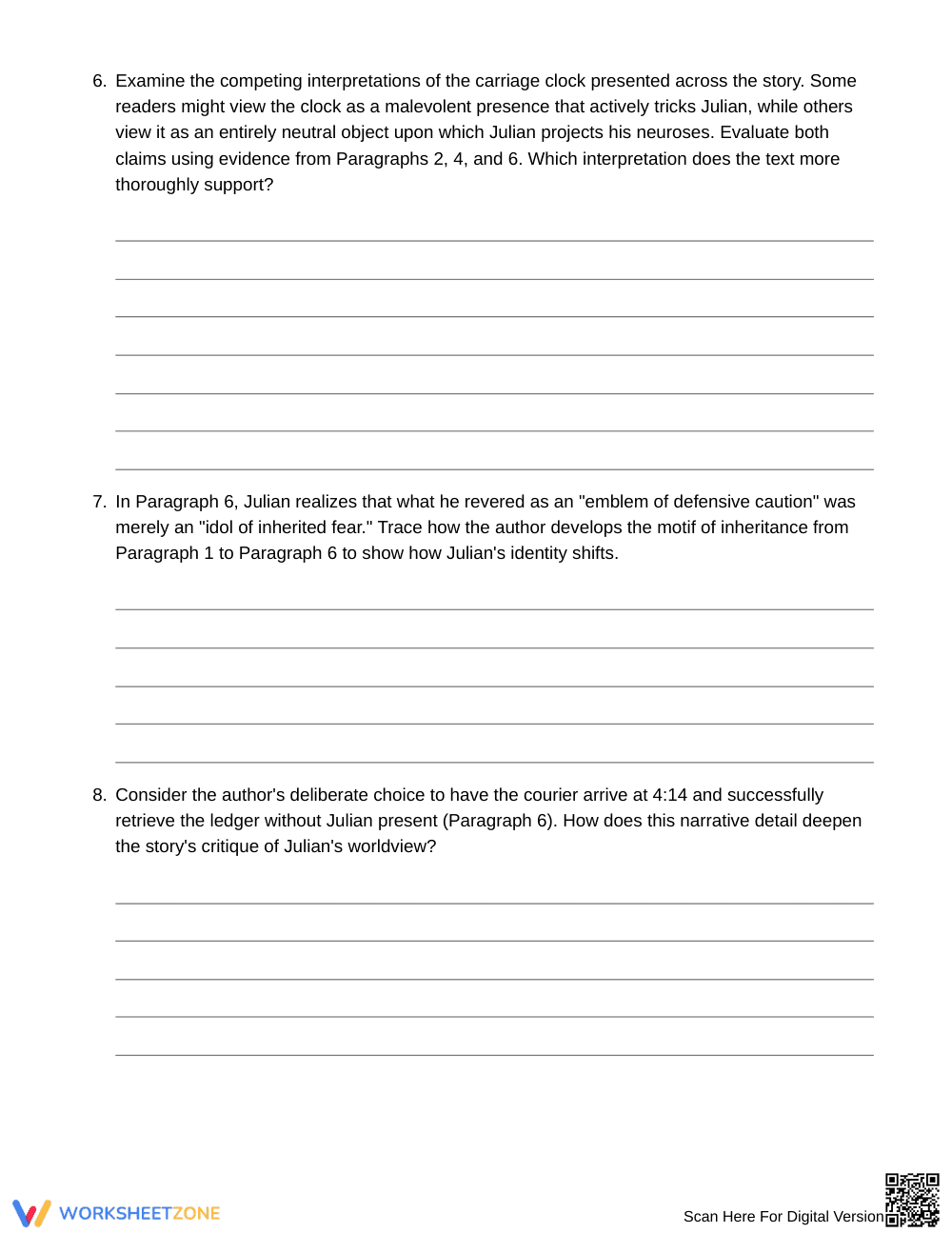
This 6-page printable includes an original short story, "The Balance Wheel at 4:17," alongside a motif analysis framework. Students work through a modeled annotation, 3 scaffolded evidence-linking tasks, 5 independent analytical prompts, and 2 multiple-choice checks with written justifications. A thorough 3-page answer key provides sample responses and citations.
Skill Progression
- Guided practice: A modeled annotation demonstrates how to analyze the carriage clock as a symbolic plumb line.
- Supported practice: Part A provides 3 scaffolded tasks connecting physical details to psychological states.
- Independent practice: Part B and Part C offer 7 rigorous prompts evaluating situational irony and competing interpretations.
This gradual release sequence transitions learners from teacher modeling to independent textual analysis.
Standards Alignment
This worksheet aligns directly to primary standard `RL.9-10.1`: Cite strong and thorough textual evidence to support analysis of what the text says explicitly as well as inferences drawn from the text. It also supports RL.9-10.3 regarding complex character development. Both standard codes can be copied directly into lesson plans, IEP goals, or district curriculum mapping tools.
How to Use It
Implement this worksheet after direct instruction on symbolism during a 45- to 60-minute period. Walk through the modeled annotation as a class, then have students complete Part A in pairs. Circulate during Part B to assess whether students distinguish Julian's projection from reality. Use Part C as an exit ticket.
Who It's For
Created for Grade 10 English II students, this resource suits general education, honors, and targeted intervention groups. Paragraph citations support developing readers, while open-ended prompts challenge advanced analysts. Pair this worksheet with an anchor chart on motifs or a lesson on narrative irony.
Aligned to standard RL.9-10.1, this Grade 10 English II resource provides structured practice to help secondary students trace how recurring objects gather symbolic associations and develop thematic meaning across a narrative text. Grounded in the gradual release framework established by Fisher & Frey (2014), the worksheet pairs explicit modeled annotations with scaffolded evidence prompts and independent analytical writing. By requiring students to cite specific textual evidence, contrast competing character viewpoints, and evaluate situational irony, the 10-item task sequence systematically builds high school reading comprehension and analytical rigor. Students learn to distinguish between literal narrative events and figurative craft choices, moving beyond basic plot summary to construct evidence-based literary arguments. This comprehensive 6-page resource includes an original short story, scaffolded analysis prompts, multiple-choice justification checks, and a complete 3-page teacher answer key designed for immediate classroom implementation.


