




























Views
Downloads


Complete Receipts Word Search | Grades 6–7 Social Studies

Paste this activity's link or code into your existing LMS (Google Classroom, Canvas, Teams, Schoology, Moodle, etc.).
Students can open and work on the activity right away, with no student login required.
You'll still be able to track student progress and results from your teacher account.
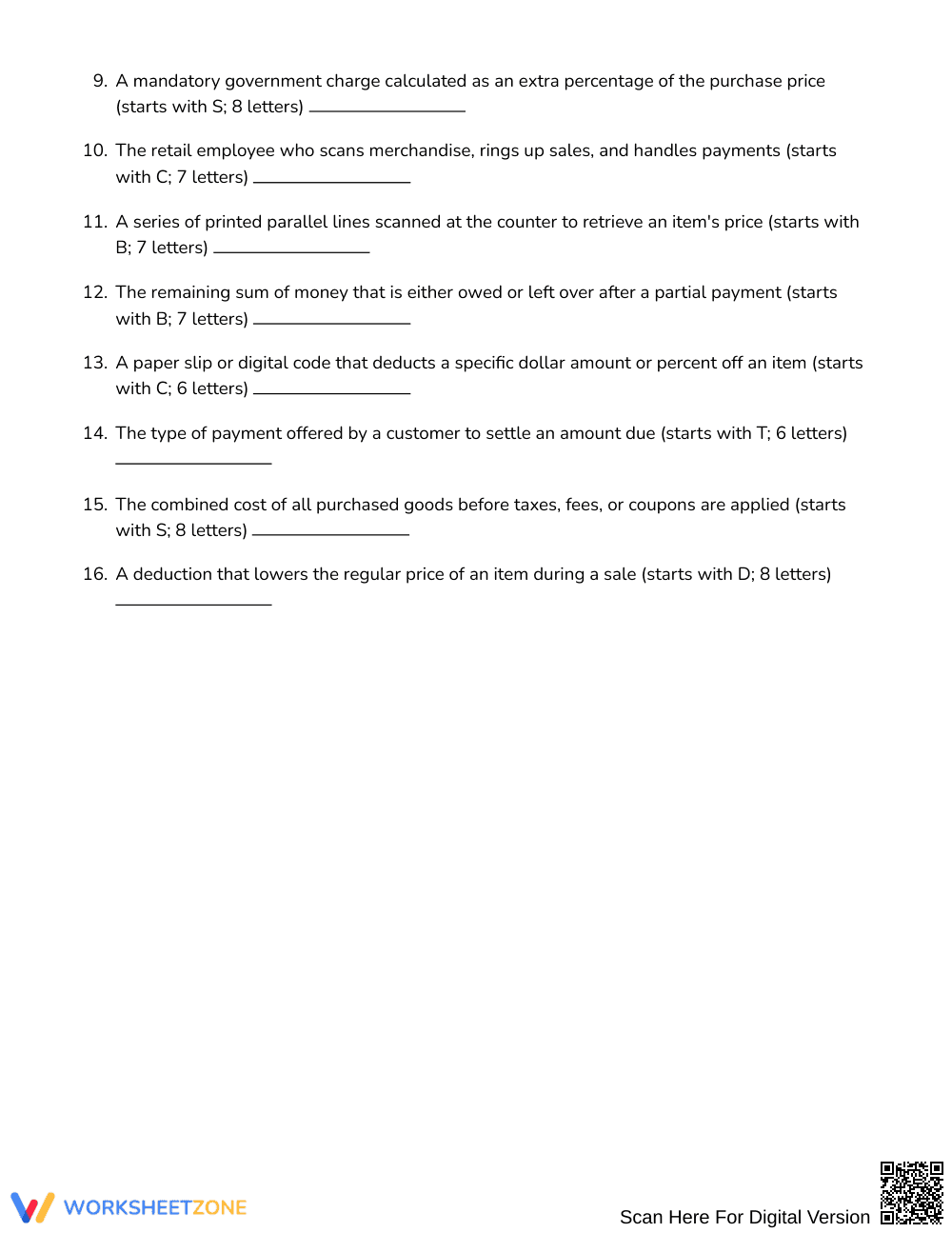
This economics word search strengthens middle school consumer math vocabulary by challenging students to identify and locate 16 terms related to receipts and change. Learners read functional transaction clues, determine the correct retail finance concept, and locate each term within the letter grid to reinforce practical financial literacy skills.
At a Glance
- Grade: Grades 6–7 · Subject: Social Studies
- Standard: Not standards-assessed — vocabulary enrichment
- Skill Focus: Receipts and change
- Format: 3 pages · 16 words · Answer key included · PDF
- Best For: Economics vocabulary enrichment and review
- Time: 20–30 minutes
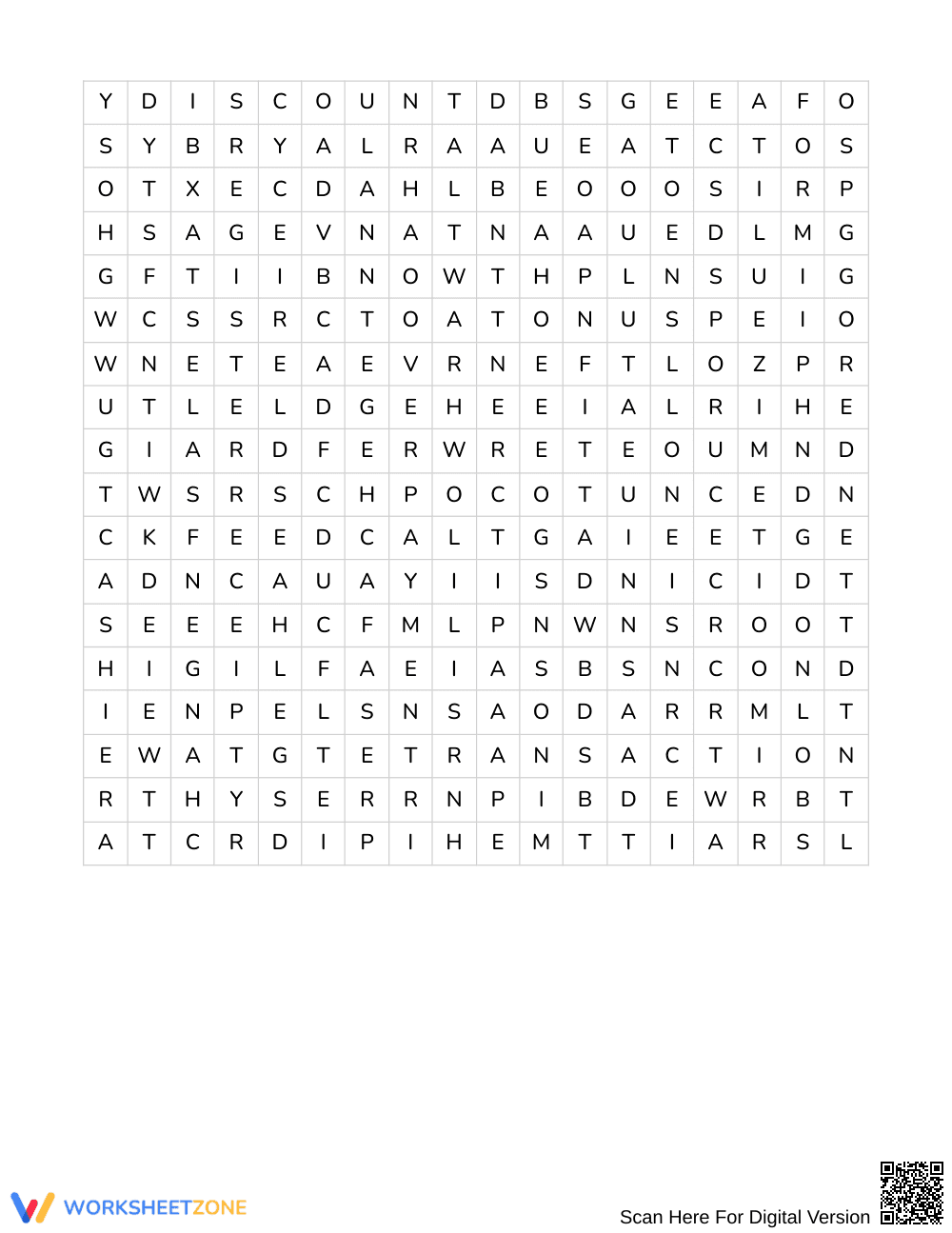
This 3-page printable PDF features an 18 by 18 letter puzzle containing 16 hidden financial terms. Instead of relying on a standard word list, students read 16 detailed definitions covering point-of-sale transactions, consumer payments, and retail calculations. A complete 3-page answer key provides full puzzle solutions and clue answers for quick verification.
Puzzle Structure and Mechanics
The activity uses an 18 by 18 grid designed to build deductive reasoning alongside vocabulary recall. Words run in eight directions: north, northeast, east, southeast, south, southwest, west, and northwest. Because no word bank is printed on the student sheet, learners must solve each clue independently before searching, transforming traditional word recognition into an active retrieval exercise.
Standards Alignment
This activity serves strictly as vocabulary enrichment and is not aligned to a specific state or national standard. It supports foundational financial literacy by reinforcing terms commonly encountered in middle grades consumer economics and applied mathematics units.
How to Use It
Deploy this activity after direct instruction on sales tax, subtotal calculations, and retail transactions. For an effective warm-up, have students collaborate in pairs to solve the 16 definition clues before finding words. During independent seatwork, observe which definitions—such as tender, balance, or overpayment—require teacher clarification to identify gaps in economic comprehension. Expected completion time is 20 to 30 minutes.
Who It's For
This word search is designed for Grades 6–7 social studies students studying personal finance and basic economic principles. It accommodates diverse learners through contextual clues, while students needing extra assistance can highlight clue keywords before searching. Pair this puzzle with an authentic receipt-reading lesson or sample store register exercise to connect terms directly to practical spending decisions.
Vocabulary acquisition in secondary social studies requires repeated exposures to domain-specific terminology across varied contexts. According to Fisher and Frey (2014), intentional word-learning tasks that require students to retrieve definitions and apply conceptual knowledge reinforce long-term semantic retention more effectively than rote memorization. This word search targets receipts and change vocabulary through a clue-based design, requiring middle grades learners to process 16 definitions before scanning an 18 by 18 letter matrix. By connecting terms such as sales tax, subtotal, tender, and itemize to real-world consumer transactions, the resource supports practical economic literacy without relying on passive word banks. Educational research confirms that pairing contextual clues with active orthographic searches strengthens cognitive associations between financial concepts and their formal economic definitions, making this resource an effective tool for classroom enrichment and vocabulary mastery across consumer finance units.


