


























Views
Downloads


Complete Protein Synthesis Worksheet | Grade 10 Biology
Paste this activity's link or code into your existing LMS (Google Classroom, Canvas, Teams, Schoology, Moodle, etc.).
Students can open and work on the activity right away, with no student login required.
You'll still be able to track student progress and results from your teacher account.
This comprehensive biology worksheet provides targeted practice to resolve student confusion between DNA template and coding strands during protein synthesis. Students practice applying 5-to-3 directional rules, transcribing mRNA from antisense DNA, interpreting codon charts accurately, and translating functional peptide sequences across sixteen structured practice tasks.
At a Glance
- Grade: 10 · Subject: Biology
- Focus: Model DNA structure and transcription-translation mechanisms in protein synthesis
- Skill Focus: Coding vs. template strand orientation and translation
- Format: 5 pages · 16 problems · Answer key included · PDF
- Best For: Independent practice, remediation, and error analysis
- Time: 40–50 minutes
What's Inside
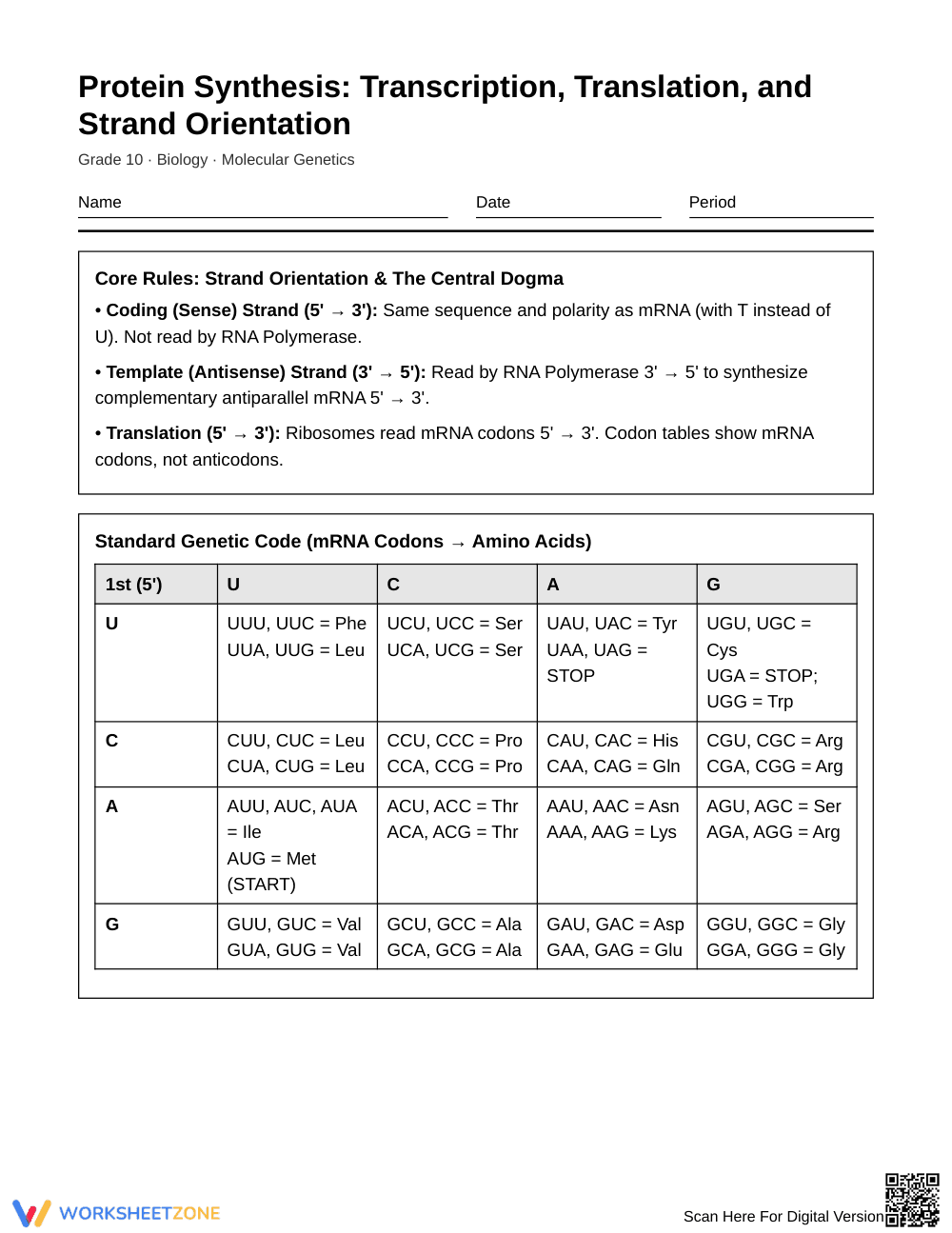
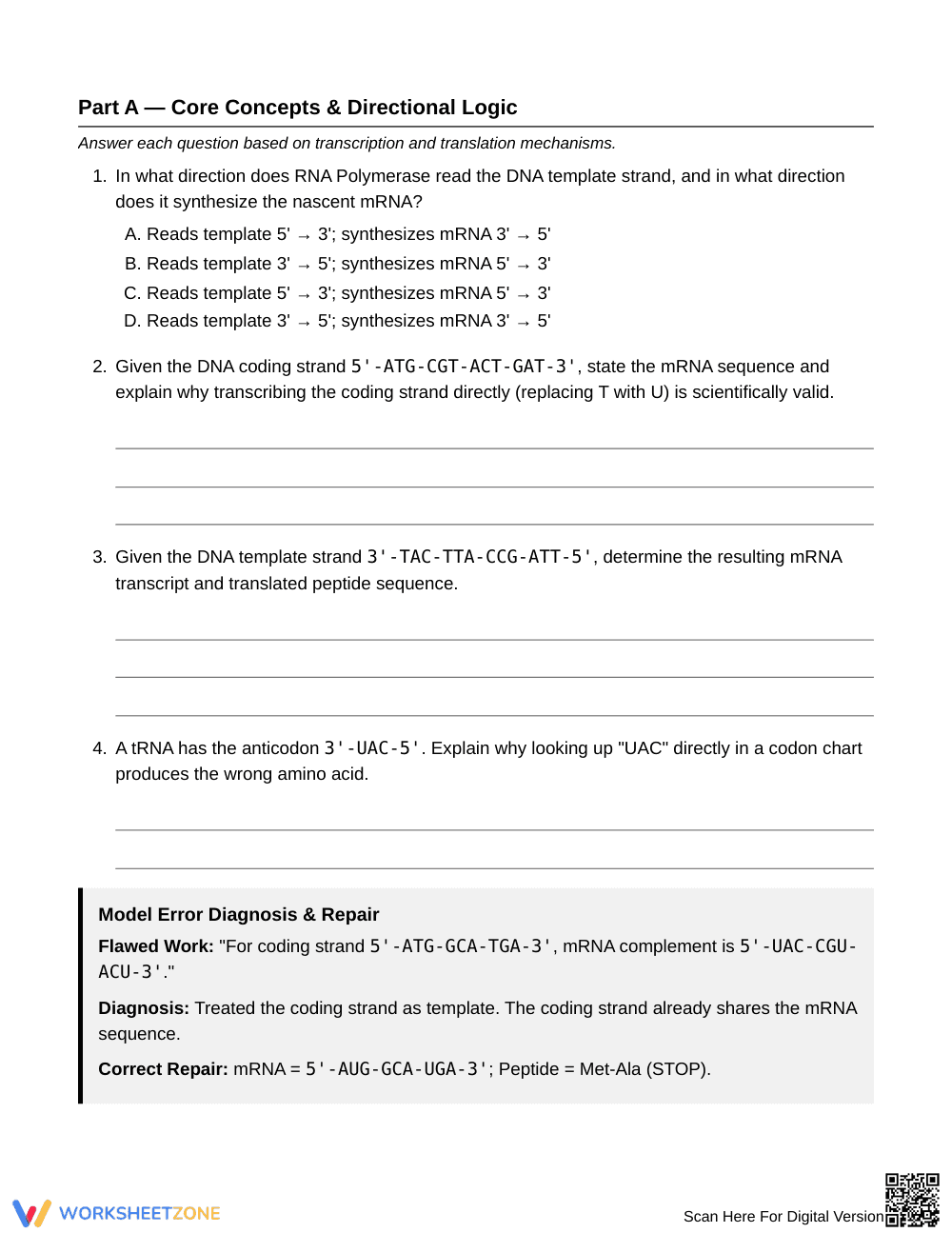
This 5-page printable resource features a dedicated reference panel with core rules of strand polarity and a complete mRNA codon table. It includes a modeled error diagnosis example, four foundational directional reasoning items, eight diagnostic error-analysis tasks, four multi-step synthesis challenges requiring explicit 5-prime and 3-prime end labeling, and a thorough 2-page answer key.
Skill Progression
- Guided Practice (Part A, 4 problems): Direct questions reinforce RNA polymerase mechanics, 3-to-5 template reading direction, and codon chart navigation.
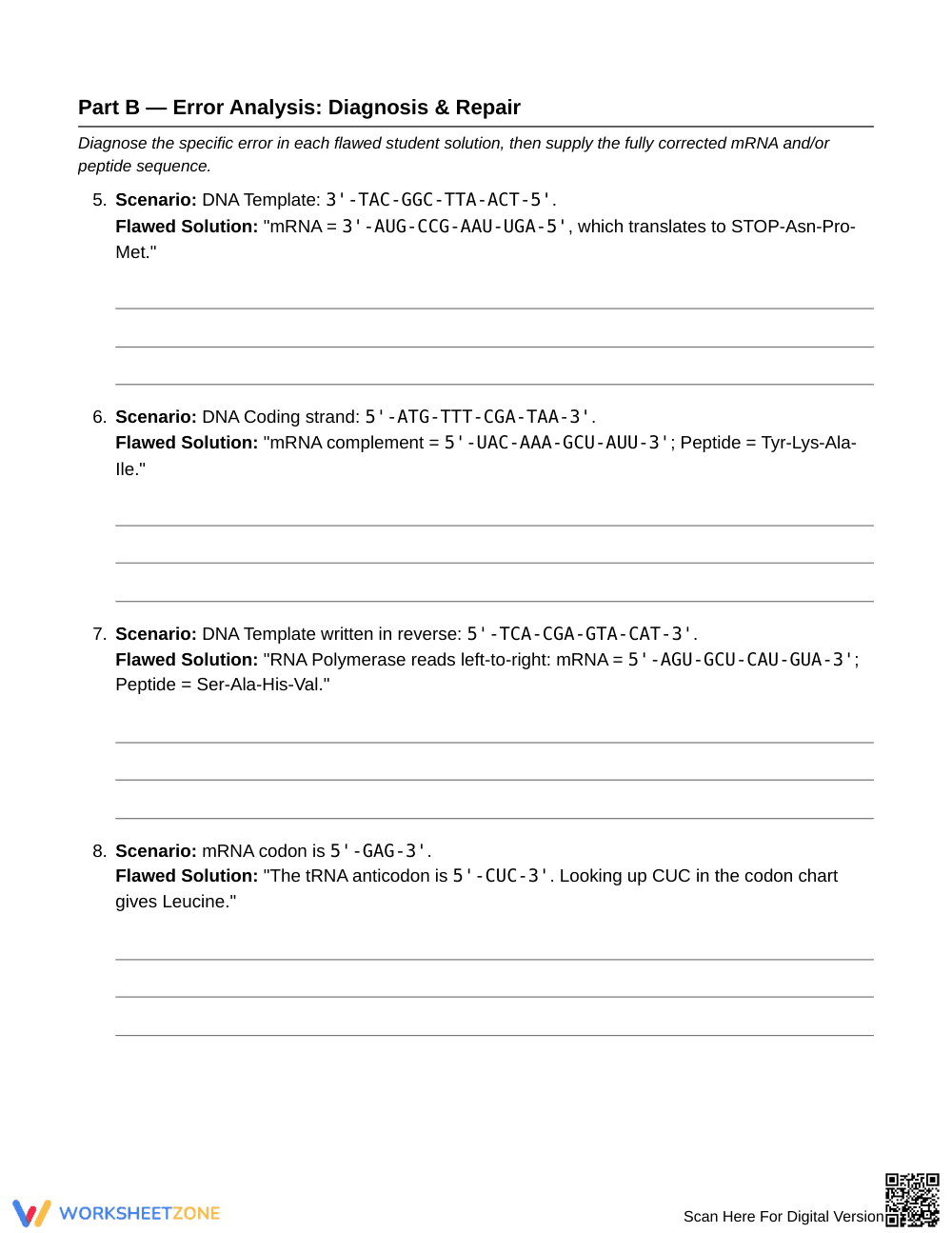
- Supported Practice (Part B, 8 problems): Students diagnose realistic student misconceptions involving antisense strands, flipped DNA orientation, and tRNA anticodons, providing corrected mRNA and peptide chains.
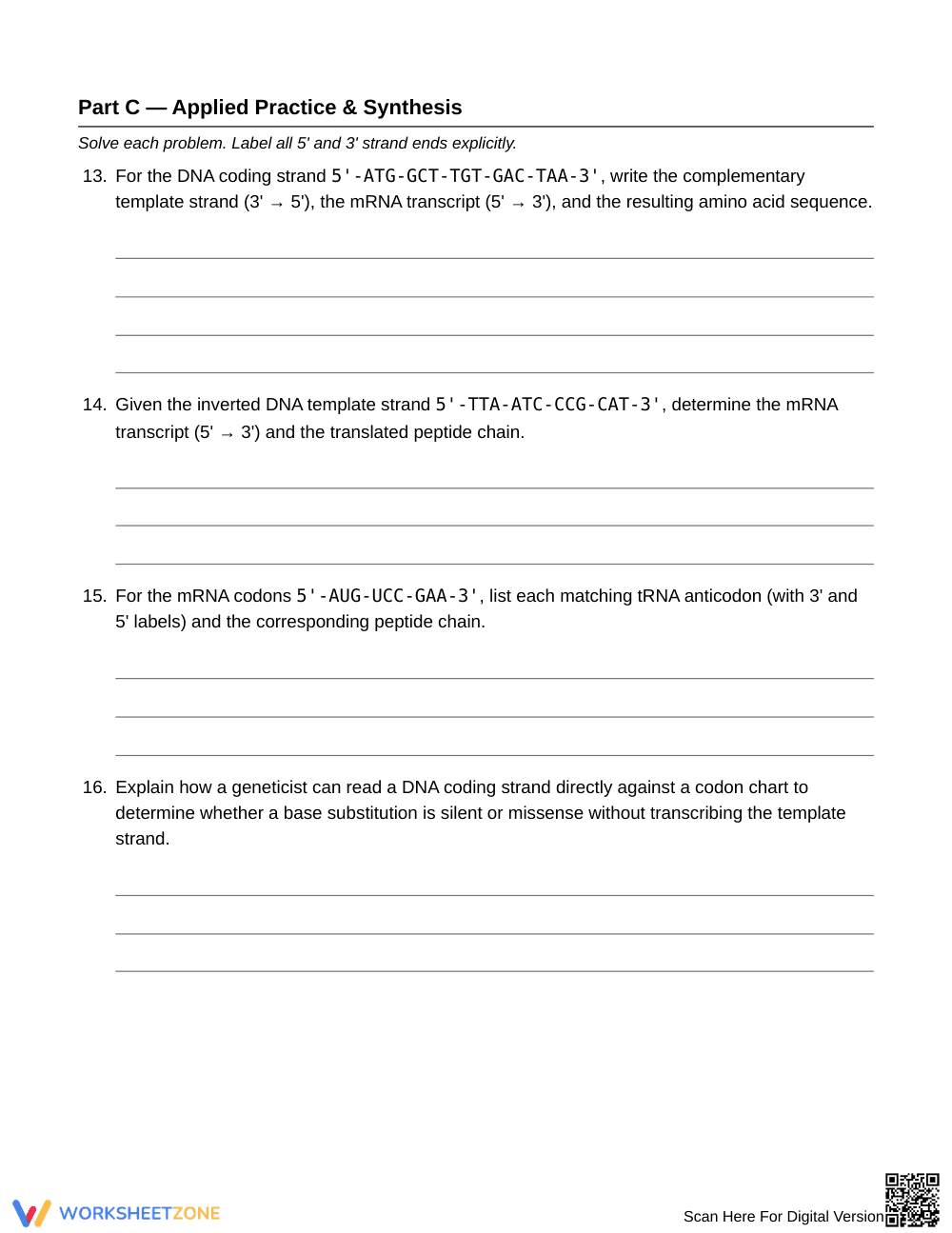
- Independent Practice (Part C, 4 problems): Comprehensive multi-step synthesis tasks require end-to-end transcription, translation, and codon chart verification without structural hints.
This structured progression reflects the gradual release of responsibility framework, ensuring learners build conceptual confidence before tackling open-ended synthesis.
Standards Alignment
Aligned to high school life science standards for molecular genetics and gene expression, this activity asks students to construct an explanation based on evidence for how the structure of DNA determines the structure of proteins. Concepts can be integrated directly into lesson plans, IEP goals, or district curriculum mapping tools.
How to Use It
Deploy this resource immediately after direct instruction on the Central Dogma or during dedicated review stations. As a formative check, observe Part B responses to confirm that students recognize that RNA polymerase transcribes the template strand rather than the coding strand. Typical completion requires 40 to 50 minutes of instructional time.
Who It's For
Designed for Grade 10 general biology and honors biology students, this resource offers targeted support for visual and procedural learners struggling with molecular polarity. It pairs naturally with molecular model kits, transcription simulation manipulatives, and codon wheel review charts.
According to research by Fisher & Frey (2014) on effective scaffolded instruction, systematically exposing common student misconceptions through guided error analysis accelerates conceptual mastery in secondary science. When tenth-grade biology learners actively identify, explain, and correct erroneous transcription and translation outputs, their retention of core molecular genetics principles increases significantly. This sixteen-task biology worksheet directly targets persistent confusion regarding five-prime to three-prime orientation, coding versus template strand identity, and codon-anticodon mapping across diverse sequence contexts. By embedding structured diagnostic routines alongside authentic nucleotide manipulation, high school students develop durable procedural fluency and deeper analytical reasoning. Consequently, secondary educators establish a strong foundation for advanced genetic coursework while helping learners independently overcome frequent pitfalls. Teachers can utilize this self-contained instructional resource for targeted intervention, small-group remediation, differentiated homework, or independent summative practice with complete confidence in scientific fidelity and pedagogical rigor.


