




























Views
Downloads


Complete Plan Feasibility Worksheet | Grade 9 Algebra I

Paste this activity's link or code into your existing LMS (Google Classroom, Canvas, Teams, Schoology, Moodle, etc.).
Students can open and work on the activity right away, with no student login required.
You'll still be able to track student progress and results from your teacher account.
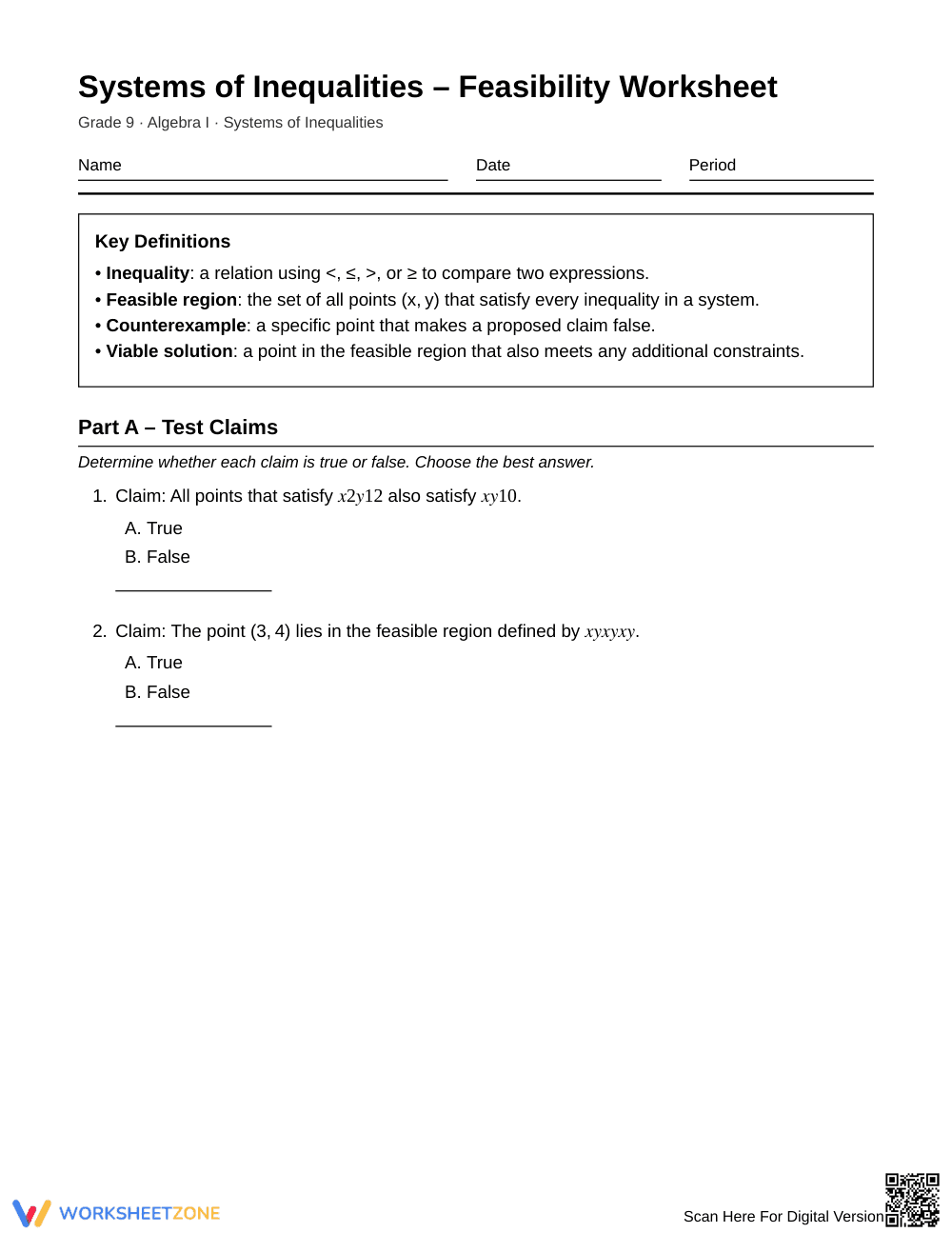
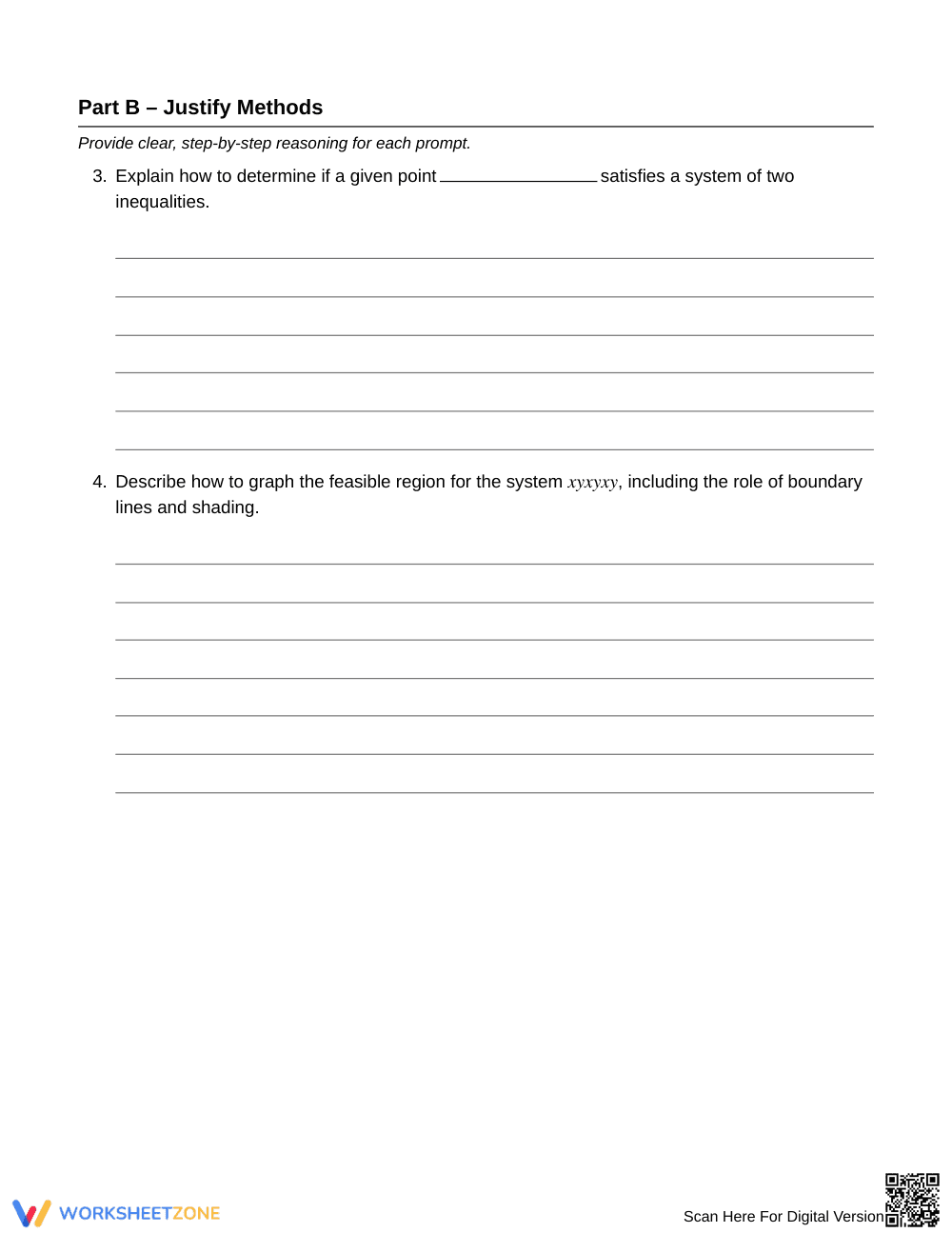
Help your high school Algebra I students master constraint analysis with this comprehensive feasibility worksheet. Learners evaluate systems of linear inequalities, justify solution viability, and test boundaries using algebraic reasoning and counterexamples. This targeted resource bridges conceptual understanding and formal mathematical justification, ensuring students confidently determine whether proposed real-world plans satisfy complex overlapping criteria.
At a Glance
- Grade: 9 · Subject: Algebra I
- Standard:
HSA-CED.A.3— Represent constraints with equations or inequalities and interpret viable solutions- Skill Focus: Justify Feasibility of a Proposed Plan
- Format: 5 pages · 8 problems · Answer key included · PDF
- Best For: High school systems unit practice
- Time: 40–50 minutes
This 5-page printable resource delivers 8 rigorously crafted tasks structured to deepen mathematical communication. It opens with an essential key definitions box covering viable solutions, feasible regions, and counterexamples. Students progress through true/false claim verification, step-by-step written justifications of boundary intersections, and analytical counterexample generation, supported by a 2-page detailed answer key.
The worksheet follows a structured pedagogical progression:
- Guided practice (Part A, 2 tasks): Students evaluate true/false claims regarding system constraints and test specific coordinate pairs against feasible regions with low scaffolded demand.
- Supported practice (Part B, 4 tasks): Learners construct written explanations detailing graphing procedures, system intersections, and the impact of additional constraints on viable regions.
- Independent practice (Part C, 2 tasks): Students operate without structural prompts to provide rigorous counterexamples and formulate algebraic validity conditions using generalized constants.
This systematic design utilizes the gradual-release framework to move students from evaluating given claims to constructing independent mathematical arguments.
Standards Alignment
This resource aligns directly to `HSA-CED.A.3`: Represent constraints by equations or inequalities, and by systems of equations and/or inequalities, and interpret solutions as viable or nonviable options in a modeling context. It also supports mathematical practice standard MP.3 through constructing viable arguments. Both standard codes can be copied directly into lesson plans, IEP goals, or district curriculum mapping tools.
How to Use It
Deploy this worksheet after direct instruction on graphing systems of linear inequalities to reinforce conceptual interpretation. For mid-unit formative assessment, have students complete Part A and Part B collaboratively in pairs, circulating to note whether students confuse strict versus non-strict boundary lines. Alternatively, assign Part C as an independent exit ticket or homework extension. Expect completion in 40 to 50 minutes.
Who It's For
This worksheet serves Grade 9 Algebra I students developing formal proof and justification skills in linear programming contexts. It offers entry-level verification for struggling learners while challenging advanced students with abstract algebraic generalization in Part C. Pair this resource directly with a visual graphing calculator investigation or an anchor chart on boundary line conventions.
According to research by Fisher & Frey (2014) on the gradual release of responsibility, structured transitions from guided claim evaluation to independent argument construction significantly enhance conceptual retention and mathematical communication in secondary classrooms. This 5-page Algebra I worksheet aligns with standard HSA-CED.A.3, guiding high school students to represent constraints through systems of inequalities and rigorously interpret viable solutions within defined feasible regions. Across 8 progressive problems, learners evaluate truth claims, explain algebraic intersection methods, and formulate algebraic counterexamples for first-quadrant systems. By moving beyond basic procedural graphing to demand written justification and constraint analysis, the resource establishes measurable evidence of student mastery during linear systems units. Educators can effectively integrate this structured practice into standards-aligned secondary math curricula to ensure deep analytical fluency.


