


























Views
Downloads



Complete Particle Deflection Worksheet | Grade 12 Physics
Paste this activity's link or code into your existing LMS (Google Classroom, Canvas, Teams, Schoology, Moodle, etc.).
Students can open and work on the activity right away, with no student login required.
You'll still be able to track student progress and results from your teacher account.
Mastering magnetic vector interactions requires students to determine Lorentz force directions and particle trajectories systematically. This Grade 12 physics worksheet equips learners to trace charged-particle deflections in magnetic fields, compute orbital radii, and analyze kinetic energy conservation through 10 multi-step analytical problems designed for advanced electromagnetism units.
At a Glance
- Grade: 12 · Subject: Physics
- Standard: Advanced Physics — Predict and calculate charged particle trajectories in magnetic fields
- Skill Focus: Charged-Particle Deflection Tracing
- Format: 5 pages · 10 problems · Answer key included · PDF
- Best For: Advanced electromagnetism practice and AP exam review
- Time: 45–60 minutes
What's Inside
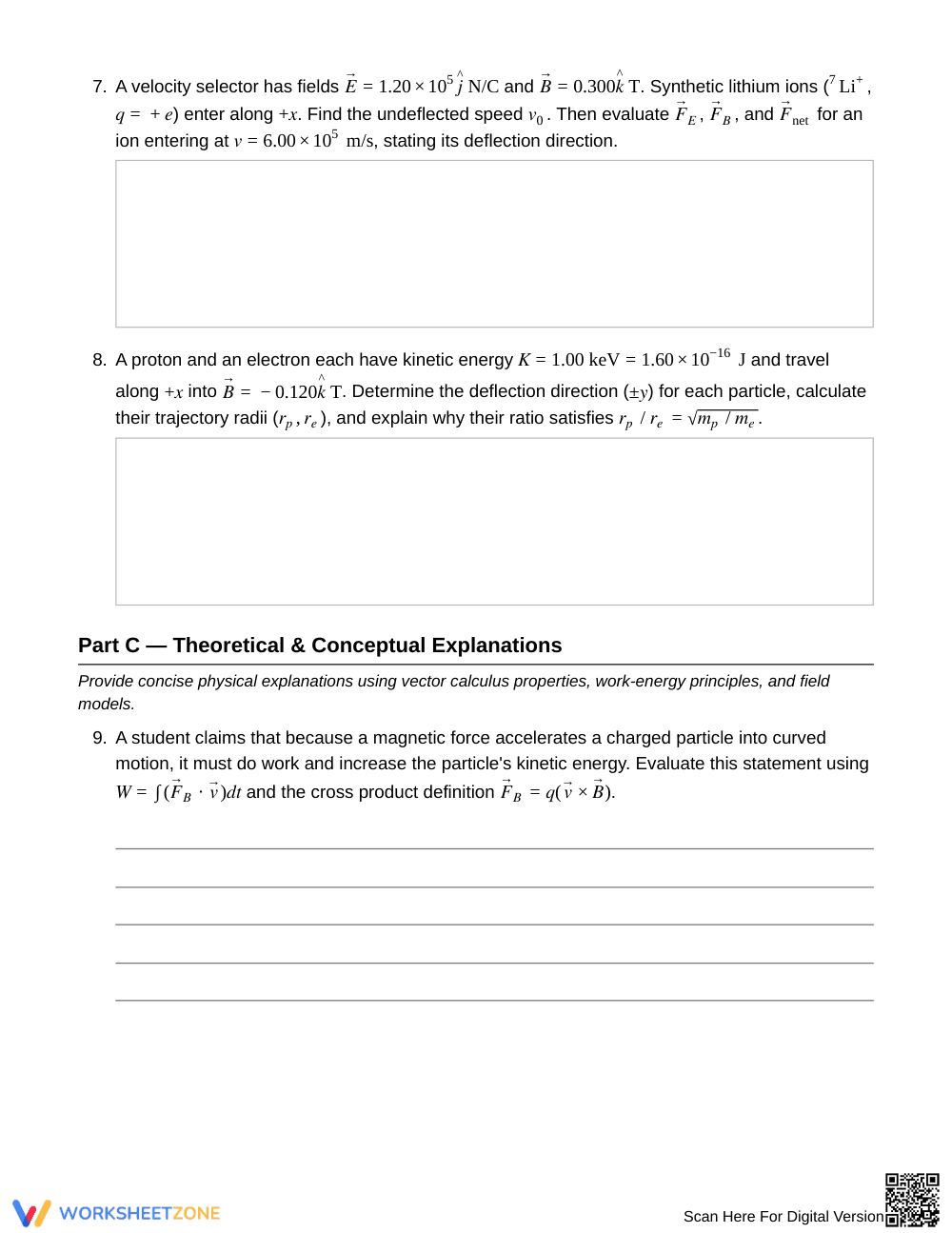
This 5-page resource features a 2-page student worksheet and a detailed 3-page answer key. It opens with a Lorentz force reference guide detailing 3D coordinate conventions, physical constants, and two worked examples. Across 10 tasks, students complete guided vector cross products, isotope separation dynamics, helical trajectories, velocity selectors, and work-energy proofs.
Skill Progression
- Guided Practice (Part A, 3 problems): Students apply right-hand rules and cross products to trace deflections of alpha particles, oxygen ions, and protons.
- Supported Practice (Part B, 5 problems): Students calculate orbital radii, helical pitch, cyclotron frequency, and isotope mass separation with fading scaffolds.
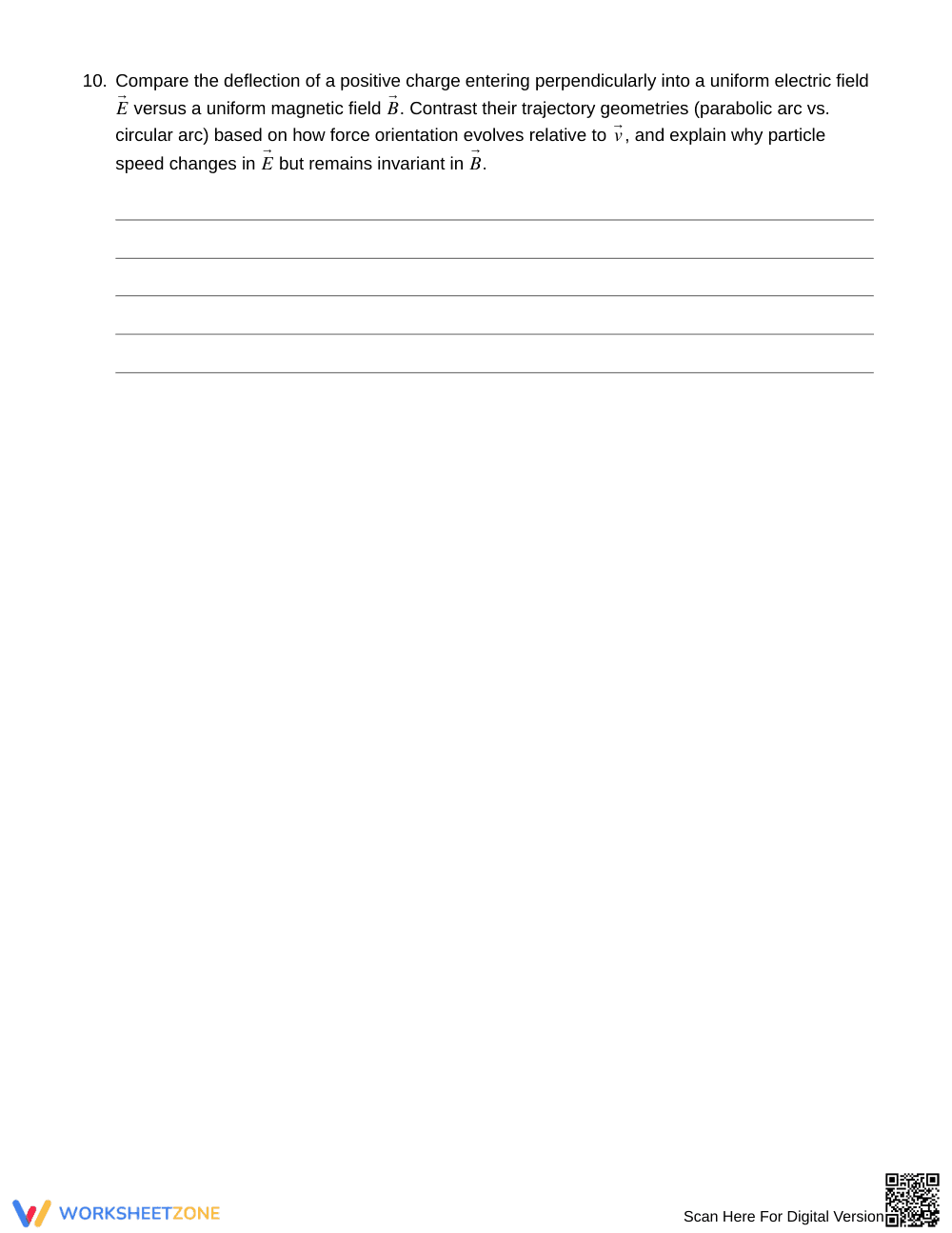
- Independent Practice (Part C, 2 problems): Students evaluate magnetic work integrals and contrast electric versus magnetic deflection geometries.
This gradual release progression transitions students from structured vector calculations to autonomous physical analysis.
Standards Alignment
This worksheet aligns with high school and AP physics electromagnetism standards, focusing on the Lorentz force law F = q(v × B) and orbital dynamics. Students demonstrate how magnetic fields exert perpendicular forces that bend particle paths without doing work. Both standard codes can be copied directly into lesson plans, IEP goals, or district curriculum mapping tools.
How to Use It
Use this worksheet after direct instruction on the right-hand rule and Lorentz force. Model the reference examples before having students complete Part A in pairs (15 minutes). Assign Parts B and C for independent practice or assessment (30 minutes). Check whether students invert force vectors for negative charges. Total time is 45 to 60 minutes.
Who It's For
This worksheet is designed for Grade 12 Physics and AP Physics students mastering electromagnetism. Built-in coordinate guides support developing learners, while helical motion and velocity selector problems challenge advanced students. Pair this resource with a cloud chamber demonstration or mass spectrometer simulation.
According to Fisher & Frey (2014), structured gradual release models significantly increase student autonomy in complex, multi-step STEM problem solving. This Grade 12 physics worksheet reinforces charged-particle deflection tracing through an intentional progression from modeled coordinate cases to independent theoretical derivations. By integrating explicit coordinate sign conventions and worked examples, the resource directly addresses common student misconceptions regarding negative charge inversions and magnetic work-energy principles. Educational research demonstrates that systematic vector mapping bridges the gap between abstract mathematical cross products and observable particle trajectories in uniform magnetic fields. Students develop both computational accuracy in determining orbital radii and conceptual mastery of velocity-dependent centripetal forces. The complete 10-problem sequence and 3-page solution key provide an evidence-based resource for secondary physics educators seeking rigorous, standards-aligned curricular materials that ensure long-term retention and analytical mastery.


