


























Views
Downloads



Complete Overreading Repair Guide | Grade 10 ELA
Paste this activity's link or code into your existing LMS (Google Classroom, Canvas, Teams, Schoology, Moodle, etc.).
Students can open and work on the activity right away, with no student login required.
You'll still be able to track student progress and results from your teacher account.
Help high school readers distinguish valid symbolic interpretation from unsupported eisegesis. This printable 6-page English II worksheet trains students to identify when an isolated narrative detail has been over-interpreted and guides them to construct rigorous, evidence-grounded textual analyses using cumulative story motifs and context.
At a Glance
- Grade: 10 · Subject: English II
- Standard:
RL.9-10.1— Cite strong, thorough textual evidence to support inferences and nuanced analysis.- Skill Focus: Repair Overreading of an Isolated Detail
- Format: 6 pages · 10 problems · Answer key included · PDF
- Best For: Close reading and textual evidence practice
- Time: 40–50 minutes
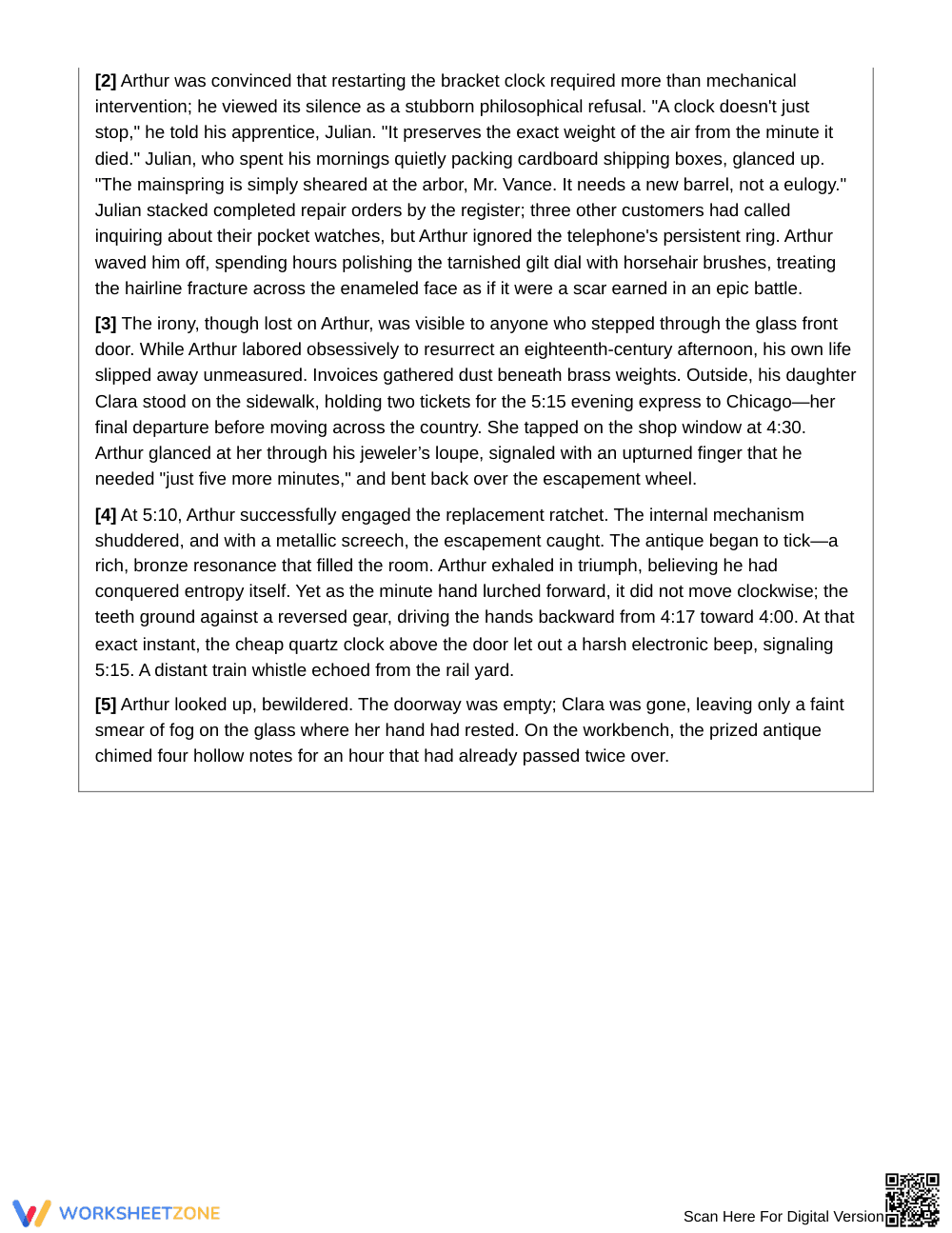
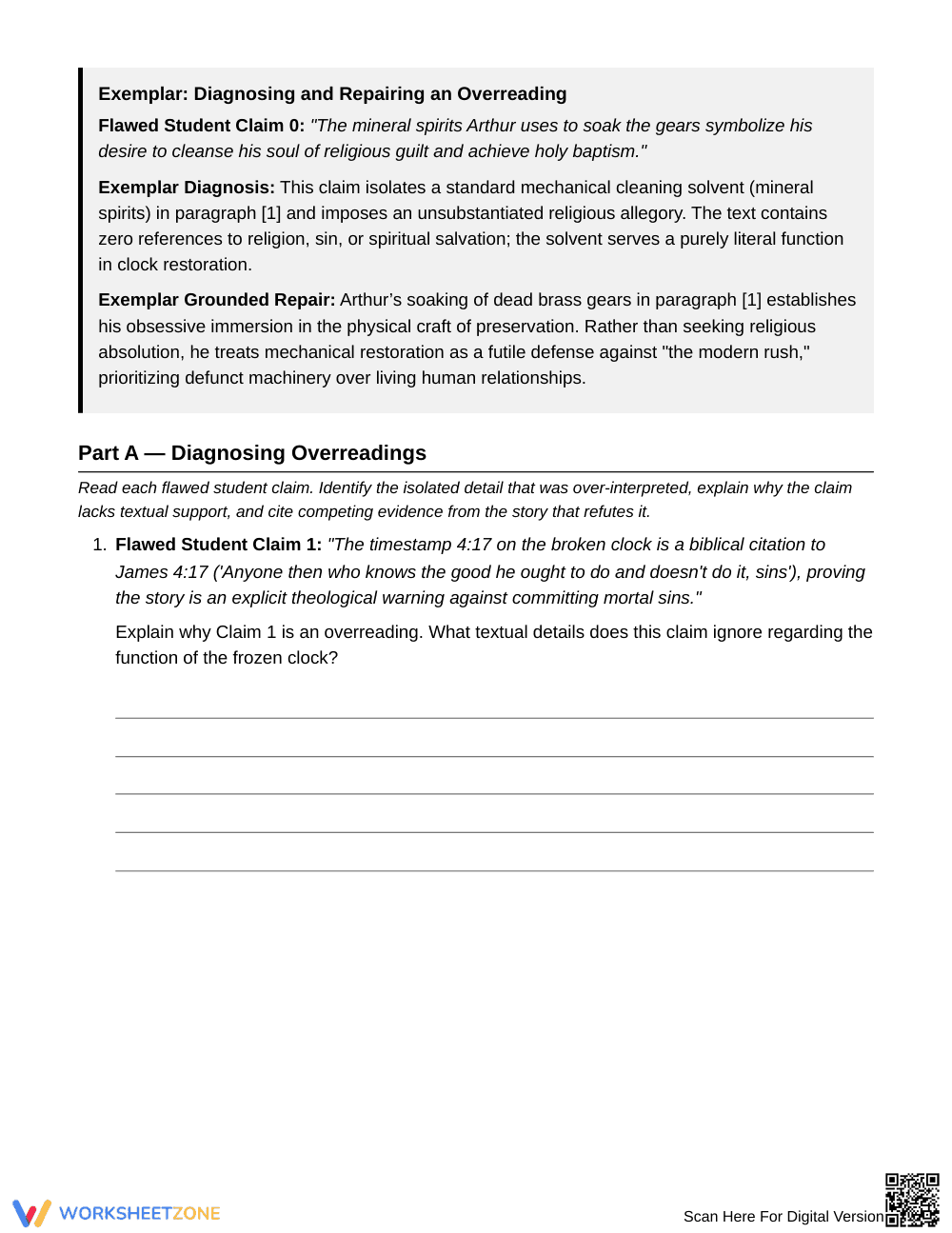
This resource features an original short story, "The Escapement," followed by a detailed diagnostic rule box outlining three concrete tests for symbolic validity: textual recurrence, contextual consistency, and irony. Students examine an annotated exemplar before completing 10 structured analytical tasks. The worksheet includes 5 targeted error-analysis diagnosis prompts, 5 evidence-based rewriting prompts, and a comprehensive 3-page answer key.
Skill Progression
- Guided Practice: Students evaluate a complete worked exemplar that demonstrates how to identify an isolated detail and repair an unsupported symbolic projection.
- Supported Practice (Tasks 1–5): Students diagnose 5 flawed claims, isolating ungrounded assumptions and locating competing textual evidence to refute each overreading.
- Independent Practice (Tasks 6–10): Students rewrite each flawed claim into a grounded, nuanced interpretation that integrates direct evidence and paragraph citations.
This structured progression leverages the gradual release of responsibility model to move students from critical evaluation to independent, text-grounded analytical writing.
Standards Alignment
This worksheet is aligned directly to primary standard RL.9-10.1: Cite strong and thorough textual evidence to support analysis of what the text says explicitly as well as inferences drawn from the text. Both standard codes can be copied directly into lesson plans, IEP goals, or district curriculum mapping tools.
How to Use It
Deploy this worksheet after direct instruction on symbolism, motif, and irony. For whole-class instruction, read the anchor text together and model Part A, prompting students to spot where claims jump to wild conclusions. For paired practice, have partners collaborate on the Part B revisions during a 45-minute block. Formative observation tip: check whether students cite specific paragraphs rather than making broad thematic generalizations.
Who It's For
This activity is designed for Grade 10 English II students mastering close reading, as well as Pre-AP literature students refining literary commentary. Pair this worksheet with an anchor chart on authorial intent or a unit assessment on short fiction.
According to Fisher & Frey (2014), close reading instruction must explicitly teach students how to weigh competing textual evidence rather than treating every isolated word as an intentional symbol. When secondary readers analyze complex narrative structures, they frequently fall into the trap of overreading—imposing external allegorical theories onto literal plot details. This worksheet operationalizes standard RL.9-10.1 by providing explicit error-analysis routines that teach students to distinguish valid symbolic motifs from unsupported subjective projections. By requiring learners to diagnose five distinct interpretive errors and rewrite them using paragraph-level textual citations, the resource reinforces disciplined text-dependent analysis. Grounding student inferences in recurrence and contextual consistency ensures that interpretations reflect the text's actual thematic design rather than unchecked reader speculation.


