




























Views
Downloads

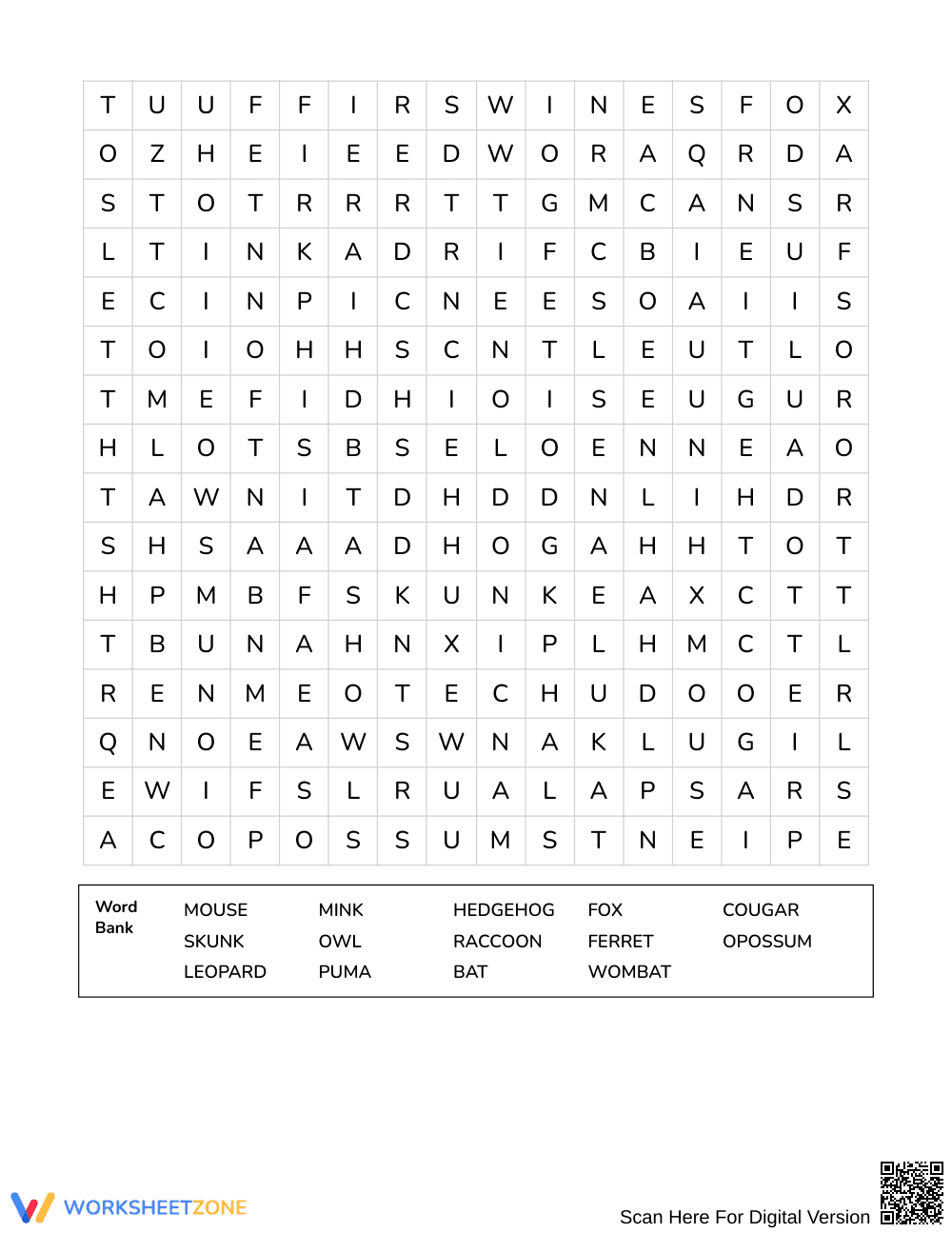

Complete Nocturnal Animals Word Search | Grades 4–5 Science

Paste this activity's link or code into your existing LMS (Google Classroom, Canvas, Teams, Schoology, Moodle, etc.).
Students can open and work on the activity right away, with no student login required.
You'll still be able to track student progress and results from your teacher account.
This nocturnal animals word search builds upper-elementary life science vocabulary by challenging students to identify nighttime creatures from behavioral clues. Students strengthen their knowledge of animal adaptations as they decode descriptive riddles and locate 14 target terms across a letter grid, reinforcing key biology concepts through active vocabulary recall.
At a Glance
- Grade: Grades 4–5 · Subject: Elementary Life Science
- Standard: Not standards-assessed — vocabulary enrichment
- Skill Focus: Nocturnal animals, physical traits, and behavioral adaptations
- Format: 2 activity pages · 14 words · Full answer key included · Printable PDF
- Best For: Science centers, early finishers, or sub plans
- Estimated Time: 20–30 minutes total
What's Inside
This printable science resource spans 2 activity pages and features a clue-based word detective format. Students read 14 informative clues describing nocturnal adaptations—such as echolocation, twilight foraging, and specialized night vision—before searching for each creature in the letter grid. The activity includes a shuffled word bank for spelling support and comes with a 3-page complete answer key illustrating word placements for rapid grading.
How the Puzzle Works
The activity centers on a 16 x 16 letter grid populated with hidden nocturnal animal names. Each entry corresponds to an adaptation clue that guides learners to determine the target animal. Target words are hidden across four distinct directional paths: northeast (NE), east (E), southeast (SE), and south (S). A shuffled word bank provides reference support without revealing solutions in alphabetical order, encouraging students to analyze each biological description carefully before scanning the letter matrix.
Standards Alignment
This science word search is designed for vocabulary enrichment and is not aligned to a specific academic standard. It complements upper-elementary life science curricula by reinforcing domain-specific terminology related to animal adaptations, predatory behavior, and nocturnal survival strategies.
How to Use It
Use this puzzle after direct instruction on animal adaptations as an independent consolidation activity or during a science station rotation. Alternatively, introduce it as an engaging hook before exploring nocturnal ecosystems. For formative assessment, observe whether learners read clues to deduce animals before searching, noting which behavioral adaptations require teacher clarification. Students typically complete the 14 words within 20 to 30 minutes.
Who It's For
This word search is tailored for Grades 4–5 students studying life science and ecosystem dynamics. To differentiate, provide struggling readers with highlighters to mark key traits within the clues before searching, while fast finishers can write sentences explaining how one animal's nocturnal adaptation aids its survival. Pair this printable with an anchor chart on nighttime animal adaptations for comprehensive instruction.
This Grades 4–5 science word search serves as an unassessed vocabulary enrichment activity designed to reinforce nocturnal animal identification and behavioral adaptation concepts. Although not indexed to a formal standard code, the resource builds essential domain-specific literacy by requiring learners to connect physical descriptions and survival traits to 14 target organism names. According to Fisher & Frey (2014), integrating intentional vocabulary retrieval into content-area learning solidifies conceptual understanding and accelerates scientific language acquisition. By pairing descriptive clues with spatial search tasks across a 16 x 16 letter grid, this puzzle provides structured exposure to biological terminology without unnecessary cognitive fatigue. The included 3-page answer key supports independent student verification and efficient classroom implementation, making this printable activity an effective supplementary resource that educators can readily integrate into life science units on animal behavior and environmental adaptations.


